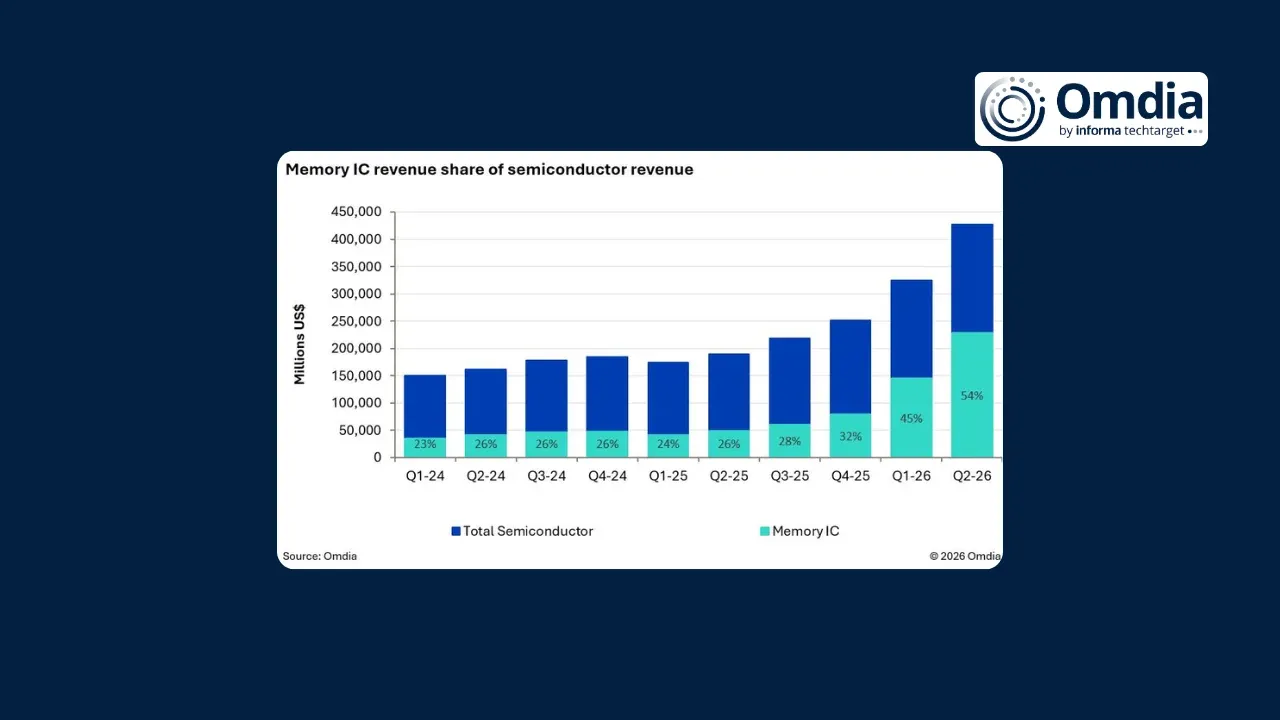
The global semiconductor market is entering a period of unprecedented expansion, driven by a massive surge in artificial intelligence infrastructure requirements and escalating memory pricing. According to new research from Omdia, total semiconductor revenue hit an all-time high of $425 billion in the second quarter of 2026. This represents a record 31.4% quarter-over-quarter growth rate, surpassing the previous sequential growth record of 29.2% established in 1Q26. This momentum has pushed total revenue for the first half of 2026 to $752 billion, signaling a fundamental shift in the industry's scaling capabilities.
Record-Breaking 31.4% Sequential Revenue Growth
The semiconductor industry is currently experiencing a sustained period of double-digit sequential growth that defies historical norms. Omdia reports that since tracking began in 1Q02, only 10 out of 97 quarters have seen sequential growth exceeding 10%. However, the market has now recorded four consecutive quarters of double-digit growth starting from 3Q25, a trend that is expected to persist into 3Q26. This acceleration is not merely a seasonal fluctuation; the first half of 2026 has already exceeded the full-year revenue of every year except 2025. Omdia forecasts that revenue will surpass $500 billion in 3Q26, which would bring the total revenue for the first three quarters of 2026 to over $1.25 trillion. This projected figure is 50% higher than the total semiconductor revenue recorded for the entire 2025 calendar year, illustrating the massive scale of current capital deployment in the sector.
AI Demand Reshaping Memory and MPU Markets
The current revenue surge is heavily concentrated in the memory sector, which now accounts for more than half of all semiconductor revenue in 2Q26. Driven by AI demand, memory suppliers are shifting production priorities, which is tightening supply-demand balances and driving higher average selling prices (ASPs). DRAM, NAND, and NOR chips each recorded their highest sequential growth for a second quarter since Omdia began tracking the market, with all three reaching record quarterly revenues. Beyond memory, the non-memory chip market is also performing significantly above historical seasonal patterns. While typical second-quarter sequential growth for non-memory semiconductors is just over 3%, the market grew by over 10% in 2Q26. Specifically, Microprocessor (MPU) revenue grew 16% quarter-over-quarter, far exceeding its typical seasonal growth of 1%, as these components become increasingly integrated into AI-centric infrastructure.
Key Takeaways
- Global semiconductor revenue reached a record $425 billion in 2Q26, marking a 31.4% quarter-over-quarter increase.
- Memory chips, specifically DRAM, NAND, and NOR, accounted for more than 50% of all semiconductor revenue in 2Q26.
- Omdia forecasts 3Q26 revenue will exceed $500 billion, pushing three-quarter 2026 totals above $1.25 trillion.
TechInsyte's Take
In our view, the semiconductor market is no longer following traditional cyclical patterns; it is being re-engineered by the structural requirements of generative AI. The fact that memory components now command over half of the total market revenue suggests that the "AI tax" is being heavily felt in the data center through specialized hardware costs. We see a critical divergence where MPU and memory growth are both decoupling from historical seasonal norms. This indicates that enterprise IT spending is being aggressively front-loaded into infrastructure to meet AI compute demands. For decision-makers, this signals a prolonged period of high component pricing and potential supply volatility as manufacturers prioritize high-margin AI-optimized silicon.
Questions & Answers
How is AI demand specifically impacting memory chip pricing and supply?
AI demand is forcing memory suppliers to shift production priorities toward specialized chips. This shift is altering supply-demand balances, which Omdia notes is resulting in higher average selling prices (ASPs) and increased revenue for DRAM, NAND, and NOR components.
What does the growth in non-memory components indicate about the broader market?
The 10% quarter-over-quarter growth in non-memory semiconductors—well above the historical 3% seasonal norm—indicates that the AI boom is extending beyond memory into broader infrastructure, specifically benefiting microprocessors (MPUs), which saw 16% growth.
How does the 2026 revenue trajectory compare to previous years?
The market is scaling at an extraordinary rate; the $752 billion earned in the first half of 2026 has already exceeded the total annual revenue of every year except 2025.
What is the projected revenue milestone for the third quarter of 2026?
Omdia forecasts that semiconductor revenue will surpass $500 billion in 3Q26, which would drive the total revenue for the first nine months of 2026 above $1.25 trillion.
Source: Businesswire