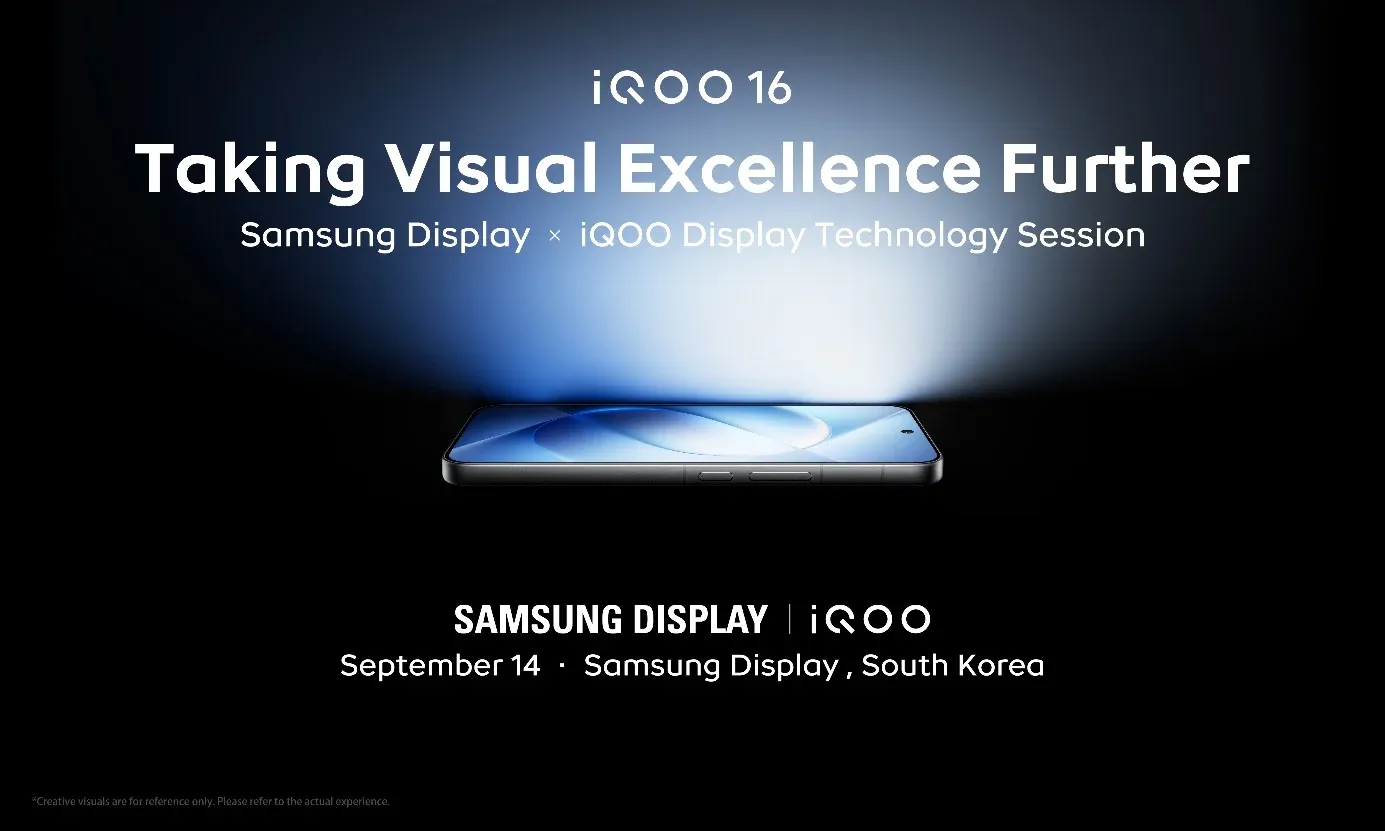
The smartphone display market is witnessing a strategic shift in how hardware specifications are defined, moving from standard procurement models toward deep-tier co-development between device manufacturers and component suppliers. During a technology session in Korea on September 14, 2026, Samsung Display and iQOO announced a deepened partnership aimed at overcoming the traditional "impossible triangle" of high resolution, high refresh rates, and low power consumption. This collaboration centers on the upcoming iQOO 16, which the companies claim will be the first Android smartphone to integrate Samsung’s M16 light-emitting material and 2K LEAD™ 2.0 technology. By moving beyond simple requirement-setting, the two entities are positioning themselves to challenge the existing dominance of Apple and Samsung in the premium display landscape.
Co-Defining the Samsung M16 2K 165Hz Display
The partnership between Samsung Display and iQOO represents an evolution in the semiconductor and display supply chain, transitioning from a transactional relationship to a "co-definer" model. Rather than merely specifying requirements and receiving finished products, the companies are jointly tackling technical barriers through the "Future Display Exploration Program." This initiative focuses on the development of the Samsung M16 2K 165Hz Display, a component designed to balance competing performance metrics that typically require significant trade-offs. To facilitate this, the companies have established a dedicated flagship production line specifically for iQOO to optimize panel performance.
A critical technical component of this rollout is a customized 22nm high-refresh-rate IC, which the companies developed to ensure stable mass production of the high-performance panel. This hardware integration is intended to address the friction between high-resolution 2K clarity and the high refresh rates required for gaming. By combining Samsung Display’s expertise in light-emitting materials and driving technologies with iQOO’s focus on real-world gaming scenarios and display tuning, the companies aim to deliver a display that achieves top-tier industry performance in image quality, smoothness, and power efficiency simultaneously.
Technical Specifications and Market Positioning
The technical benchmarks provided for the iQOO 16 suggest a significant push into high-performance mobile hardware. The Samsung M16 2K 165Hz Display features a global peak brightness of 2800 nits. In terms of energy efficiency, the company reports that at a display brightness of 150 nits, the panel's power consumption is 31% lower than a similarly sized 1.5K display. To manage motion and latency, iQOO is deploying proprietary Q-Flex control technology to reduce touch latency, alongside a frame synchronization technology designed to mitigate motion blur. Furthermore, the company utilizes a pixel-level compensation algorithm to calibrate all 9.12 million subpixels on the display to improve color uniformity and brightness.
This technological advancement is part of a broader competitive realignment in the premium smartphone sector. According to the announcement, a new "global top-three" landscape is forming among brands utilizing Samsung’s flagship light-emitting materials. While Apple is noted for its ecosystem optimization and Samsung for its vertical integration, iQOO is positioning itself as a specialist in display definition driven by gaming and performance requirements. In 2026, the deployment of Samsung’s M16 material and 2K LEAD™ 2.0 will be shared by both the iQOO 16 and the iPhone Duo, highlighting the critical role of these specific material technologies in the high-end market.
Key Takeaways
- The iQOO 16 will be the first Android smartphone to feature Samsung M16 light-emitting material and 2K LEAD™ 2.0 technology.
- The new Samsung M16 2K 165Hz Display achieves a peak brightness of 2800 nits and consumes 31% less power at 150 nits compared to a similar 1.5K display.
- Samsung Display and iQOO have launched the "Future Display Exploration Program" to move toward a co-development model for display technology.
TechInsyte's Take
In our view, the Samsung Display and iQOO partnership signals a maturing of the mobile hardware supply chain, where the distinction between "device maker" and "component manufacturer" is increasingly blurred. By co-developing a customized 22nm high-refresh-rate IC and establishing dedicated production lines, iQOO is attempting to bypass the generic hardware cycles that often limit mid-to-high-tier Android devices. This move is a direct challenge to the vertical integration advantage held by Samsung and the ecosystem lock-in of Apple. If iQOO can successfully prove that its specialized tuning and co-developed materials can deliver a superior user experience in high-performance scenarios, it may force other OEMs to move away from off-the-shelf component procurement toward much more expensive and complex co-engineering models to remain competitive in the premium segment.
Questions & Answers
How does the iQOO 16 address the power consumption challenges of high-resolution displays?
The iQOO 16 utilizes the Samsung M16 light-emitting material and 2K LEAD™ 2.0 technology. According to the company, at a brightness level of 150 nits, the display panel achieves 31% lower power consumption than a similarly sized 1.5K display.
What specific hardware was developed to support the new 165Hz refresh rate?
To support the high refresh rate and ensure stable mass production, iQOO and Samsung Display co-developed a customized 22nm high-refresh-rate IC and established a dedicated flagship production line for iQOO to optimize the panel.
How does iQOO manage color accuracy and uniformity across the display?
iQOO employs a proprietary scientific calibration production line and a pixel-level compensation algorithm. This process is used to calibrate the color of all 9.12 million subpixels on the display to improve brightness and color uniformity.
What is the competitive landscape for premium displays using M16 materials in 2026?
The market is characterized by a three-way competition between Apple, Samsung, and iQOO. In 2026, both the iQOO 16 and the iPhone Duo are expected to feature Samsung's latest M16 light-emitting material and 2K LEAD™ 2.0.
Source: GlobeNewswire