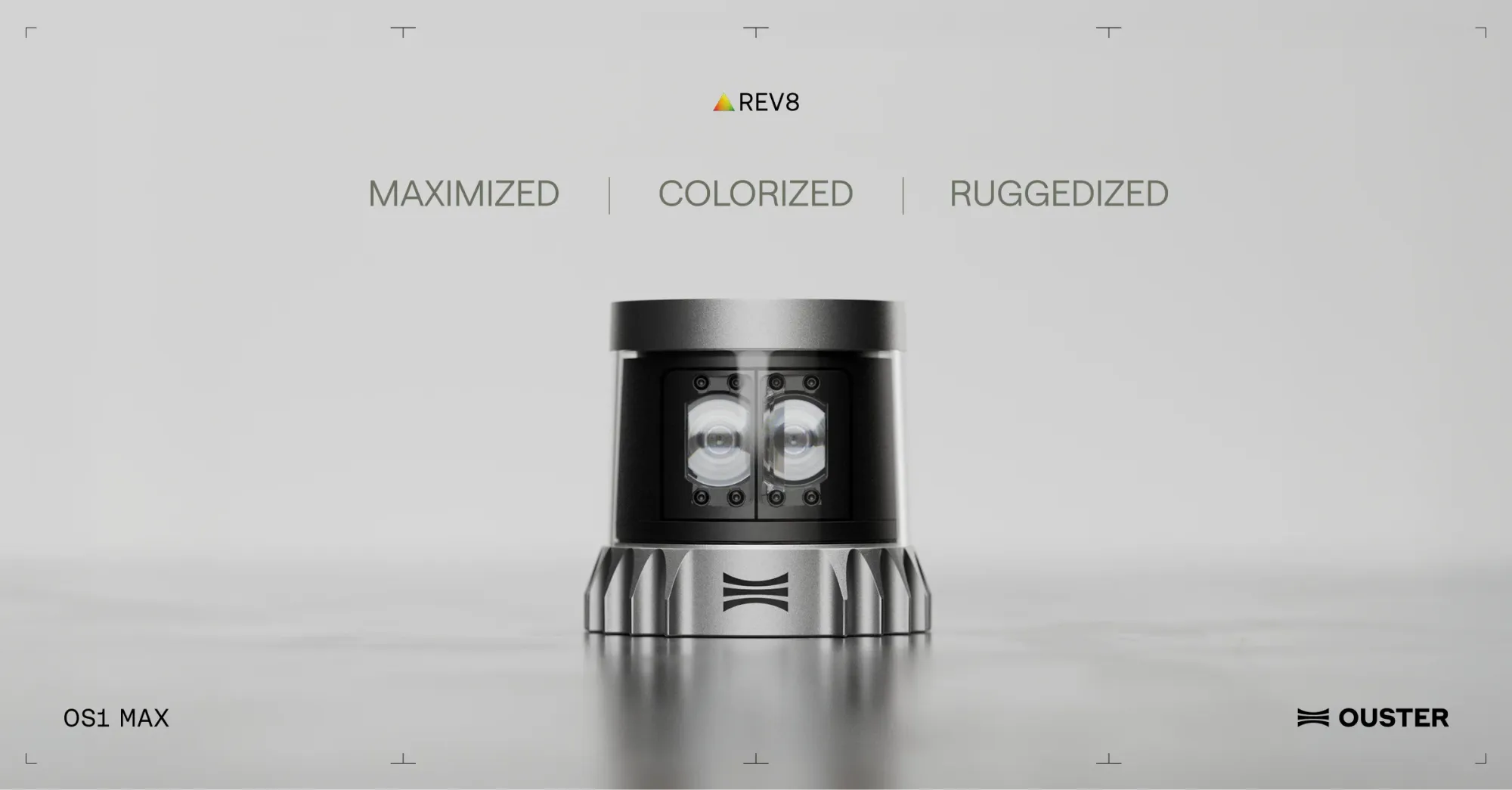
Ouster is attempting to resolve a long-standing technical trade-off in aerial surveying by integrating high-resolution color data directly into its digital lidar hardware. The company announced that its new Rev8 OS1 Max sensor, powered by the L4 Max chip, provides native 48-bit RGB colorization alongside survey-grade 3D range data. This development aims to eliminate the parallax errors and complex post-processing workflows typically required when aligning separate camera and lidar streams. By combining these data types at the silicon level, Ouster is positioning the Rev8 OS1 Max as a specialized tool for high-altitude drone mapping, utility corridor inspections, and critical infrastructure management where precision and speed are paramount.
Precision Breakthroughs in the Rev8 OS1 Max
The Rev8 OS1 Max introduces significant hardware improvements designed to increase the efficiency of drone-based survey missions. According to the company, the sensor achieves ±0.25 cm 1σ precision and ±1.25 cm accuracy, which represents a twofold increase in precision and accuracy over the previous Rev7 generation. This leap in performance is supported by tighter beam collimation, resulting in a spot size up to 50% smaller than its predecessor. For aerial operators, this technical shift is intended to prevent thin objects, such as power lines or branches, from "smearing" into the surrounding environment during high-altitude flights.
The sensor architecture supports 256 vertical channels and up to 4K horizontal resolution, a configuration Ouster claims allows for higher ground speeds without sacrificing point density. This capability is designed to help operators cover more ground per battery charge, potentially increasing the number of corridors inspected during a single mission. Furthermore, the company states that every unit undergoes calibration across range, reflectivity, temperature, and beam angle before shipping to ensure repeatable results across different aircraft in a fleet. The hardware is also built for environmental resilience, featuring IP68 and IP69K ingress protection, 100 G shock resistance, and an operating temperature range from -40 °C to +85 °C.
Navigating Regulatory Compliance and Industrial Use
Beyond raw sensor performance, Ouster is leveraging domestic manufacturing to address tightening supply chain security requirements in North America and Europe. The company is positioning its Rev8 digital lidar sensors as compliant with §164 of the FY2025 National Defense Authorization Act (NDAA) and the Build America, Buy America Act (BABA). This strategic alignment is intended to provide a "trusted option" for government, utility, and enterprise operators who must adhere to strict domestic sourcing mandates for critical infrastructure projects. Companies like GeoCue are already integrating these sensors into TrueView payloads to meet these specific regulatory demands.
The utility of the Rev8 technology extends into specialized industrial sectors, including confined-space inspections. Flyability, which currently utilizes Ouster's OS0 lidar for its Elios 3 platform, is reportedly evaluating the Rev8 OS0 to enable native color 3D mapping in hazardous, GPS-denied environments. This suggests that the move toward native color lidar is not limited to wide-area aerial mapping but is also being tested for high-stakes, localized industrial inspections. By removing the need for secondary camera calibration, Ouster aims to shorten the data processing pipeline between the initial flight and the final deliverable.
Key Takeaways
- The Rev8 OS1 Max delivers ±0.25 cm 1σ precision and ±1.25 cm accuracy, doubling the performance of the Rev7 generation.
- The sensor features native 48-bit RGB colorization at the detector level, eliminating parallax issues between color and geometry.
- Ouster’s Rev8 sensors are designed to meet NDAA §164 and Build America, Buy America Act (BABA) compliance standards.
TechInsyte's Take
In our view, Ouster is executing a dual-track strategy that addresses both technical bottlenecks and geopolitical regulatory shifts. By integrating color at the silicon level, they are not just improving data quality; they are attacking the operational friction that slows down the transition from raw data collection to actionable intelligence. This "native color" approach could become a standard requirement for enterprise mapping as the demand for high-fidelity digital twins grows. Simultaneously, by aggressively pursuing NDAA and BABA compliance, Ouster is insulating itself against the increasing scrutiny of foreign-manufactured sensing technology. This move effectively turns a regulatory hurdle into a competitive moat, positioning their hardware as a "safe" choice for high-value government and utility contracts. For CIOs and infrastructure leads, the value proposition lies in the intersection of hardware durability, data precision, and supply chain certainty.
Questions & Answers
How does native colorization at the silicon level impact the data processing workflow?
By assigning RGB values at the detector rather than using a separate camera, the Rev8 OS1 Max eliminates parallax between color and geometry. This removes the need for complex post-flight calibration and alignment, which Ouster claims shortens the time required to move from flight to final deliverable.
What specific regulatory standards does the Rev8 OS1 Max meet for U.S. infrastructure projects?
The Rev8 digital lidar sensors are designed to comply with §164 of the FY2025 National Defense Authorization Act (NDAA) and the Build America, Buy America Act (BABA), making them suitable for projects with strict domestic sourcing requirements.
In what ways does the Rev8 OS1 Max improve high-altitude mapping efficiency?
The sensor provides a 50% smaller spot size through tighter collimation and offers 256 vertical channels with 4K horizontal resolution. These features are intended to allow operators to fly at higher altitudes and faster speeds while maintaining the point density necessary to resolve thin objects like power lines.
What environmental protections are integrated into the Rev8 OS1 Max hardware?
The sensor is built for extreme conditions with IP68 and IP69K ingress protection, 100 G shock resistance, and an operating temperature range of -40 °C to +85 °C, allowing for use in environments ranging from frozen corridors to high-heat desert sites.
Source: Businesswire