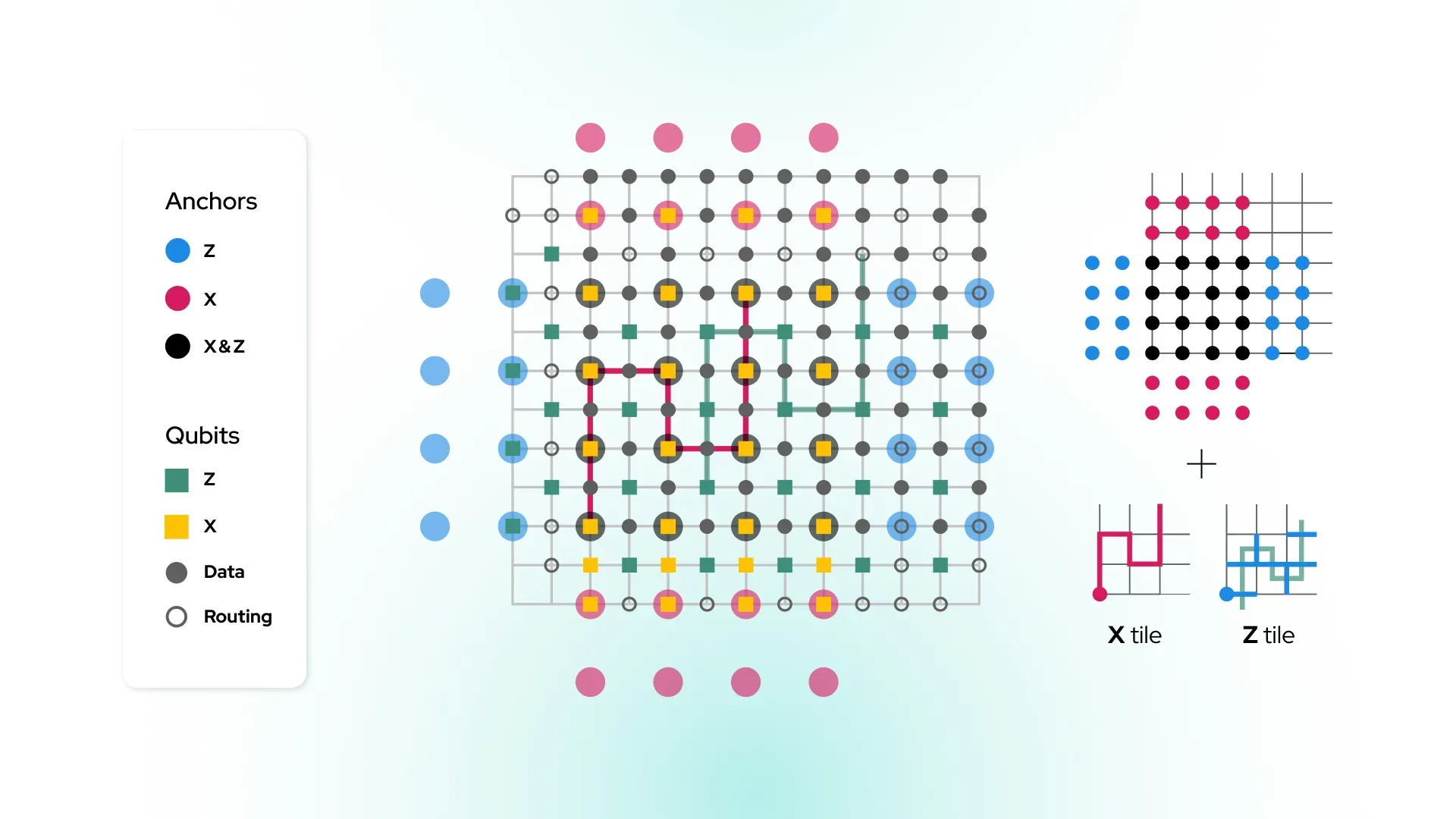
IQM Quantum Computers announced that its newly developed “directional tile codes” can lower logical error rates by up to 1,000 times compared with the surface code, using only the native nearest‑neighbour iSWAP gates of its Crystal processors. The result, detailed in a paper on arXiv and co‑authored with researchers from Freie Universität Berlin, the University of Edinburgh, and Johannes Gutenberg‑Universität Mainz, marks a concrete step toward the fault‑tolerant quantum computers IQM targets for 2030.
Directional Tile Codes Cut Logical Errors on Existing Hardware
The research introduces a family of quantum error‑correcting codes—directional tile codes—that achieve a per‑logical‑per‑round error‑rate reduction of up to 1,000× relative to the widely used surface code. Crucially, the improvement is realized on a hardware footprint of roughly 30 physical qubits per logical qubit, matching the size of current surface‑code implementations. The codes rely solely on the nearest‑neighbour iSWAP gates already native to IQM’s Crystal processors, avoiding any need for new gate types or additional connectivity.
Dr. Inés de Vega, IQM’s Chief Scientist, emphasized that the codes were designed for “scalable and manufacturable hardware architectures” and that the result “represents a breakthrough” in co‑designing error correction with hardware. Senior Quantum Error‑Correction Engineer Dr. Vincent Steffan added that the key innovation lies in “dynamic syndrome extraction circuits” that enable implementation on a square qubit grid, a layout IQM currently produces.
Alignment with IQM’s Fault‑Tolerant Roadmap
IQM positions the directional tile codes as a measurable advance toward its 2030 fault‑tolerant target and the broader goal of scaling to one million qubits. The company’s technology roadmap has long identified quantum error correction as a core pillar; the new codes demonstrate that the efficiency benefits of quantum low‑density parity‑check (QLDPC) codes can be realized on IQM’s planar hardware. IQM’s leadership notes that the approach “creates a baseline for further improvements through continued co‑design of error‑correcting codes and hardware architectures.”
The announcement arrives as IQM prepares for a Nasdaq listing through a merger with Real Asset Acquisition Corp. (Nasdaq: RAAQ). The firm has already sold 23 quantum systems worldwide—the most of any quantum hardware vendor—to research institutions, high‑performance computing centres, and enterprises. The error‑correction breakthrough therefore supports the company’s narrative of delivering production‑grade quantum systems while advancing foundational science.
Implications for Enterprise Quantum Adoption
For enterprises evaluating quantum‑computing investments, the reduction in logical error rates could shorten the timeline to run deeper, more complex algorithms on near‑term hardware. Because the tile codes operate on the existing square‑grid architecture, customers with on‑premises IQM systems would not need hardware upgrades to benefit. The improvement also aligns with IQM’s on‑premises deployment model, which gives organizations direct ownership and control of their quantum infrastructure.
However, the paper does not provide performance data for specific application workloads, nor does it quantify the impact on total qubit counts required for particular problem sizes. IQM did not disclose further details on integration steps, software toolchain changes, or timelines for making the codes available to customers beyond the research publication.
Key Takeaways
- Directional tile codes reduce per‑logical‑per‑round error rates by up to 1,000 × compared with the surface code, using only native nearest‑neighbour iSWAP gates.
- The codes achieve this improvement on a hardware footprint of about 30 physical qubits per logical qubit, matching current surface‑code implementations.
- IQM has sold 23 quantum systems globally and is preparing a Nasdaq listing via a merger with Real Asset Acquisition Corp. (Nasdaq: RAAQ).
TechInsyte's Take
The announcement provides a concrete, hardware‑compatible path toward lower logical error rates, a prerequisite for scaling quantum workloads. While the results are promising, enterprises should monitor how quickly IQM integrates the tile codes into its product stack and whether software support will be ready for production use. The broader impact will depend on subsequent demonstrations of algorithmic performance on the improved error‑correction layer.
Source: Businesswire