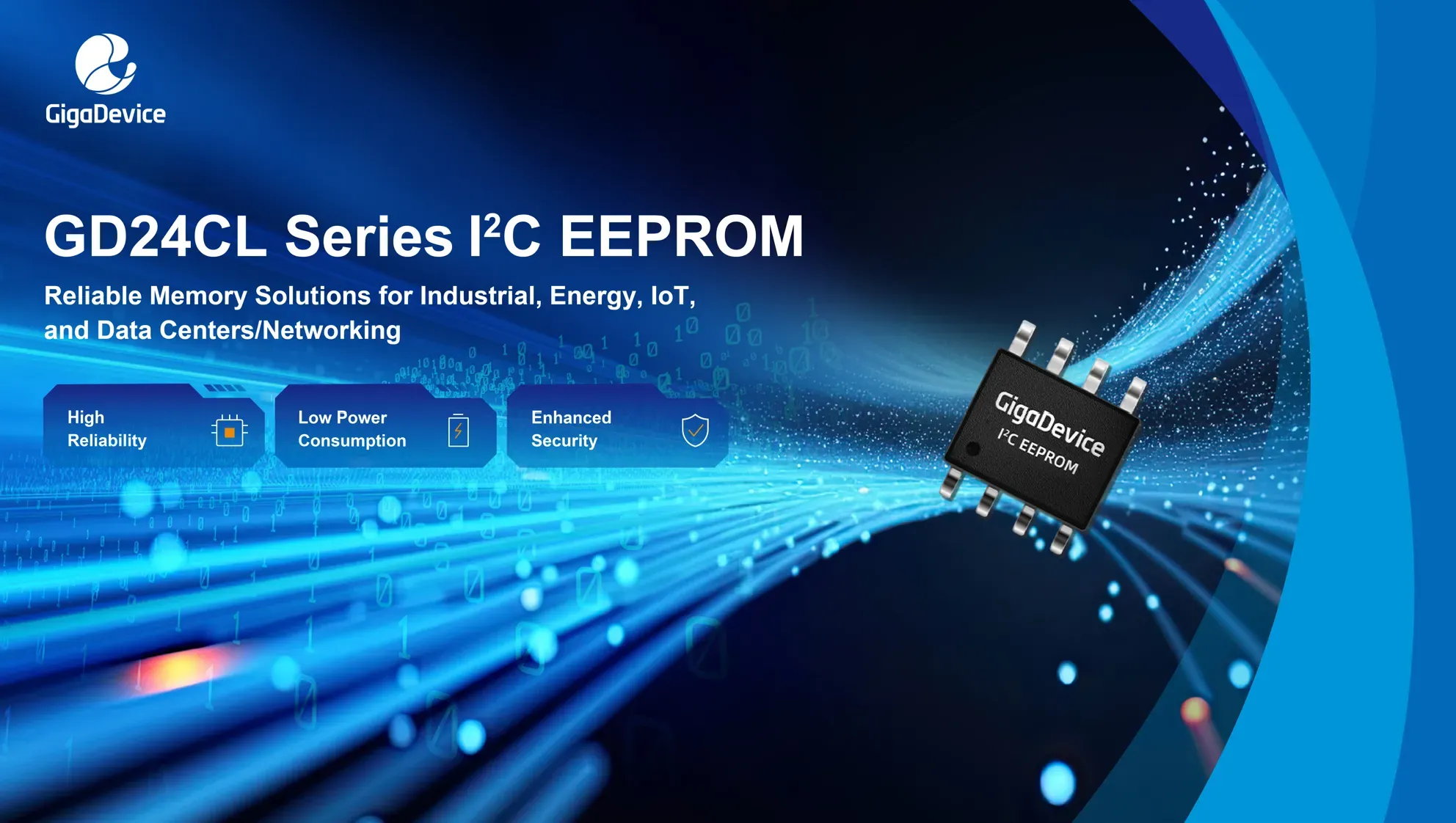
GigaDevice announced the launch of its GD24CL series, the company’s first I²C EEPROM products. The series targets industrial, energy, IoT, data‑center, and networking applications, offering higher endurance, long‑term data retention, and built‑in security features that align with the storage needs of enterprise hardware designers.
GD24CL Series Launch Expands GigaDevice’s Non‑Volatile Memory Portfolio
The GD24CL line adds EEPROM capability to GigaDevice’s existing flash, MCU, sensor, and analog offerings. Available initially with a 256 Kb part (GD24CL256B), the series will grow to include 128 Kb and 512 Kb devices in the first half of next year. Capacity options range from 32 Kb to 1 Mb, providing a broader set of storage choices for customers. GigaDevice describes the series as designed for “stable and long‑term storage of critical configuration data,” positioning it for use cases that require frequent parameter updates and reliable retention.
Technical Features Position GD24CL for Industrial and IoT Deployments
Endurance is a key differentiator: the devices support up to 4 million program/erase cycles, which GigaDevice states is four times the industry standard. Data retention is rated at 100 years, and an on‑chip Error‑Correction Code (ECC) improves data integrity. The EEPROM operates over a temperature range of –40 °C to 125 °C and accepts supply voltages from 1.7 V to 5.5 V, matching the environmental demands of rugged equipment.
Communication flexibility is provided through three I²C clock speeds—100 kHz, 400 kHz, and 1 MHz—allowing integration from low‑speed sensors to high‑speed industrial controllers. Byte‑level random read/write capability further supports applications that update small data fields frequently.
Security mechanisms include a hardware Write Protect (WP) pin and a lockable Security Page that, once engaged, makes the protected region permanently non‑writable. GigaDevice notes that these features “fundamentally eliminate the risk of data tampering” in complex operating environments.
Power consumption figures are modest: standby current as low as 1 µA, read current around 1 mA, and write current near 1.5 mA. The low‑pin‑count I²C interface and compact packages—SOP8 (150 mil), TSSOP8 (173 mil), and UDFN8 (2 × 3 mm)—help designers meet PCB space constraints while maintaining energy efficiency, a benefit for industrial IoT terminals and green data‑center modules.
Operational Relevance for Enterprise Hardware Teams
For CIOs and CTOs overseeing hardware platforms, the GD24CL series offers a single‑chip solution that combines endurance, security, and low power in a small footprint. The extended temperature range and wide voltage tolerance simplify board‑level design across diverse environments, reducing the need for additional protection circuitry. The availability of multiple capacities allows system architects to select the smallest viable memory size, potentially lowering bill‑of‑materials costs while still meeting long‑term reliability targets.
Key Takeaways
- GigaDevice’s GD24CL series is the company’s first EEPROM line, initially shipping the 256 Kb GD24CL256B with 128 Kb and 512 Kb variants planned for the first half of next year.
- The devices deliver up to 4 million program/erase cycles, 100‑year data retention, and on‑chip ECC, exceeding typical industry endurance specifications.
- Built‑in hardware security (WP pin and lockable Security Page) and low power consumption (standby 1 µA, read 1 mA, write 1.5 mA) target industrial IoT, data‑center, and networking equipment.
TechInsyte's Take
The GD24CL series gives enterprise hardware teams a purpose‑built EEPROM that aligns with the durability and security requirements of mission‑critical systems. While the announced specifications are strong, adoption will depend on sample availability and pricing, which GigaDevice has not disclosed. Buyers should monitor the upcoming 128 Kb and 512 Kb parts and evaluate how the series fits within existing I²C bus architectures and power budgets.
Source: Businesswire