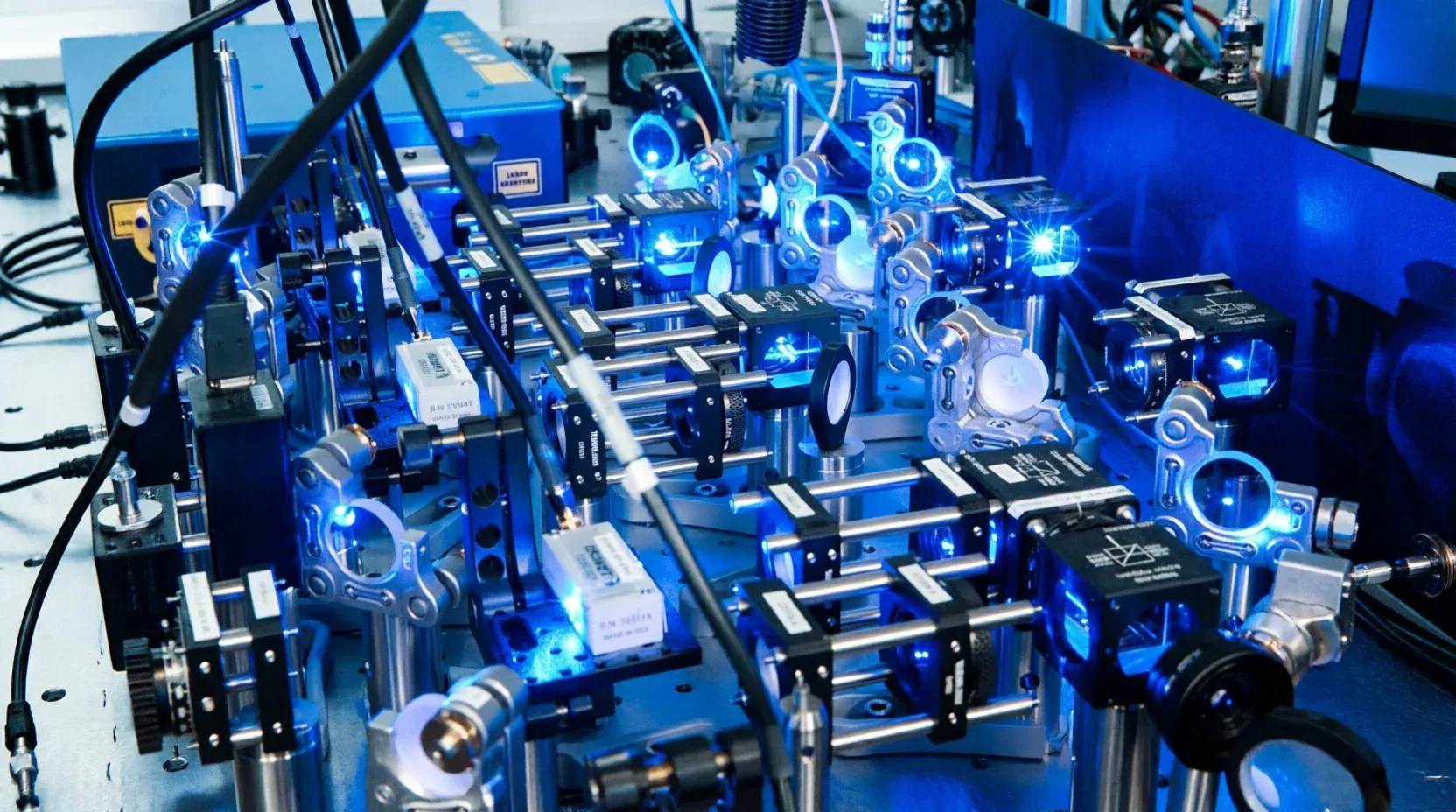
IonQ is attempting to solve the fundamental scaling bottleneck in quantum computing by linking disparate hardware components through high-speed light-based connections. The company announced it has achieved entanglement rates exceeding 1,000 per second (1 kHz) between a trapped ion qubit and a solid-state silicon vacancy (SiV) quantum memory. This milestone, reached via a photonic interconnect, is intended to facilitate distributed quantum computing. By enabling separate quantum systems to work together, IonQ is positioning its architecture to support the eventual transition from single processors to networked quantum data centers.
High-Speed Entanglement via Photonic Interconnects
The technical achievement centers on an end-to-end link between a trapped ion system and a silicon vacancy (SiV) qubit, utilizing IonQ’s existing SiV quantum memory platform. According to the company, this demonstration achieves entanglement rates more than four times faster than the previous record held by a research group at Duke University. The strategy relies on combining the high coherence standards of trapped ion qubits with the superior light-coupling efficiency of solid-state quantum memory. This hybrid approach aims to mitigate the interconnect bottlenecks that typically hinder the expansion of quantum networks. By moving qubits through photons, IonQ is testing a method to bridge different hardware modalities. The company suggests this architecture could eventually interface with neutral atoms or superconducting systems using transducers to convert microwave signals into light, potentially creating a universal interconnect standard for diverse quantum hardware types.
Scaling Toward Distributed Quantum Data Centers
IonQ is framing this development as a foundational step toward modular, large-scale quantum infrastructure. The company’s CEO, Niccolo de Masi, compared the trajectory of quantum systems to classical data centers, which achieved scale by connecting specialized processors, memory, and networks. This interconnect technology is currently supporting IonQ’s involvement in the Defense Advanced Research Projects Agency’s (DARPA) HARQ program, which focuses on developing high-speed interconnects compatible with various qubit types. Beyond research, the company is actively commercializing its memory and interconnect platform. Following a sale to the University of Maryland in April and a second system sale to SDT in South Korea in September, IonQ is moving toward a model where quantum computing is not limited to a single unit but is distributed across a networked environment. This modularity is intended to support applications ranging from networked sensing to large-scale distributed computing.
Key Takeaways
- IonQ achieved entanglement rates above 1,000 per second (1 kHz) using a photonic interconnect.
- The technology links a trapped ion qubit with a silicon vacancy (SiV) solid-state quantum memory.
- This rate is more than four times faster than the previous record held by research at Duke University.
TechInsyte's Take
In our view, IonQ is making a calculated bet that the future of quantum computing lies in modularity rather than monolithic processor scaling. By focusing on the interconnect—the "glue" between quantum components—they are addressing the most significant physical barrier to building a quantum data center. The ability to link different qubit types via photons suggests a move toward a heterogeneous quantum ecosystem, much like modern classical data centers. If IonQ can maintain these high entanglement rates while scaling the number of connected nodes, they may bypass the physical limitations of single-chip quantum processors, effectively shifting the competition from qubit count to network topology and interconnect bandwidth.
Questions & Answers
How does this interconnect technology address the scalability limits of current quantum computers?
Current quantum systems often struggle to scale because increasing qubit counts on a single chip introduces noise and physical constraints. IonQ’s photonic interconnect allows for distributed computing, where multiple smaller quantum modules are linked together via light, theoretically enabling much larger, networked systems.
What specific hardware components are involved in this entanglement milestone?
The demonstration utilized a trapped ion qubit, known for high coherence, and a silicon vacancy (SiV) solid-state quantum memory, which provides efficient coupling to light, connected through a photonic interconnect.
Is this technology limited strictly to trapped ion-based quantum computers?
While this specific demonstration used trapped ion systems, IonQ states the underlying architecture is expected to be compatible with multiple qubit approaches, including neutral atoms and superconducting systems that utilize transducers.
What is the commercial status of IonQ's quantum memory and interconnect platform?
The platform is currently ramping up commercially; IonQ reported a sale to the University of Maryland in April and a sale to SDT in South Korea in September.
Source: IonQ