T-Mobile is leveraging automated network intelligence and satellite redundancy to maintain connectivity across the Gulf Coast as Hurricane Isaias triggers widespread power outages and infrastructure damage. The company is positioning its Self-Organizing Network (SON) technology and T-Satellite service as critical layers of resilience for both civilian users and emergency responders. As commercial power failures disrupt traditional cellular access, particularly in the Mobile, Alabama, region, the carrier is attempting to stabilize coverage through real-time automated adjustments and localized hardware deployment. This response highlights a strategic shift toward software-defined network resiliency to mitigate the physical vulnerabilities of terrestrial cell sites during extreme weather events.
Automated SON Adjustments and Site Operationality
T-Mobile reports that approximately 96% of its sites across the four affected markets remained operational as of Saturday morning, despite significant commercial power disruptions. To manage the remaining outages and the impact of damaged infrastructure, the company is relying heavily on its Self-Organizing Network (SON) technology. Since October 9, the SON system has executed more than 7,500 automated adjustments, allowing neighboring cell sites to dynamically adapt their performance to compensate for offline or degraded nodes. This automated reconfiguration is intended to maintain coverage footprints even as individual sites lose power or connectivity.
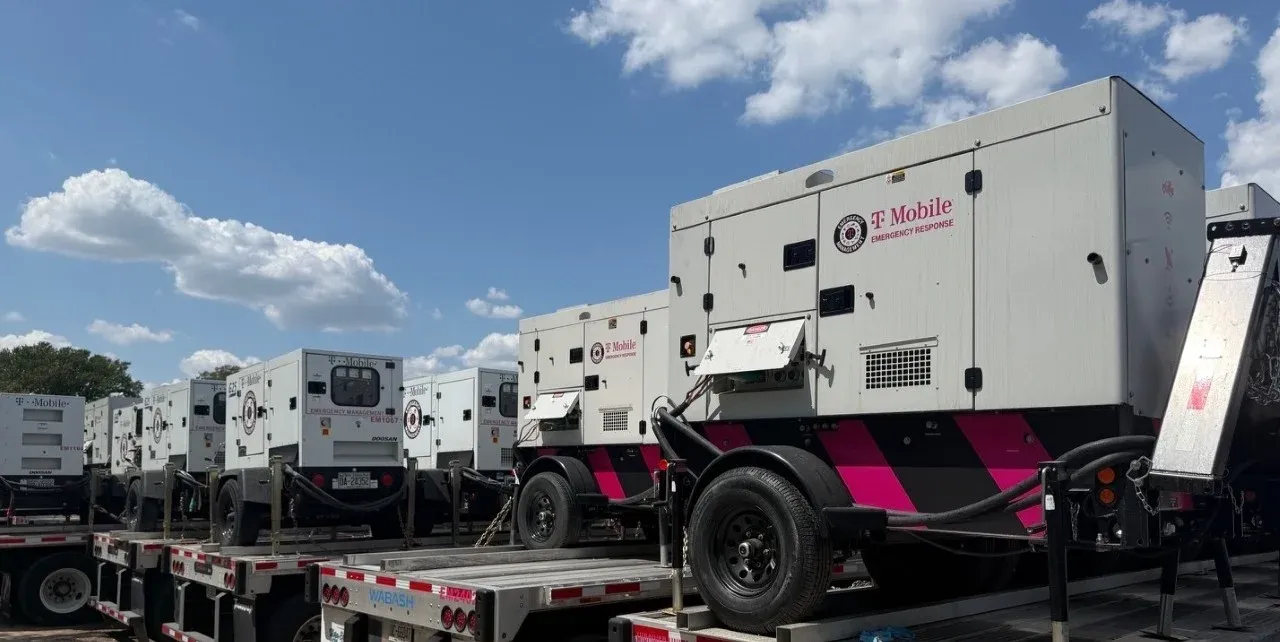
On the ground, technical crews are working to stabilize the physical layer by deploying generators and refueling existing backup power equipment. The company is specifically prioritizing restoration efforts in the hardest-hit areas, such as the Mobile, Alabama, corridor, where power outages are most concentrated. Beyond hardware, T-Mobile is deploying mobile resources, including vehicles equipped with Wi-Fi and device-charging capabilities, to community gathering points and shelters. To alleviate consumer costs during the recovery phase, the company is providing unlimited talk, text, and data to customers on its T-Mobile, Metro by T-Mobile, Assurance Wireless, Mint Mobile, and Ultra Mobile brands within the impacted zones.
T-Satellite and T-Priority Redundancy Layers
As traditional terrestrial coverage faces intermittent gaps, T-Mobile is utilizing its T-Satellite service to provide a non-terrestrial communication fallback. On Friday, October 9, the company recorded more than 16,000 unique users utilizing T-Satellite to send and receive over 38,000 text messages. This service, which is available to customers with compatible devices, allows for essential communication, including Text to 911 via satellite, when standard cellular signals are unavailable.
For critical infrastructure and public safety, the company is deploying T-Priority, a service designed to support first responders. T-Mobile is coordinating with emergency management agencies to ensure that eligible public safety organizations receive 30 days of T-Priority combined with T-Satellite access at no cost. This move is intended to secure high-priority communication channels for emergency personnel during the immediate aftermath of the storm. By linking satellite capabilities with priority access protocols, the company is attempting to bridge the gap between standard consumer connectivity and the specialized requirements of emergency management during large-scale regional disasters.
Key Takeaways
- T-Mobile's Self-Organizing Network (SON) technology performed over 7,500 automated adjustments since October 9 to maintain coverage.
- Approximately 96% of T-Mobile sites in the affected Gulf Coast markets remained operational as of Saturday morning.
- More than 16,000 users utilized T-Satellite to exchange over 38,000 text messages on October 9.
TechInsyte's Take
In our view, T-Mobile’s response to Hurricane Isaias serves as a live stress test for the efficacy of software-defined network resiliency. While the 96% operationality rate is a significant metric, the true strategic value lies in the 7,500 automated adjustments made by the SON technology. This suggests that the industry is moving away from purely manual, crew-based restoration toward a model where the network itself manages localized failures in real-time. Furthermore, the heavy utilization of T-Satellite by 16,000 users underscores the growing necessity of non-terrestrial network (NTN) integration for enterprise and consumer continuity. For IT decision-makers, this highlights that "resilience" is no longer just about backup generators; it is increasingly about the ability of the network software to autonomously reroute traffic and leverage satellite layers when the physical terrestrial layer fails.
Questions & Answers
How is T-Mobile using automation to mitigate the impact of site outages?
T-Mobile is utilizing Self-Organizing Network (SON) technology to make real-time, automated adjustments to cell site performance. Since October 9, the system has made over 7,500 adjustments, allowing neighboring sites to adapt to changing conditions and maintain coverage even when specific sites are offline.
What role does T-Satellite play in the company's disaster recovery strategy?
T-Satellite acts as a redundant communication layer for customers with compatible devices when traditional cellular coverage is unavailable. It allows for text-based communication, including Text to 911, providing a critical fallback for families and individuals in areas with significant power or infrastructure damage.
How are first responders being supported during the recovery phase?
T-Mobile is providing eligible first responders and public safety agencies with 30 days of T-Priority service combined with T-Satellite access at no charge. This is intended to ensure that critical communications remain prioritized and functional during the emergency response.
Which specific regions are experiencing the most significant network disruptions?
While the impact is widespread across the Gulf Coast, the company noted that commercial power outages are causing the vast majority of disruptions, particularly in the Mobile, Alabama, area.
Source: T-Mobile