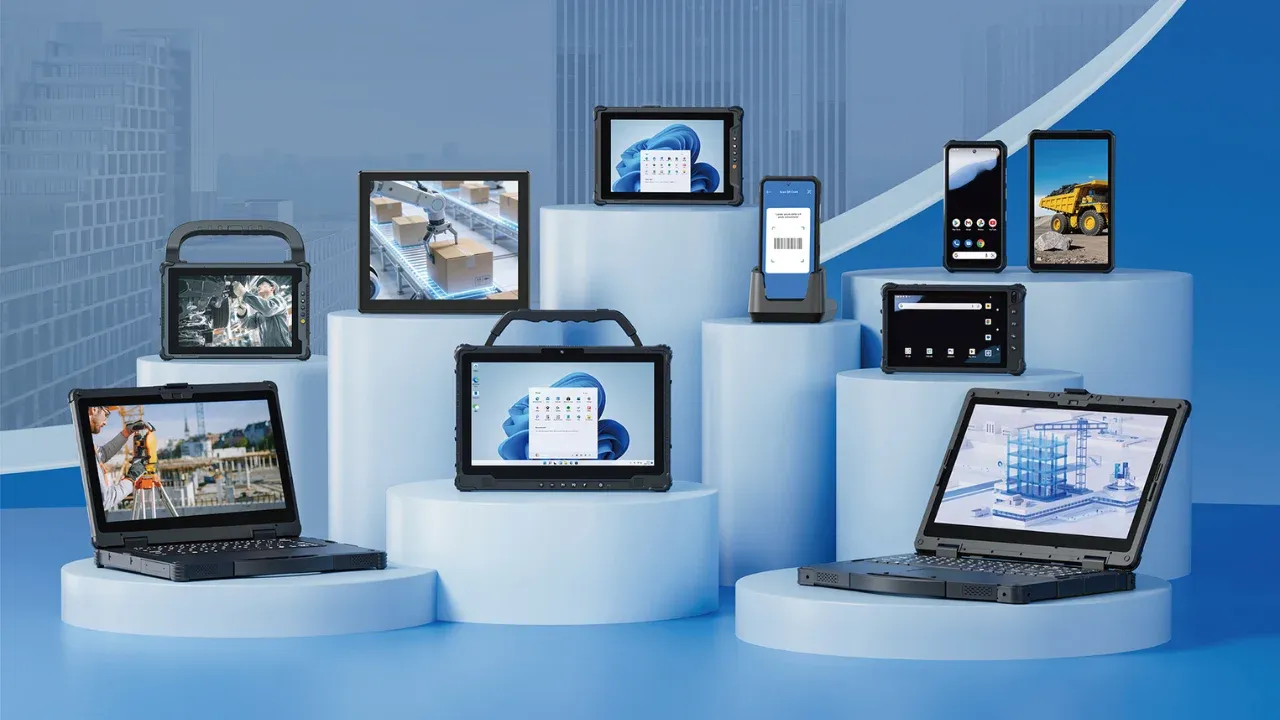
The accelerating demand for mission-critical mobile computing in industrial automation and smart manufacturing is driving a shift toward vertically integrated hardware providers. Emdoor Information, a company listed on China’s A-share main board since 2023, is positioning itself to capture this growth by linking full-stack R&D with large-scale, intelligent manufacturing. The company reported 2025 revenue of RMB 4.583 billion (approximately USD 640 million), representing a 44.15% year-over-year increase. This financial trajectory suggests a strategic focus on scaling ruggedized hardware—including tablets, laptops, and handhelds—to meet the requirements of sectors like public utilities, energy, and intelligent manufacturing across North America, Europe, and the Asia-Pacific region.
Scaling Production via the Emdoor Building Manufacturing Base
Emdoor Information is leveraging its centralized infrastructure to manage the complexities of ruggedized hardware production. The company operates the Emdoor Building, a facility that houses its corporate offices alongside a 20,000-square-meter intelligent manufacturing base. This site features four production floors and 15 integrated assembly and testing lines, providing a total annual capacity of 7.8 million units. By co-locating R&D and manufacturing, the company aims to accelerate design validation and reduce time-to-market for new industrial devices.
To maintain quality standards required for extreme field environments, the company has invested tens of millions of RMB into a dedicated reliability testing base. This includes specialized laboratories for environmental simulation, waterproofing, drop testing, and mechanical durability. The company states that all rugged tablets, laptops, and handheld terminals undergo validation against MIL-STD-810 standards and specific IP ratings. Furthermore, the manufacturing process utilizes AI-powered visual inspection and Manufacturing Execution Systems (MES) to ensure full-process traceability across its production lines. This integrated approach is designed to provide the stability and quality control necessary for long-term enterprise deployments in harsh industrial settings.
Managing Supply Chain Volatility and Hardware Customization
To mitigate the risks associated with component shortages and price fluctuations, Emdoor Information utilizes a centralized procurement model through its group supply chain management center. The company maintains long-term partnerships with major semiconductor providers, including Intel, Qualcomm, and Rockchip, which it claims provides prioritized supply allocation and early access to technical resources. To protect customer project margins against volatility in memory and storage, the company maintains a rolling finished goods inventory valued at RMB 120 million. This inventory strategy is intended to enable the delivery of standard configurations within one to three days, while customized units are targeted for a seven-to-thirty-day window.
The company’s product portfolio currently includes nearly 100 models across five hardware platforms: Intel, AMD, Qualcomm, MediaTek, and Rockchip. These devices support three operating systems—Windows, Android, and Linux—and range from 4 to 21.5 inches. Beyond standard hardware, Emdoor provides software-level integration, including a Mobile Device Management (MDM) platform for fleet-wide deployment and open SDK/API access for modules like barcode scanning. This allows enterprise users to integrate rugged devices into existing workflows without building custom adapter frameworks from scratch.
Key Takeaways
- Emdoor Information reported 2025 revenue of RMB 4.583 billion (approx. USD 640 million), a 44.15% year-over-year increase.
- The company’s manufacturing base has an annual capacity of 7.8 million units across 15 integrated assembly and testing lines.
- R&D investment over the last five years reached RMB 964 million, with R&D staff comprising over 40% of the total workforce.
TechInsyte's Take
In our view, Emdoor Information’s strategy highlights a growing trend where enterprise hardware reliability is increasingly tied to vertical integration rather than mere assembly. By controlling the manufacturing base, the reliability testing labs, and the supply chain through significant inventory holdings, Emdoor is attempting to insulate its industrial clients from the two greatest risks in rugged computing: hardware failure in the field and component-driven lead-time volatility. The company's heavy R&D spend—representing over 40% of its workforce—suggests it is moving beyond simple ODM services toward a more sophisticated, platform-centric model. For CIOs in sectors like energy or logistics, this model offers a potential hedge against the supply chain instability that has historically plagued specialized industrial hardware. However, the success of this approach will depend on whether their centralized procurement can continue to maintain cost advantages as global semiconductor markets fluctuate.
Questions & Answers
How does Emdoor Information address the long lifecycle requirements of industrial computing?
The company has established a service architecture designed for device lifecycles of five to ten years. This includes providing repair services in Hong Kong, a dedicated technical support hotline, and a continuous feedback mechanism that integrates after-sales insights back into the product development cycle to ensure long-term reliability.
What specific technical capabilities are provided for enterprise software integration?
Emdoor provides an integrated Mobile Device Management (MDM) platform for remote fleet control and batch configuration. Additionally, the company offers open SDK and API access for components such as barcode scanners, which is intended to allow enterprises to perform rapid secondary development and integration into existing software ecosystems.
How does the company manage hardware customization for specialized operational needs?
Emdoor offers customization across three primary layers: hardware, software, and structural redesign. This allows the company to match specific configurations to diverse industrial scenarios, such as intelligent patrol, quality inspection, or edge computing, using their existing five hardware platforms and three operating systems.
What measures are in place to ensure product durability in extreme environments?
All rugged devices undergo rigorous validation in dedicated labs for waterproofing, drop testing, and environmental simulation. The company tests its products against MIL-STD-810 standards and various IP ratings to ensure they can operate reliably under extreme field conditions.
Source: Emdoor