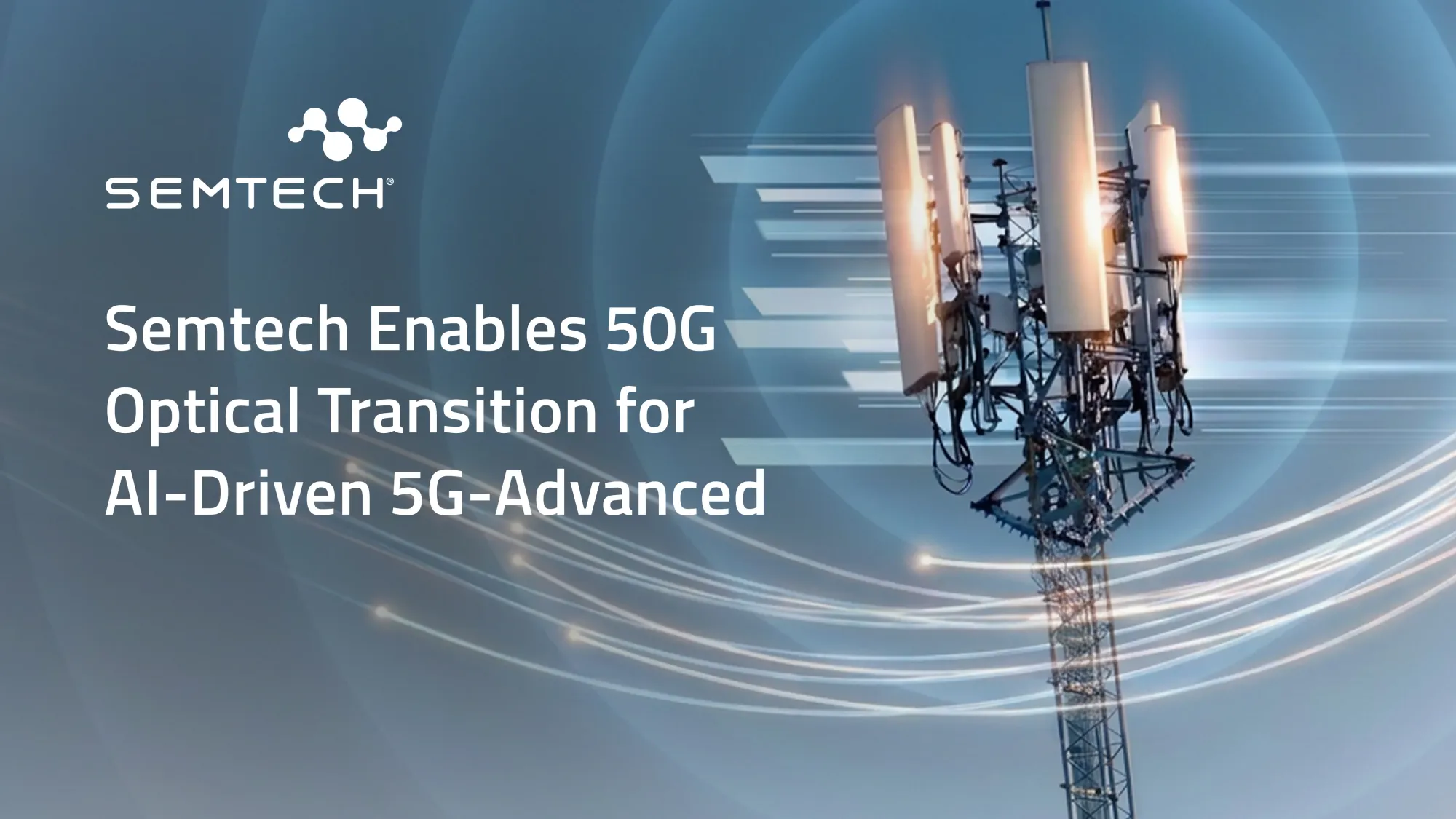
Semtech Corporation is positioning its semiconductor portfolio to address the massive uplink capacity requirements triggered by the shift toward cloud-assisted AI. By moving into full production of 50G optical fronthaul solutions, the company aims to support the next generation of 5G-Advanced radio deployments. This transition is driven by the need to handle heavy AI inference, augmented reality, and generative AI traffic, which industry forecasts from the Mobile Optical Pluggables Alliance (MOPA) suggest could increase uplink capacity requirements by 3x to 5x.
Semtech 50G Production for AI-Driven Uplink
The company has announced the full production availability of a mobile transport portfolio designed to enable 50G fronthaul. This move targets the growing tension in mobile network architecture where encoding overhead in uplink traffic reduces available headroom for growth. Semtech is offering specific silicon combinations to support various deployment architectures: 10 km duplex links using the GN2255 Clock and Data Recovery (CDR) and GN1700TI Transimpedance Amplifier (TIA); 15 km bidirectional (BiDi) links utilizing the GN2255S CDR and GN1700TI TIA; and Wavelength Division Multiplexing (WDM) or longer-reach architectures via the GN2256 CDR and GN1700TI TIA. These components, built on the ClearEdge®, Tri-Edge™, and FiberEdge® product families, are intended to serve the immediate 5G-Advanced market while providing a technical pathway toward 6G through 2030.
Supporting Ericsson and Nokia 5G-Advanced Architectures
Semtech’s hardware rollout aligns with major industry shifts toward AI-ready infrastructure. Specifically, the company is targeting the requirements of Ericsson’s Mobile World Congress 2026-announced portfolio of AI-ready Massive Multiple-Input Multiple-Output (MIMO) and remote radios. Additionally, the portfolio supports Nokia’s Doksuri Remote Radio Heads, which are built on the ReefShark System on Chip (SoC). As these system vendors move toward 50G interfaces to manage the surge in mobile data, Semtech is positioning its CDR and TIA silicon as a qualified solution for module makers. Source Photonics’ CTO, Frank Chang, noted that this portfolio provides the flexibility required to deliver across the diverse range of fronthaul architectures currently being deployed by customers.
Key Takeaways
- Semtech has entered full production of a 50G optical portfolio featuring GN2255, GN2255S, and GN2256 CDRs paired with GN1700TI TIAs.
- Industry forecasts from MOPA indicate that cloud-assisted AI applications could drive a 3x–5x increase in uplink capacity requirements.
- The portfolio is designed to support 5G-Advanced deployments and is intended to scale toward 6G through 2030.
TechInsyte's Take
In our view, Semtech is making a calculated bet that the "uplink bottleneck" will be the defining infrastructure challenge of the AI-mobile era. While much of the industry focus has remained on downlink speeds, the shift toward offloading heavy AI inference to the cloud fundamentally changes the traffic symmetry of mobile networks. By providing specific silicon configurations for 10 km, 15 km BiDi, and WDM architectures, Semtech is not just offering a component, but a modular response to the varied ways operators must scale their fronthaul. This move suggests that the transition to 5G-Advanced is as much about managing AI-driven data symmetry as it is about raw speed.
Questions & Answers
How does AI influence the need for 50G optical fronthaul?
Cloud-assisted AI applications, including generative AI and augmented reality, require significant uplink capacity to offload heavy inference tasks to the cloud. MOPA forecasts suggest this could necessitate a 3x to 5x increase in uplink capacity.
Which specific hardware architectures does Semtech's portfolio support?
The portfolio supports 10 km duplex links (GN2255 CDR and GN1700TI TIA), 15 km bidirectional links (GN2255S CDR and GN1700TI TIA), and WDM/longer-reach architectures (GN2256 CDR and GN1700TI TIA).
What major vendor ecosystems is this technology targeting?
The technology is positioned to support Ericsson’s AI-ready Massive MIMO and remote radios, as well as Nokia’s Doksuri Remote Radio Heads built on the ReefShark SoC.
What is the long-term roadmap for this semiconductor portfolio?
While currently focused on 5G-Advanced, Semtech has designed the portfolio to scale toward 6G technology through the year 2030.
Source: Semtech Corporation