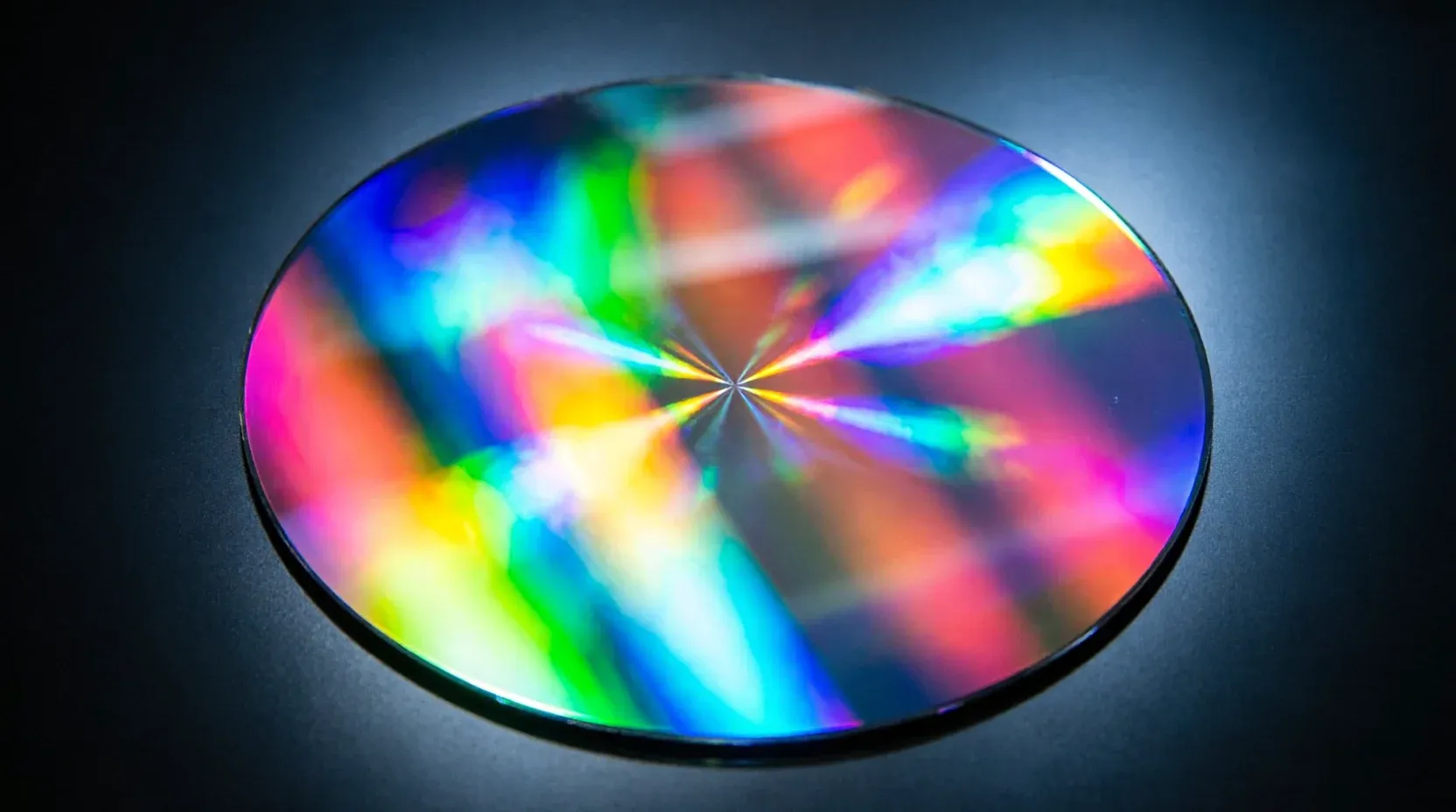
The scaling of augmented reality (AR) hardware depends on solving the tension between lightweight form factors and high-fidelity image quality. To address this, NTT ADVANCED TECHNOLOGY CORPORATION (NTT-AT) and EV Group (EVG) have jointly verified the compatibility of NTT-AT’s UV-curable high-refractive-index resins with EVG’s proprietary SmartNIL® nanoimprint lithography process. This validation targets the manufacturing of waveguides, the critical optical components required for next-generation wearable displays. By proving that NTT-AT’s NH700 Series resins can be successfully imprinted using EVG’s technology, the companies aim to provide a pre-validated material-and-process solution. This development could potentially reduce the time manufacturers spend on material selection and early-stage process development for AR optical devices.
Validating NH762 Resin with SmartNIL® Technology
The joint evaluation focused on the NH762 resin, a component of the NH700 Series, to test its performance alongside EVG’s SmartNIL® technology and EVG® NIL UV/AS5 working stamp material. The technical results indicate that the combination can achieve high-precision replication of complex micro-optical structures. Specifically, the testing confirmed the ability to replicate 350 nm line-and-space structures, as well as 45° slanted gratings and meta-optical elements with minimum feature sizes of 65 nm. These results were achieved without reported defects or deformation in the imprinted patterns.
Beyond initial precision, the companies tested the dimensional stability and repeatability of the process, which are essential for high-volume production. In a consecutive 25-imprint test using the EVG® NIL UV/AS5, the change in imprinted pattern height was limited to approximately 2.2%. This level of stability suggests the process is capable of the repeatable performance required for industrial applications. Furthermore, the NH762 resin demonstrated environmental resistance; samples subjected to damp-heat and light-exposure testing showed only minimal changes in pattern geometry. This durability is a critical requirement for optical components integrated into wearable consumer electronics that face varying environmental conditions.
Scaling AR Waveguide Production via Nanoimprint Lithography
As the industry moves toward commercial-scale deployment of AR glasses, the manufacturing of diffraction gratings and meta-optical elements must become more scalable. Nanoimprint lithography (NIL) is positioned as a promising method for producing these structures with high precision and cost efficiency. However, the effectiveness of NIL is heavily linked to the compatibility between the nanoimprint system and the high-refractive-index materials used to create the optical effects. The NH700 Series resins used in this evaluation offer a refractive index for cured films of 1.8 to 1.9, with a typical cured film thickness of 300 nm (ranging from 200 nm to 1 μm).
The companies intend to expand this evaluation beyond the NH762 resin to include other materials within the NH700 Series. While the current focus remains on AR waveguides, NTT-AT and EVG are looking toward broader applications in the semiconductor and sensing sectors. This includes the development of next-generation meta-optical elements, LiDAR, and various sensing devices. By providing a solution where material and process compatibility is pre-verified, the companies aim to facilitate a smoother transition from laboratory prototyping to production-scale manufacturing for enterprise and consumer hardware developers.
Key Takeaways
- NTT-AT and EVG verified that NH762 resin can replicate meta-optical elements with minimum feature sizes of 65 nm using SmartNIL® technology.
- The NH700 Series resins provide a cured film refractive index of 1.8 to 1.9 and a typical thickness of 300 nm.
- Testing showed that a 25-imprint consecutive cycle resulted in only an approximately 2.2% change in imprinted pattern height.
TechInsyte's Take
In our view, the collaboration between NTT-AT and EVG addresses one of the most significant bottlenecks in the AR hardware roadmap: the manufacturing reliability of high-index waveguides. While the theoretical potential of nanoimprint lithography is well-documented, the practical difficulty of pairing specialized resins with high-precision stamps without losing dimensional stability has historically slowed commercialization. By delivering a pre-validated "material-and-process" package, these companies are attempting to de-risk the supply chain for AR OEMs. This move suggests that the industry is shifting from fundamental material research toward standardized, production-ready workflows. If the expansion into LiDAR and sensing devices signals successful, this partnership could establish a foundational manufacturing standard for the entire spatial computing ecosystem, moving AR from a niche prototype phase into a scalable enterprise reality.
Questions & Answers
How does this technology impact the development timeline for AR hardware manufacturers?
The pre-evaluated compatibility between NTT-AT’s NH700 Series resins and EVG’s SmartNIL® process is intended to significantly shorten the time required for material selection and early-stage process development, potentially accelerating the transition to production-scale manufacturing.
What specific technical capabilities were demonstrated during the joint evaluation?
The evaluation confirmed the high-precision replication of 350 nm line-and-space structures and 45° slanted gratings, alongside the ability to produce meta-optical elements with minimum feature sizes of 65 nm without deformation.
What are the optical specifications of the NH700 Series resins used in this process?
The NH700 Series resins produce a cured film with a refractive index of 1.8 to 1.9 and a typical cured film thickness of 300 nm, with a range between 200 nm and 1 μm.
Beyond AR waveguides, what other technologies are targeted for this manufacturing approach?
NTT-AT and EVG plan to continue development and evaluation for applications including next-generation meta-optical elements, LiDAR, and various sensing devices.
Source: Businesswire