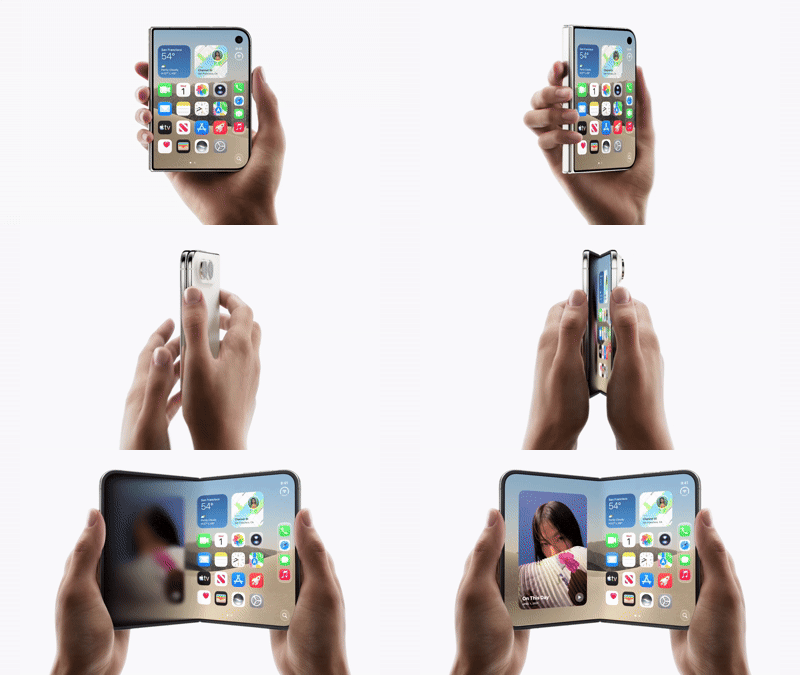
Apple is pivoting its mobile hardware strategy by entering the foldable market with the iPhone Duo, a device designed to bridge the gap between compact smartphones and large-format tablets. This move marks the company's first foray into foldable architecture, attempting to solve the durability and usability challenges that have historically hindered the category. The iPhone Duo features a dual-display system, utilizing a 5.4-inch outer Super Retina XDR display when closed and expanding to a 7.6-inch inner display when opened. By integrating the new A20 Pro chip and a specialized thermal management system, Apple is positioning the Duo not merely as a novelty, but as a high-performance productivity tool. This launch signals a significant shift in Apple's device ecosystem, testing whether a foldable form factor can maintain the brand's premium positioning while meeting the demands of multitasking and intensive AI workloads.
iPhone Duo Display and Hinge Engineering
The iPhone Duo's architecture centers on a precision hinge composed of more than 100 components, which Apple claims provides a smooth opening and closing mechanism while supporting the center of the display. To address the visual imperfections common in foldable devices, the 7.6-inch inner display utilizes a nano-texture finish designed to minimize glare and reduce crease visibility. This inner panel is protected by a custom polymer cover layer that Apple states possesses up to 40 percent higher stiffness than other industry materials. The device also incorporates high-strength glass and custom adhesives that allow internal layers to glide past one another to relieve bend stress.
On the exterior, the 5.4-inch display provides 90 percent of the screen area found on the iPhone 18 Pro, maintaining a compact footprint for one-handed use. Both displays are engineered with ProMotion, Always On capabilities, and a peak outdoor brightness of 3000 nits. Apple is also planning to extend the device's utility through upcoming support for Apple Pencil with USB-C, allowing for sketching and document markup on either screen. To maintain structural integrity, the enclosure is crafted from grade 5 titanium and includes internal support ribs and antenna splits reinforced with ceramic fiber inserts. This hardware configuration aims to provide a rigid frame capable of protecting the sensitive folding mechanism from daily wear.
A20 Pro Silicon and AI Integration
Underpinning the foldable design is the A20 Pro chip, built on a 2-nanometer process. This silicon is paired with a custom-designed vapor chamber and a dual-battery architecture to manage the thermal demands of a larger, more complex device. Apple reports that this configuration delivers up to 35 percent better sustained performance compared to the iPhone 17 Pro. The chip includes a 6-core CPU that is up to 20 percent faster than the A19 Pro and a 7-core GPU that is up to 40 percent faster and more power-efficient. Furthermore, a dual 16-core Neural Engine provides 2x the compute power required to run on-device AI models.
The device is a primary vehicle for the new Siri AI, which is being rolled out in beta with iOS 27. This version of Siri is designed to leverage personal context from messages, emails, and photos to assist users. The integration of Apple Intelligence allows for advanced computational tasks, such as "Smart Take," where on-device AI models analyze scenes in real time to automatically capture photos when subjects are posing. Additionally, the hardware supports a new "Siri Camera mode," enabling the AI to see what the user sees to answer questions. To support these intensive AI and multitasking workloads, the A20 Pro delivers 50 percent more unified memory bandwidth than previous iterations.
Key Takeaways
- The iPhone Duo features a 7.6-inch inner display and a 5.4-inch outer display, both utilizing Super Retina XDR technology.
- Hardware is powered by the 2-nanometer A20 Pro chip, which includes a dual 16-core Neural Engine for enhanced AI processing.
- The device starts at a retail price of $1,999 (U.S.) and is available in star white and night sky colors.
TechInsyte's Take
In our view, the iPhone Duo represents Apple's calculated attempt to reclaim the narrative in the foldable segment by focusing on structural rigidity and silicon-driven intelligence rather than just screen real estate. By utilizing grade 5 titanium and a 100-component hinge, Apple is signaling to the enterprise market that this is a durable tool rather than a fragile experiment. The decision to pair the device with the A20 Pro and a specialized vapor chamber suggests that Apple recognizes the high thermal overhead required to run large-scale AI models and multitasking workflows on a folding chassis.
This launch also highlights a strategic move toward "intelligent" hardware; the inclusion of features like Smart Take and Siri's onscreen awareness suggests that the foldable form factor is being used as a canvas for advanced AI interaction. While the $1,999 entry price is high, the integration of professional-grade specs—such as 3000 nits brightness and 2-nanometer silicon—positions the Duo as a premium workstation for mobile professionals. We believe the success of this device will depend on how effectively third-party developers utilize the new APIs to move beyond simple scaling and into true multi-app productivity.
Questions & Answers
How does the iPhone Duo manage thermal loads during intensive multitasking?
The device utilizes an advanced thermal management system that includes a custom-designed vapor chamber. This system is specifically paired with the A20 Pro chip to dissipate heat, supporting sustained performance for gaming and complex AI workloads.
What specific hardware improvements were made to increase the durability of the folding screen?
Apple implemented a nano-textured cover layer made from a custom polymer with up to 40 percent higher stiffness than industry standards. Additionally, the device uses custom adhesives that allow layers to glide past each other to relieve bend stress, supported by a titanium plate at the bottom.
What are the battery performance expectations for the dual-display setup?
The iPhone Duo uses a dual-battery architecture. Depending on usage, users can expect up to 31 hours of video playback on the inner display, up to 44 hours on the outer display, or up to 24 hours of usage if both displays are used equally.
How does the new Siri AI integrate with the iPhone Duo's hardware?
Siri AI, powered by Apple Intelligence, utilizes the A20 Pro's Neural Engine to process personal context from a user's data. It also leverages "onscreen awareness" to take actions based on what is currently displayed on the device's large inner or outer screens.
Source: Businesswire