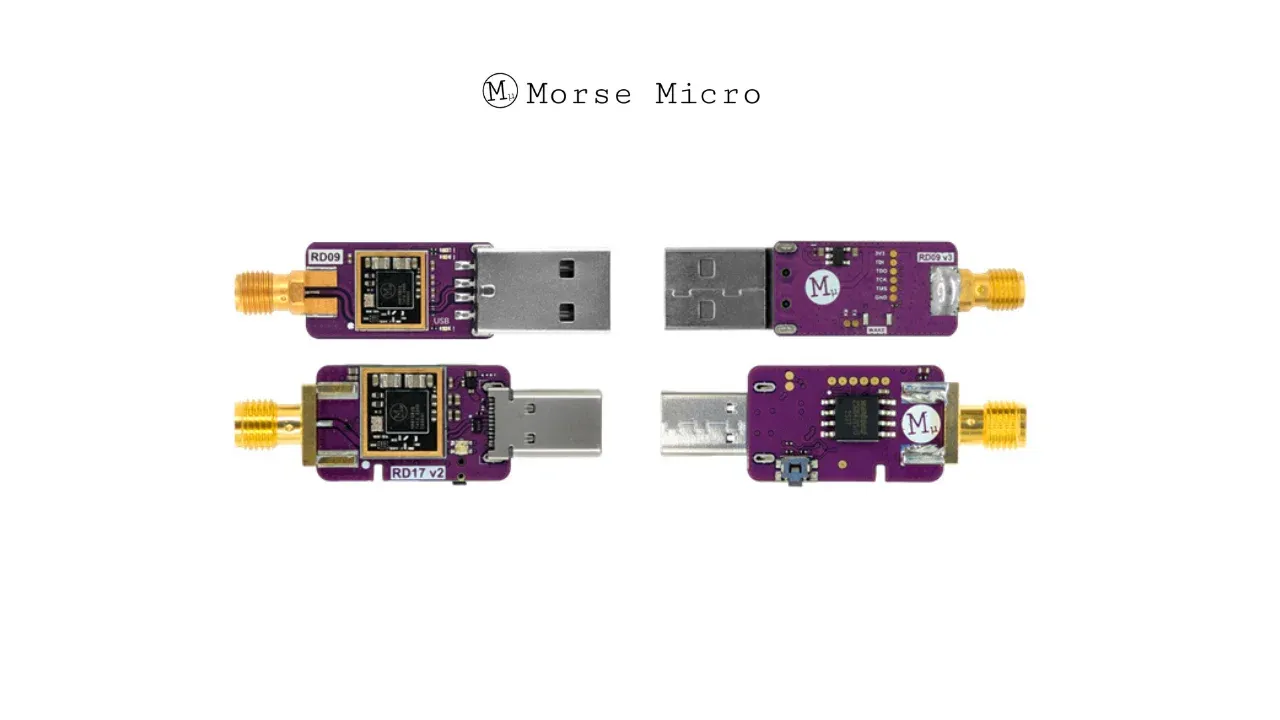
Morse Micro is attempting to bypass the hardware replacement cycle by introducing two USB dongle reference designs aimed at retrofitting existing infrastructure with long-range connectivity. By utilizing the MM8108 SoC, the Sydney-based semiconductor company intends to provide Wi-Fi HaLow capabilities to legacy devices via standard USB ports. This move targets the expansion of IoT networks to ranges of up to one kilometer, potentially simplifying the deployment of wide-area wireless connectivity for enterprise and industrial users.
MM8108-RD09 and RD17 Connectivity Strategies
The company has released two distinct reference designs to address different integration requirements. The MM8108-RD09 is positioned for access points and station products, utilizing OpenWRT drivers for routers and native Windows, Linux, and MacOS drivers for client devices. This design allows users to connect to HaLow networks similarly to traditional Wi-Fi. Conversely, the MM8108-RD17 targets a broader range of client products, such as industrial computers, robotics, and mobile devices running Android or iOS. This specific design avoids the need for host-side driver installations by appearing as a standard CDC-NCM Ethernet interface. This distinction allows for immediate connectivity on devices where software updates or driver deployments might be restricted or technically unfeasible in complex industrial environments.
Expanding Reach via MM8108 SoC Integration
Morse Micro is leveraging its MM8108 SoC to enable native IP connectivity across significantly larger footprints than traditional Wi-Fi. The company claims its technology can provide ten times the range and cover 100 times the area of standard Wi-Fi networks. By offering these USB-based designs, Morse Micro is targeting Internet Service Providers (ISPs) looking to upgrade existing wireless routers and enterprises needing to connect tablets or point-of-sale terminals across large properties. The RD17 design further supports security through Wi-Fi Easy Connect (DPP) authentication via a pairing button. These reference designs, including schematics and software, are currently available to tier-1 customers through Morse Micro sales channels.
Key Takeaways
- Morse Micro introduced two USB dongle reference designs, MM8108-RD09 and MM8108-RD17, based on the MM8108 SoC.
- The MM8108-RD17 design functions as a standard CDC-NCM Ethernet interface, eliminating the requirement for host-side driver installations.
- Wi-Fi HaLow technology is designed to provide native IP connectivity at ranges reaching up to one kilometer.
TechInsyte's Take
In our view, Morse Micro is executing a pragmatic market-entry strategy by focusing on interoperability rather than forcing a total hardware overhaul. By utilizing the USB interface and the CDC-NCM Ethernet standard, they are lowering the barrier to entry for industrial IoT adoption. This approach suggests that the company recognizes the friction inherent in updating legacy firmware or driver stacks in enterprise environments. If successful, these dongles could serve as a low-cost bridge for extending the lifecycle of existing networking hardware into the long-range HaLow ecosystem.
Questions & Answers
How does the MM8108-RD17 design simplify deployment for mobile and industrial devices?
The MM8108-RD17 appears as a standard CDC-NCM Ethernet interface to the host, which means devices like Android/iOS phones or industrial robots can achieve connectivity without requiring specific driver installations.
What is the primary strategic advantage of the MM8108-RD09 design for ISPs?
The MM8108-RD09 enables Internet Service Providers to upgrade existing wireless routers to provide kilometer-range Wi-Fi connectivity to customers by utilizing OpenWRT drivers and existing USB interfaces.
What specific range and coverage improvements does Morse Micro claim for HaLow?
The company states that Wi-Fi HaLow can achieve ten times the range of traditional Wi-Fi and cover 100 times the area, with specific connectivity reaching up to one kilometer.
How is device authentication handled on the new reference designs?
Devices can be authenticated using Wi-Fi Easy Connect (DPP) through the use of a pairing button.
Source: Businesswire