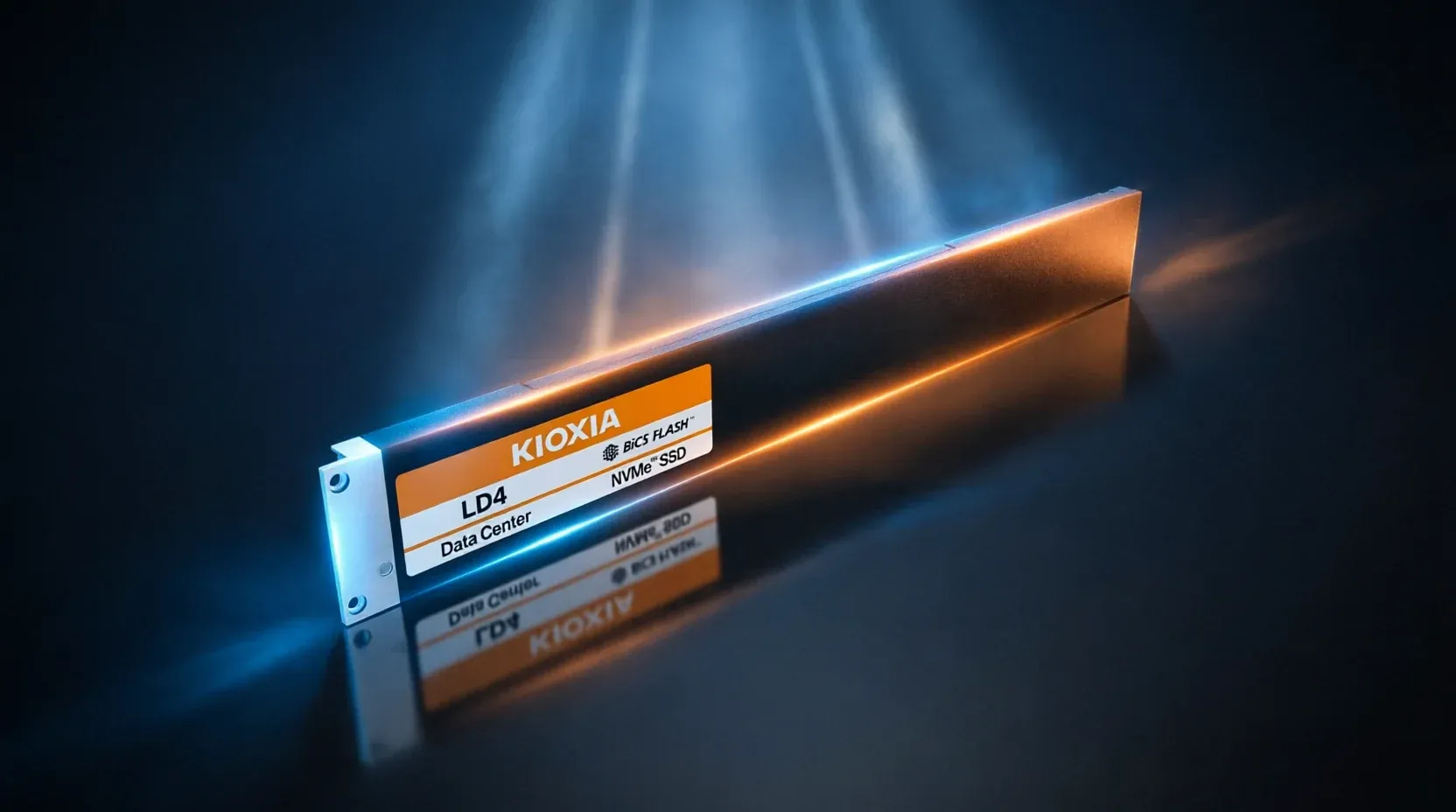
KIOXIA America is attempting to address the escalating storage density requirements of hyperscale data centers by introducing its first E1.L form factor SSD. The KIOXIA LD4 Series utilizes BiCS FLASH generation 8 QLC flash memory to target read-intensive workloads. This move specifically aims to support the massive data storage demands inherent in modern AI-driven environments and scale-out architectures.
LD4 Series E1.L Form Factor Deployment
The KIOXIA LD4 Series is engineered for high-density 1U servers, providing a specialized solution for hyperscale and data center-class scale-out environments. By adopting the E1.L form factor, KIOXIA is positioning these drives to maximize capacity within constrained physical server footprints. The series is currently in the sampling phase with select customers, with a planned showcase at the 2026 OCP Global Summit in San Jose. This rollout suggests a strategic focus on capturing market share in the rapidly expanding read-intensive storage segment, where high-capacity QLC flash is increasingly utilized to manage the vast data volumes generated by generative AI and other data-intensive workloads.
BiCS FLASH Gen 8 and NVMe Specifications
Technically, the LD4 Series leverages KIOXIA BiCS FLASH generation 8 QLC flash memory to achieve its density goals. The drives are compliant with the NVMe 2.0e specification and support the OCP Datacenter NVMe SSD Specification 2.6. Connectivity is handled via a PCIe 5.0 (Gen 4 x4) interface, utilizing a single-port design optimized for hyperscale server architectures. Regarding capacity, KIOXIA is currently offering the series at 15.36 TB and 30.72 TB points. However, the company has noted a validated architecture that is intended to enable much higher capacities, reaching up to 122.88 TB, as the product line matures to meet evolving enterprise infrastructure needs.
Key Takeaways
- The LD4 Series utilizes KIOXIA BiCS FLASH generation 8 QLC flash memory.
- Available capacity points include 15.36 TB and 30.72 TB, with a roadmap to 122.88 TB.
- The drives comply with NVMe 2.0e and OCP Datacenter NVMe SSD Specification 2.6.
TechInsyte's Take
In our view, KIOXIA’s pivot toward the E1.L form factor signals an aggressive attempt to dominate the high-density 1U server market. By pairing Gen 8 QLC flash with a roadmap targeting 122.88 TB, the company is directly addressing the "density vs. power" dilemma facing hyperscalers. This isn't just about more storage; it is about maximizing the data-per-rack-unit metric. If KIOXIA successfully scales these capacities, they will provide a critical hardware lever for operators trying to sustain AI workload growth without expanding physical data center footprints.
Questions & Answers
How does the LD4 Series address the specific needs of AI workloads?
The series utilizes QLC flash memory, which KIOXIA identifies as compelling for read-intensive applications. This architecture is designed to support the high capacity and high read performance required by the massive data storage demands of modern AI workloads.
What are the immediate and long-term capacity capabilities of this series?
KIOXIA is currently offering the LD4 Series in 15.36 TB and 30.72 TB capacities. The company has stated that its validated architecture enables future capacities to reach up to 122.88 TB.
Which industry standards does the KIOXIA LD4 Series follow?
The drives are compliant with the NVMe 2.0e specification and support the OCP Datacenter NVMe SSD Specification 2.6, ensuring compatibility with modern hyperscale and data center-class server environments.
What is the intended physical deployment environment for these SSDs?
The LD4 Series is specifically designed for high-density 1U servers and scale-out environments, utilizing the E1.L form factor to optimize storage density in hyperscale data centers.
Source: KIOXIA