
Infleqtion, Inc. (NYSE: INFQ) has announced record second-quarter 2026 financial results, reporting $12.6 million in revenue, representing a 116% increase year over year. This growth was entirely organic and derived solely from its quantum computing and sensing business segments. Following these results, the company raised its full-year 2026 revenue outlook to approximately $43 million. The announcement highlights a significant acceleration in quantum commercialization, supported by substantial government interest and expanding enterprise applications. As the company scales its neutral-atom technology, it remains focused on achieving 30 logical qubits by the end of 2026 while maintaining a strong balance sheet with $582 million in cash and no debt.
Infleqtion Q2 2026 Financial Performance and Government Funding
The company's Q2 2026 revenue of $12.6 million marks a significant milestone in its commercialization trajectory. While the GAAP operating loss increased to $30.6 million from $10.1 million in Q2 2025—driven by higher operating expenses and stock-based compensation—the company maintains a robust liquidity position. Infleqtion ended the quarter with $582 million in cash, cash equivalents, restricted cash, and available-for-sale securities, carrying no debt. Notably, the reported operating cash flow of $13.2 million included a $27.4 million temporary working-capital benefit from payroll taxes collected but not yet remitted on stock-option exercises; excluding this, the operating cash burn was approximately $14 million.
A critical driver for future growth is a Letter of Intent (LOI) from the U.S. Department of Commerce. This LOI provides for up to $100 million in proposed funding intended to advance commercialization following a technical review of Infleqtion’s technology and roadmap. The agreement also contemplates the U.S. Department of Commerce receiving Infleqtion common stock, though final funding remains subject to definitive agreements and government approvals. This government validation is paired with the selection of Infleqtion for three Department of Energy (DOE) Genesis Mission projects, which cover critical areas including nuclear applications, quantum sensing, and fusion research.
Scaling Neutral-Atom Quantum Computing and Sensing Applications
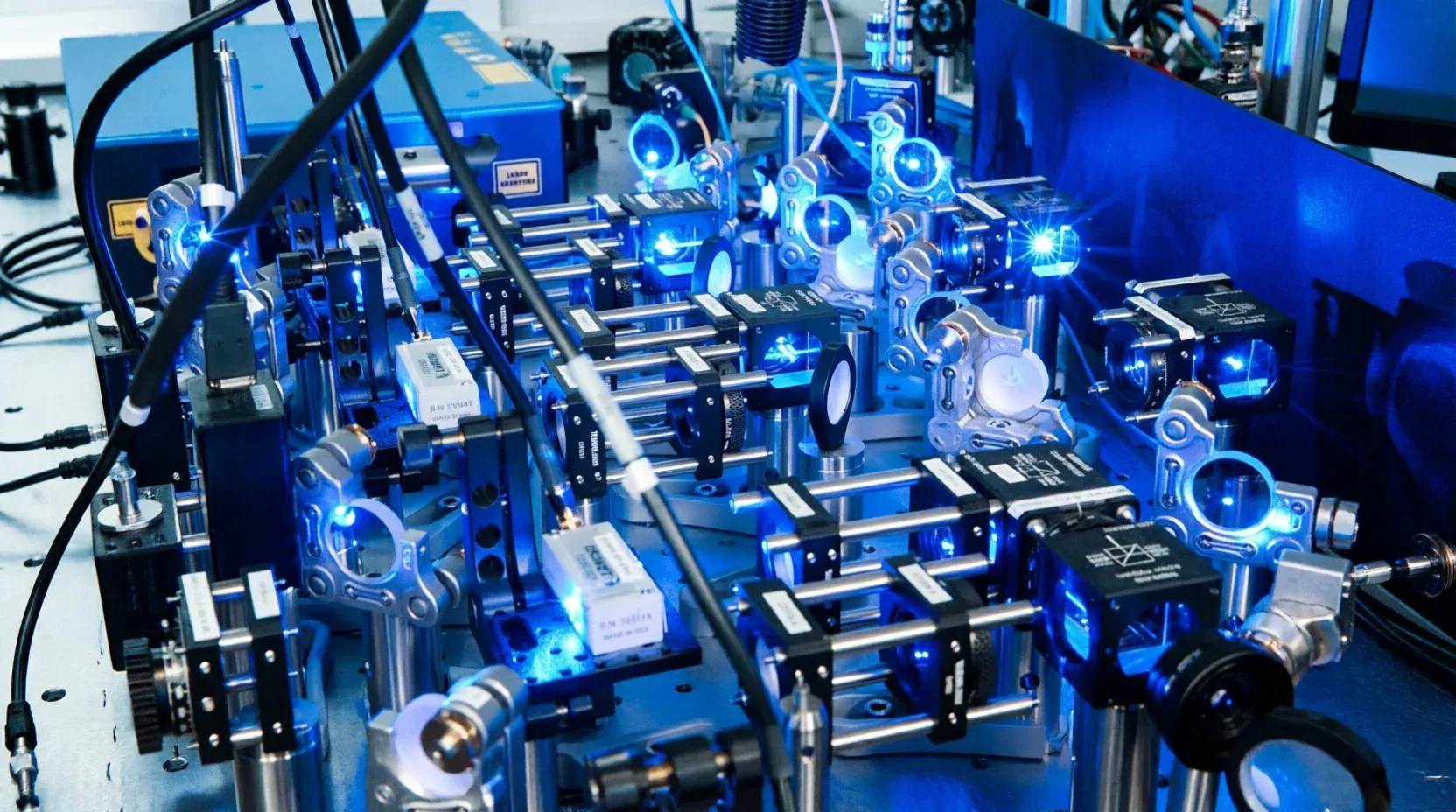
Infleqtion is actively transitioning from theoretical research to utility-scale quantum applications. The company is currently on track to reach 30 logical qubits in 2026, having already defined logical qubit circuits for specific customer workloads in the finance, energy, and precision medicine sectors. Looking toward 2027, Infleqtion is under contract to deploy a neutral-atom quantum computer at the Illinois Quantum & Microelectronics Park. This system utilizes a new architecture designed for modularity, allowing it to scale from its initial deployment to more than 50 logical qubits, with a long-term goal of reaching 100 logical qubits.
In the commercial sector, the company is seeing adoption in specialized industrial workflows. Eaton is currently utilizing private-cloud access to the Sqale platform to explore quantum computing applications for complex energy problems. Additionally, the quantum sensing division saw significant revenue drivers from NASA’s Quantum Gravity Gradiometer program. The company also continues to market its third-generation Tiqker optical atomic clock systems through a global co-selling partnership with Safran. These developments suggest a multi-pronged approach to revenue generation, spanning high-performance computing, precision sensing, and cloud-based quantum access for industrial enterprises.
Key Takeaways
- Infleqtion reported Q2 2026 revenue of $12.6 million, a 116% year-over-year increase driven entirely by organic quantum business.
- The U.S. Department of Commerce has issued a Letter of Intent for up to $100 million in proposed funding to support commercialization efforts.
- The company aims to achieve 30 logical qubits in 2026 and plans to deploy a modular quantum computer in Illinois by 2027.
TechInsyte's Take
In our view, Infleqtion’s Q2 results signal a pivotal shift from the "research phase" to the "execution phase" of the quantum industry. The fact that 100% of their 116% revenue growth is organic and derived from quantum technology is a powerful indicator of market pull rather than mere subsidized experimentation. While the widening GAAP operating loss reflects the heavy capital requirements of scaling hardware, the $582 million cash position provides a substantial runway to navigate this intensive investment period. The proposed $100 million from the Department of Commerce is particularly strategic; it serves as a high-level technical validation that could lower the perceived risk for other enterprise buyers. As Infleqtion moves toward its 2027 Illinois deployment, the focus for decision-makers should shift from watching qubit counts to monitoring the successful integration of their modular architecture into industrial workloads like energy and finance.
Questions & Answers
How does Infleqtion's current liquidity position impact its ability to scale quantum hardware?
With $582 million in cash and no debt, Infleqtion is well-positioned to fund the high R&D and capital expenditures required for its 2026 and 2027 milestones. This liquidity allows the company to absorb the current operating losses as it builds toward the 30-qubit target and the Illinois quantum computer deployment without immediate reliance on external debt.
What role does government involvement play in Infleqtion's commercialization strategy?
Government involvement acts as both a funding mechanism and a technical validator. The $100 million proposed via the Department of Commerce LOI and the selection for three DOE Genesis Mission projects provide the capital necessary for commercialization while simultaneously providing a "seal of approval" that can influence broader enterprise and sovereign adoption.
How is Infleqtion targeting specific industrial sectors for quantum utility?
The company is moving beyond general-purpose computing by defining logical qubit circuits tailored for finance, energy, and precision medicine. Practical examples include Eaton's use of the Sqale platform for energy applications and the execution of NASA’s Quantum Gravity Gradiometer program, demonstrating a focus on solving specific, high-value industrial problems.
What is the significance of the modular architecture planned for the 2027 Illinois deployment?
The modular architecture is designed to solve the scalability challenge inherent in quantum computing. By allowing for upgrades from the initial deployment to more than 50 logical qubits, and eventually toward a 100-qubit goal, Infleqtion is building a roadmap that allows customers to scale their quantum capabilities incrementally as the technology matures.
Source: INFLEQTION