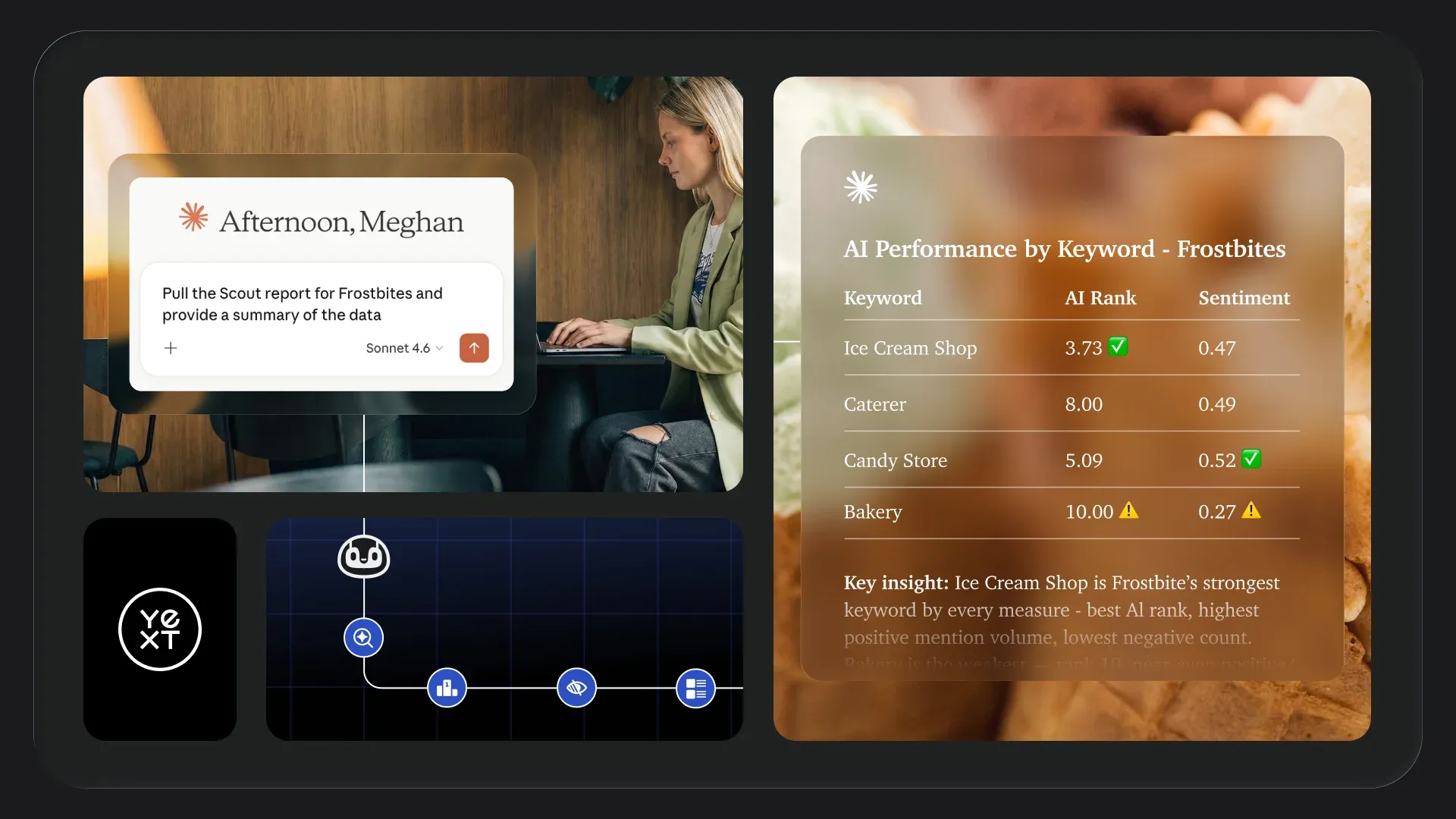
Yext Inc. (NYSE: YEXT) announced the availability of Scout MCP and Scout API, two new access points to its Scout visibility‑intelligence platform. The offering opens Yext’s data layer—built on more than 10 billion monthly signals from over 12 million business locations—to the global partner ecosystem, including local digital‑marketing agencies that need granular competitive insights for their clients.
Why the Timing Matters
The U.S. Chamber of Commerce’s 2025 “Empowering Small Business” report shows that 58 % of small businesses now use generative AI, more than double the adoption rate recorded in 2023. As AI tools automate content creation and publishing, agencies that rely solely on manual execution risk losing relevance. The report underscores a shift toward data‑driven advisory services: firms that can surface insights unavailable to the end‑user will retain strategic value. Yext positions Scout as that differentiated data source, promising “visibility and competitive intelligence … that would have been impossible to assemble five years ago,” according to Christian Ward, Yext’s Chief Data Officer.
What Scout Provides to Partners
Scout aggregates and analyzes a breadth of signals across four AI models, delivering 150 visibility metrics for each of up to 20 competitors in a single scan. The platform’s capabilities are organized into four functional areas:
- Competitive intelligence and prospecting – Real‑time dashboards show where a client is losing ground to rivals in AI‑augmented and traditional local search.
- AI citation and model analysis – Brands can see which AI models reference them, the frequency, sentiment, and thematic context, benchmarked against competitors.
- SEO and AI‑search performance – Visibility is tracked across both conventional search results and emerging AI‑driven search surfaces.
- Prioritized action recommendations – A 90‑day growth plan highlights high‑impact fixes and paid‑media guidance for prospect meetings and upsell opportunities.
Partners can consume these insights through three channels:
- Scout UI – A ready‑made interface for immediate use.
- Scout MCP (Managed Conversational Platform) – A no‑code, conversational access point that integrates with existing agency workflows.
- Scout API – A fully customizable, white‑labeled endpoint for building bespoke products.
All three pathways draw from the same underlying dataset, ensuring consistency across partner experiences.
Integration, Security, and Operational Implications
For enterprise technology leaders, the launch raises several practical considerations:
- Infrastructure reliance – By building on Yext’s managed platform, partners inherit continuous data‑pipeline improvements without maintaining separate ingestion or storage layers. This reduces operational overhead but also creates a dependency on Yext’s roadmap and service‑level commitments.
- API governance – The Scout API will require standard API‑security controls (OAuth, rate limiting, audit logging) to protect both Yext’s data assets and client confidentiality. CIOs should assess compatibility with existing API‑management solutions.
- Data compliance – The visibility dataset includes brand mentions and sentiment analysis, potentially subject to privacy regulations (e.g., GDPR, CCPA) when combined with personally identifiable information. Partners must implement appropriate data‑processing agreements and ensure that downstream applications respect regional compliance rules.
- Workflow integration – The conversational MCP can be embedded in agency CRM or proposal tools, enabling sales teams to surface live visibility scores during client calls. This aligns with the trend toward “AI‑augmented selling” where data informs real‑time recommendations.
- Vendor positioning – Yext’s move positions the company as a “data layer” rather than a pure SaaS front‑end. For CTOs evaluating technology stacks, Scout offers a plug‑and‑play intelligence component that can complement existing SEO, analytics, or marketing‑automation platforms.
Market Context and Competitive Landscape
Scout’s dataset size—10 billion signals monthly and coverage of 12 million locations—places it among the most extensive local‑business intelligence sources publicly disclosed. Competitors in the local‑search intelligence space typically rely on smaller crawls or third‑party aggregators, which can limit granularity. Brock Berry, CEO & Co‑Founder of AdCellerant, highlighted the “depth of visibility into AI models, search performance, and competitor analysis” as a differentiator that could enable new client experiences not feasible a few years ago.
While Yext’s announcement does not claim market leadership, the combination of a managed conversational interface (MCP) and a fully customizable API is relatively rare. Agencies that can quickly prototype white‑labeled solutions may gain a time‑to‑market advantage, especially as AI‑driven search continues to evolve.
Key Takeaways
- Scout processes roughly 10 billion monthly signals, delivering 150 visibility metrics for each of up to 20 competitors per scan.
- The platform is now accessible via a no‑code MCP, a ready‑made UI, and a fully customizable API, all powered by the same dataset.
- Partners inherit Yext’s ongoing infrastructure updates, reducing the need for independent data‑pipeline maintenance but creating reliance on Yext’s service roadmap.
- Security and compliance responsibilities remain with the partner; proper API governance and data‑privacy safeguards are essential.
- Early access to Scout MCP and API begins immediately, with interested partners directed to yext.com.
TechInsyte's Take
Yext’s Scout MCP and API extend a substantial visibility‑intelligence dataset to the partner ecosystem, offering a concrete data advantage for local‑marketing agencies navigating an AI‑centric market. For technology decision‑makers, the offering promises reduced operational burden, rapid integration options, and a foundation for building differentiated, data‑driven client services. Success will depend on how well partners embed the intelligence into existing workflows, manage security and compliance, and align Yext’s roadmap with their own product strategies.
Source: Businesswire