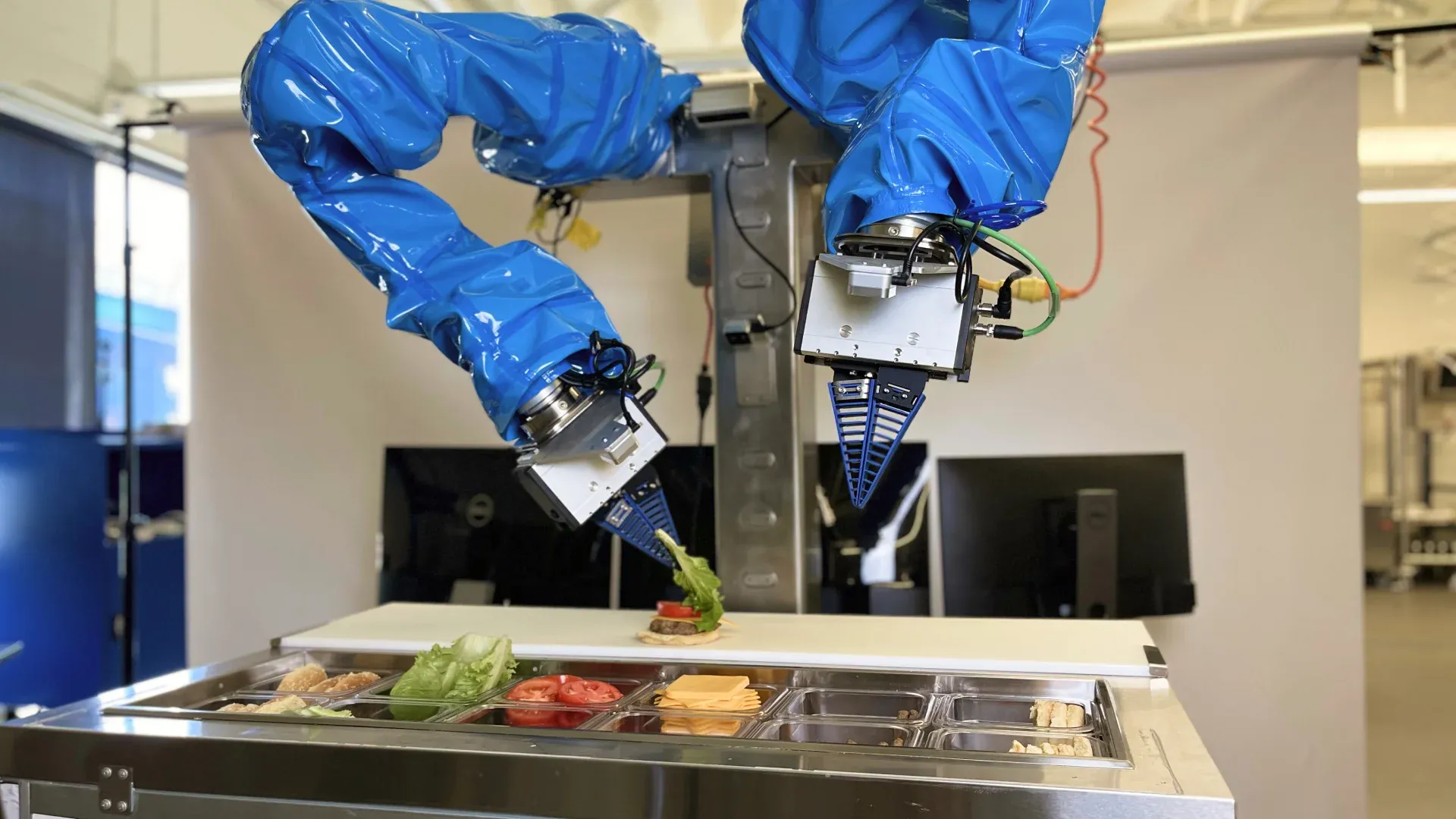
Chef Robotics announced a new bi‑manual physical AI system designed for lower‑volume, higher‑complexity food‑prep tasks such as burger or burrito assembly. The solution expands the company’s existing high‑throughput conveyor‑line robots into environments that rely on manual prep tables—ghost kitchens, fast‑casual restaurants, airline catering, schools, hospitals, military messes, prisons, stadiums, corporate dining, and hotels.
System Overview and Core Technology
The system employs two robotic arms that provide coordinated, dexterous manipulation comparable to human hands. End effectors are engineered to handle a variety of food ingredients and utensils while meeting food‑safety standards for wash‑down, temperature, and humidity. Chef describes the hardware as proprietary to the food industry and “collaborative,” meaning it can operate safely alongside human workers.
Underlying the hardware is Chef’s Food Foundation Model (FFM), a single foundation‑level AI model that combines vision, language, and action capabilities. Unlike off‑the‑shelf vision‑language‑action (VLA) models that focus on rigid‑body manipulation, the FFM is trained on deformable, wet, and sticky food items. It learns tasks through imitation learning—observing human demonstrations of specific assemblies—and can generalize across different robotic platforms by abstracting task representations. Chef claims the model supports “zero‑shot or few‑shot ingredient onboarding” and will self‑improve to increase yield and consistency over time.
Enterprise Implications: Workflow and Integration
For operators that already use Chef’s Robotics‑as‑a‑Service (RaaS) offering on high‑volume lines, the bi‑manual system introduces a new automation layer for back‑of‑house stations that traditionally require skilled labor. The shift from a single‑arm, conveyor‑based robot to a dual‑arm, tabletop robot changes the workflow in several ways:
- Task Consolidation – One robot can assemble an entire meal rather than passing components between stations, potentially reducing labor hand‑offs and associated error rates.
- Space Utilization – The tabletop footprint is smaller than a conveyor line, allowing deployment in existing kitchen layouts without major structural modifications.
- Skill Transfer – Because the FFM is language‑prompted, kitchen managers can reconfigure recipes or add new items through simple textual commands rather than extensive re‑programming.
From an integration perspective, the system must connect to existing kitchen management systems (KMS), point‑of‑sale (POS) data feeds, and inventory controls. Chef’s AI platform, ChefOS, provides APIs for these connections, but enterprises will need to evaluate data latency, network security, and compliance with food‑service regulations (e.g., HACCP). The collaborative design reduces the need for safety cages, but organizations should still conduct risk assessments for human‑robot interaction in high‑traffic prep areas.
Operational Efficiency and ROI Considerations
Automation of prep‑table assembly promises several efficiency gains:
| Potential Benefit | Typical Impact |
|---|---|
| Labor cost reduction | 10‑30 % lower hourly labor for repetitive assembly tasks |
| Consistency & yield | 2‑5 % increase in portion accuracy, reducing waste |
| Throughput scaling | Ability to add new menu items without proportional staffing increases |
However, ROI calculations must account for capital expenditures on proprietary hardware, ongoing model‑training services, and maintenance contracts. Chef’s RaaS model spreads hardware costs over a subscription, but enterprises should verify service‑level agreements (SLAs) for uptime, model updates, and support response times. The claim that the FFM “learns faster and adapts to a wider range of use cases than traditional robotic systems” is a company assertion; buyers should request benchmark data against baseline manual performance and any existing single‑arm robots.
Decision‑Maker Checklist
- Security & Data Governance – Verify encryption of video streams and command APIs, especially if the system ingests proprietary recipes.
- Scalability – Assess whether the FFM can support the full menu breadth across multiple locations without degradation.
- Vendor Lock‑In – Determine the portability of trained task models if the organization later adopts alternative hardware.
- Regulatory Compliance – Ensure the hardware meets local food‑safety certifications and can be validated under existing sanitation protocols.
- Change Management – Plan for staff training on collaborative robot safety and on using language‑prompted task configuration.
Key Takeaways
- Chef Robotics’ new bi‑manual system extends physical AI from high‑throughput conveyor lines to prep‑table environments, targeting sectors such as ghost kitchens and institutional catering.
- The Food Foundation Model (FFM) consolidates vision, language, and manipulation into a single model trained on deformable food items, enabling imitation‑learning based task creation and potential zero‑shot ingredient onboarding.
- Enterprises can expect workflow consolidation, space‑efficient deployment, and measurable gains in labor cost and consistency, but must evaluate subscription terms, security, and compliance before adoption.
TechInsyte's Take
Chef Robotics’ bi‑manual physical AI system represents a logical next step for food‑service operators seeking to automate complex, low‑volume assembly tasks. By combining dual‑arm hardware with a foundation‑level AI model, the company aims to reduce reliance on manual labor while maintaining flexibility for menu changes. For CIOs, CTOs, and operations leaders, the technology offers a measurable path to efficiency, provided that integration, security, and ROI analyses are rigorously performed. As the system matures, its ability to onboard new ingredients with minimal training could further lower the barrier for broader automation across diverse food‑service venues.
Source: Businesswire