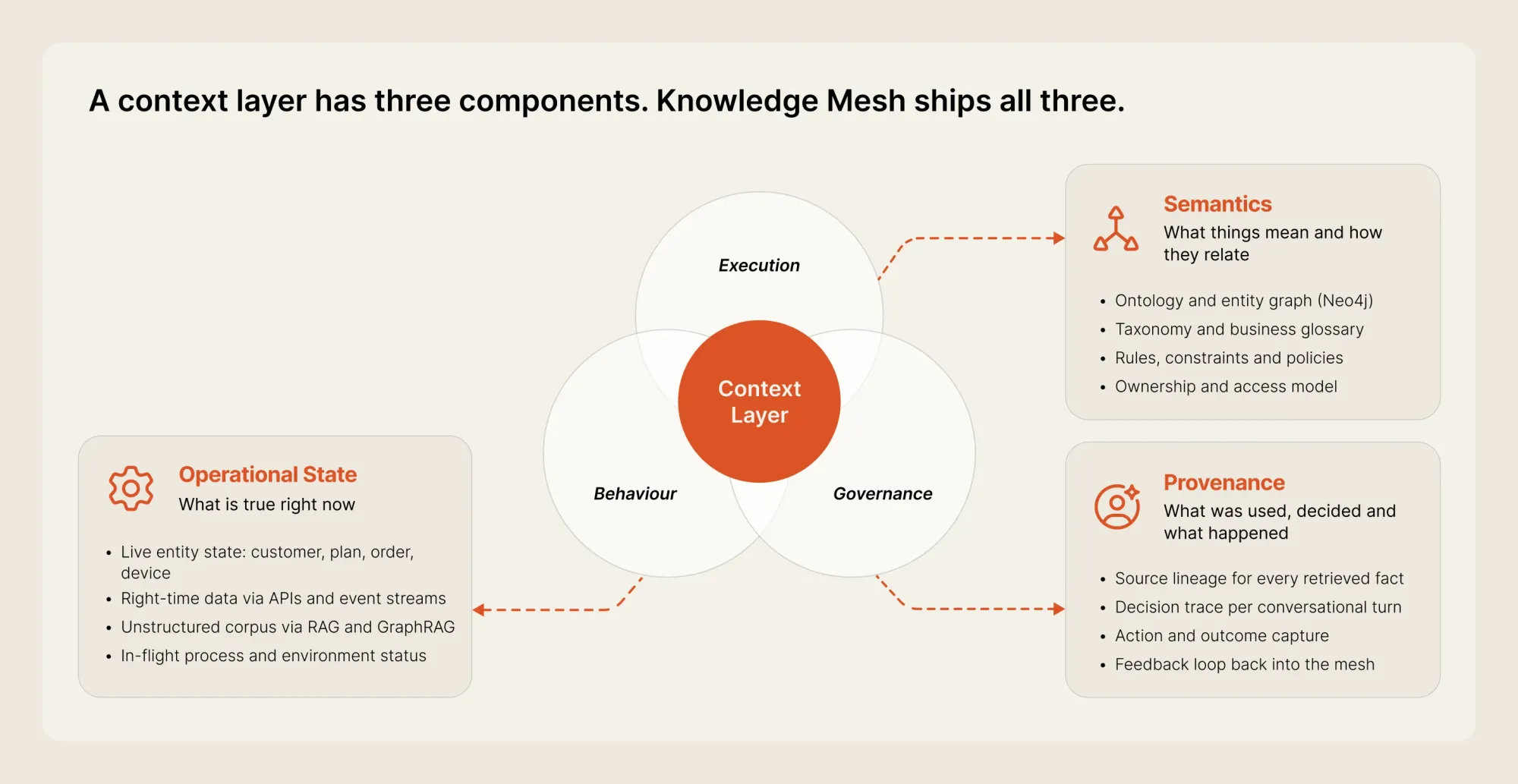
The escalating cost of reasoning at runtime is threatening to derail the enterprise adoption of agentic AI, as organizations struggle to balance model accuracy with unsustainable token consumption. Voicing AI has announced the general availability of Knowledge Mesh, a governed context layer designed to resolve semantics, state, and provenance at index time rather than during inference. This architectural shift aims to address a critical failure point identified by Gartner, which forecasts that more than 40% of agentic AI projects will be cancelled by the end of 2027 due to escalating costs, unclear business value, and inadequate risk controls. By moving the heavy lifting of data relationship resolution and permission scoping from the model to the infrastructure layer, Voicing AI is positioning its technology to stabilize the unit economics of AI agents in production environments, specifically within the highly regulated financial services and telecommunications sectors.
Resolving the Context Failure in Agentic AI
The primary driver behind the launch of Knowledge Mesh is the recognition that AI failures are often not failures of the underlying large language models, but failures of the context provided to them. When agents receive incomplete, disorganized, or incorrect information, their performance degrades and reliability vanishes. Voicing AI is targeting a market for AI context platforms that is projected to grow from approximately $28 billion in 2026 to $78 billion by 2030. The company argues that as enterprises move from single-use case pilots to complex multi-agent systems, the lack of a centralized, governed semantic layer leads to "context poisoning," "context confusion," "context rot," and "context clash."
In current deployment models, agents often attempt to resolve complex relationships and permissions at inference time. This requires the model to "reason" through disconnected data points, a process that consumes massive amounts of tokens and drives up costs. Voicing AI co-founder Abhi Kumar describes this as an "architecture cost problem wearing a model cost costume," noting that many projects fail during scaling because organizations realize they are paying the model to perform structural work that should have been resolved during data indexing. Knowledge Mesh attempts to mitigate this by flattening hierarchies, resolving entity aliases, and attaching access permissions directly to content before a query is even made. This allows the agent to perform a single, filtered lookup rather than an expensive, broad reasoning exercise.
Addressing the Token Burn and Integration Gap
The economic viability of agentic AI hinges on reducing the "token burn" associated with complex, multi-intent queries. For example, a banking customer asking about a payment, a fee, and an account status requires an agent to navigate multiple knowledge domains. Without a dedicated context layer, an agent may "fan out," pulling broad datasets and burning tokens to figure out which pieces of information are relevant. Voicing AI claims that organizations prioritizing semantics in their AI-ready data can improve agentic AI accuracy by up to 80% and reduce costs by up to 60% by 2027.
A significant hurdle for the broader context layer market is the integration gap between third-party governance software and off-the-shelf vendor agents. Many enterprise agents are not architected to pull from external context layers, potentially rendering a standalone governance tool ineffective. Voicing AI is attempting to bypass this by building its own voice agents natively against the Knowledge Mesh architecture. This ensures that retrieval, permission scoping, and citation handling are baked into the agent's operation rather than added as a post-hoc integration. Furthermore, the company is making Knowledge Mesh reachable via the Model Context Protocol, which may allow enterprises to point their own custom agents at the same governed source.
Key Takeaways
- Voicing AI has released Knowledge Mesh, a context layer designed to resolve data semantics and permissions at index time to reduce runtime token costs.
- Gartner predicts that over 40% of agentic AI projects will be cancelled by the end of 2027 due to costs, lack of value, and risk control issues.
- The AI context platform market is estimated to reach $78 billion by 2030, shifting from simple retrieval to governed semantic knowledge delivery.
TechInsyte's Take
In our view, Voicing AI is correctly identifying the "scaling wall" that many enterprise AI pilots are currently hitting. The industry has spent much of the last two years obsessing over model capabilities—the "brain"—while largely ignoring the quality and cost of the "nervous system" that delivers data to that brain. The realization that reasoning at runtime is an expensive and error-prone substitute for structured indexing is a vital distinction for CIOs to grasp.
By framing the problem as an architectural cost issue rather than a model limitation, Voicing AI is signaling a shift toward "infrastructure-first" AI. However, the success of Knowledge Mesh will likely depend on the industry's willingness to adopt open protocols like the Model Context Protocol. If enterprises remain locked into proprietary, closed-loop vendor agents that refuse to ingest external context, the market for standalone context layers will remain constrained. Voicing AI’s decision to build both the agent and the layer is a pragmatic move to prove the economics, but the broader enterprise value will only be realized if this "context-first" architecture becomes a standard requirement for all agentic deployments.
Questions & Answers
How does Knowledge Mesh impact the unit economics of deploying AI agents at scale?
Knowledge Mesh reduces costs by resolving data hierarchies, entity aliases, and access permissions at "index time" (when data is ingested) rather than "inference time" (when the agent is answering a question). This prevents the agent from having to use expensive reasoning tokens to connect disconnected data points or re-verify permissions for every single request, which is critical for maintaining budget as call volumes increase.
What specific technical failure modes does this technology aim to prevent?
The technology is designed to mitigate four specific context-related failures: "context poisoning" (where errors are repeatedly referenced), "context confusion" (where too much information overwhelms the model), "context rot" (where quality declines due to accumulated irrelevant input), and "context clash" (where contradictory information derails reasoning).
Why is the integration of context layers a challenge for existing enterprise AI deployments?
Many off-the-shelf vendor agents are not architected to communicate with external context layers. This creates a gap where an enterprise might invest in a sophisticated governance and semantic layer, only to find that their existing AI agents cannot effectively ingest or utilize that structured data, limiting the ROI of the investment.
How does the system ensure the accuracy and provenance of AI-generated answers?
Knowledge Mesh implements "evidence gating," meaning the system checks if retrieved data actually supports an answer before the model attempts to compose it; if it does not, the response stops to prevent hallucinations. Additionally, it provides traceability by tying every claim to a specific source document and recording all retrieval actions in an uneditable log.
Source: EINPresswire