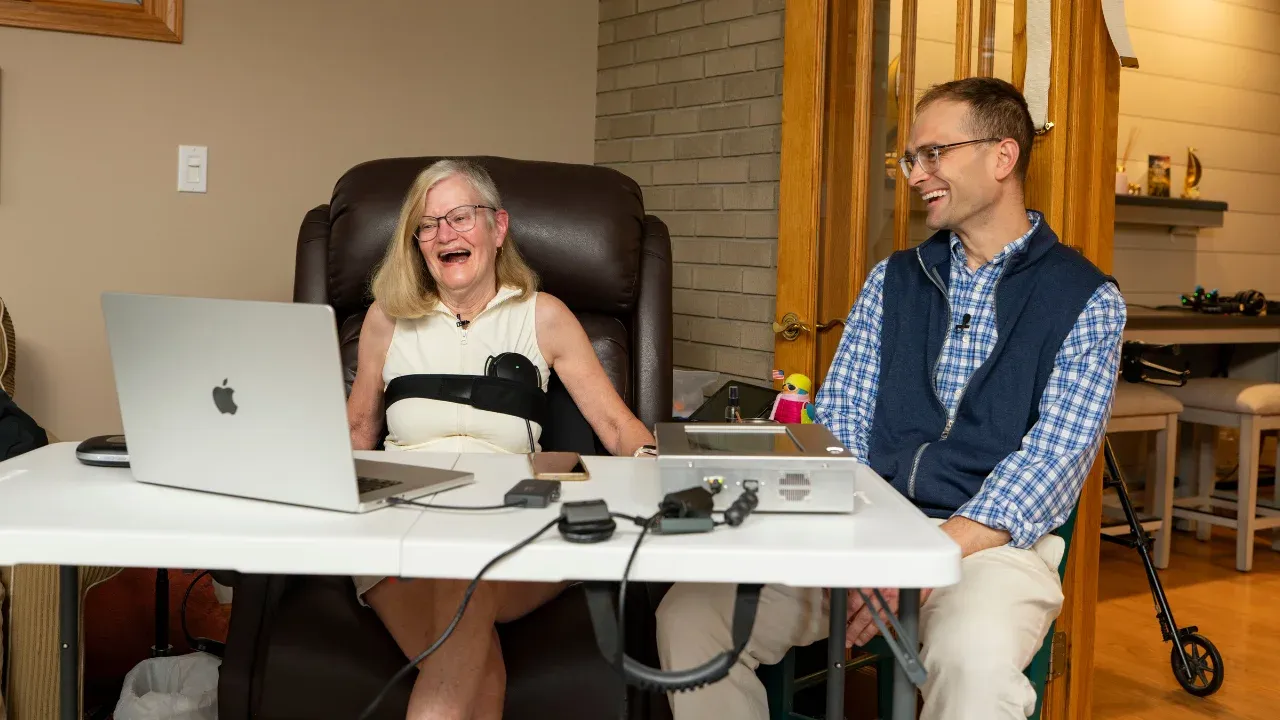
Paradromics is attempting to bridge the gap between human neural intention and digital output by demonstrating real-time, autonomous speech through its fully implanted brain-computer interface. The company announced that the first participant in its Connect-One Early Feasibility Study successfully used the Connexus® BCI to generate original words, answer open-ended questions, and engage in live phone calls with family members. This milestone moves the technology beyond controlled, researcher-led copy tasks into the realm of unscripted, natural communication. By decoding neural activity into text and synthesized speech, the system is positioning itself as a high-data-rate conduit for restoring agency to individuals living with progressive motor neuron diseases, such as amyotrophic lateral sclerosis (ALS) or primary lateral sclerosis (PLS).
Real-Time Speech Milestone in Connect-One Study
The successful demonstration involved a Michigan woman in her 60s suffering from a progressive motor neuron disease that has severely impaired her ability to speak. Unlike previous BCI benchmarks that often rely on participants repeating specific phrases, this participant utilized the Connexus system to choose her own words and respond to spontaneous inquiries. During the session, the participant generated the sentence, “Okay, I have a lot to say,” which the system decoded in real time without errors. She also engaged in a live phone call with her grandchildren, using the BCI to ask questions and receive responses through synthesized speech.
This achievement was conducted under an FDA-approved Investigational Device Exemption (IDE) as part of the Connect-One Early Feasibility Study. The study is being executed across three sites, including University of Michigan Health, UC Davis Health, and the Mass General Brigham Neuroscience Institute. Beyond the immediate communication success, the data collected from this participant has allowed Paradromics to identify distinct neural patterns associated with both "attempted speech"—the physical effort to produce sound—and "imagined speech," where language is generated internally without physical movement. This distinction is critical for developing more robust decoders that can interpret intent even when motor functions are entirely absent.
Connexus BCI Architecture and Neural Decoding
The Connexus BCI is engineered to record neural activity at the resolution of individual neurons, capturing high-fidelity data that is then transmitted wirelessly through intact skin to an external computing system. This high-bandwidth approach is designed to support a wide array of future applications, ranging from advanced prosthetics and sensory feedback to direct interaction with artificial intelligence models. By recording across hundreds of neural channels, the platform aims to map how neural states change as a user listens to language, prepares to speak, or engages in internal rehearsal.
Paradromics is leveraging these longitudinal data sets to study the stability of neural information and how decoders can adapt to the user over time. Chief Scientific Officer Vikash Gilja, PhD, noted that observing the structure of neural activity across populations of individual neurons helps the team build communication tools that are more accurate and natural. The company is specifically investigating how different brain areas handle various types of language information, which may inform future surgical placements for different patient profiles. Ultimately, the company views this high-resolution recording capability as a way to build a sophisticated interface between human intention and AI, potentially allowing users to query and control large-scale models directly through neural commands.
Key Takeaways
- The first participant in the Connect-One Early Feasibility Study successfully used the Connexus BCI for unscripted, real-time speech and text communication.
- Paradromics has identified distinct neural activity patterns for both attempted speech and imagined speech using high-resolution intracortical recordings.
- The Connexus BCI platform is designed to transmit neural data wirelessly through intact skin to external computing systems at the resolution of individual neurons.
TechInsyte's Take
In our view, Paradromics is moving the BCI conversation from "proof of concept" to "functional utility" by prioritizing high-data-rate, unscripted communication. While many BCI projects struggle with the transition from laboratory-controlled tasks to the unpredictability of natural language, the ability of this participant to engage in a live phone call suggests a significant leap in system reliability. This signals that the industry is shifting its focus toward the bandwidth requirements necessary for true human-machine integration. If Paradromics can successfully scale this high-resolution decoding, they are not just building a medical device for paralysis; they are building the foundational hardware for a direct neural link to AI. The strategic importance here lies in the "imagined speech" data, which could eventually bypass motor pathways entirely, offering a level of autonomy that current, lower-resolution interfaces cannot match.
Questions & Answers
How does the Connexus BCI differ from previous speech-based BCI demonstrations?
Unlike many demonstrations that rely on researcher-selected copy tasks, the Connexus BCI has demonstrated the ability to decode unscripted, "free speech." This allows the participant to choose their own words, answer open-ended questions, and engage in spontaneous social interactions, such as live phone calls, rather than simply repeating pre-set phrases.
What technical capability allows the Connexus system to function without physical wires?
The Connexus BCI is designed to record neural activity at the resolution of individual neurons and transmit that high-resolution data wirelessly through intact skin to an external computing system, facilitating a fully implanted solution for long-term human use.
Why is the distinction between "attempted" and "imagined" speech significant for future development?
Identifying distinct patterns for both attempted and imagined speech allows Paradromics to understand how neural information remains stable and how decoders can adapt to a user. This capability is essential for creating more natural communication tools that can function even when a user is internally generating language without the physical attempt to speak.
What is the long-term strategic goal for the Paradromics BCI platform beyond medical restoration?
Beyond restoring communication for those with motor impairments, Paradromics is positioning the platform as a conduit for direct human-AI interaction. The company intends to use its high-data-rate interface to enable users to more effectively query and control AI models and potentially support advanced prosthetics and sensory feedback.
Source: Businesswire