Truffle Security is attempting to solve the critical visibility gap between detecting a leaked credential and understanding its actual blast radius within cloud environments. By launching TruffleHog AWS Analyze as an add-on to its Enterprise platform, the company aims to provide security teams with immediate identity and access context for exposed AWS keys. This move follows research by the company showing that a staggering 88% of verified leaked AWS keys remain active, often for years, despite being exposed in public code or datasets. For enterprise IT leaders, the development addresses the growing complexity of managing secrets in environments where automated, agentic workflows are rapidly increasing the volume of exposed credentials.
Mitigating the Blast Radius of Leaked AWS Keys
The introduction of TruffleHog AWS Analyze targets the high-stakes problem of credential remediation latency. When an AWS credential is leaked, security responders often face a manual, time-consuming process to determine the identity, permissions, and IAM relationships associated with that specific key. Truffle Security is positioning this new tool to automate that investigation by identifying the specific AWS user or role behind a credential and mapping its effective permissions. Crucially, the tool reveals which roles a leaked key can assume to gain further access, providing a clearer picture of the potential impact.
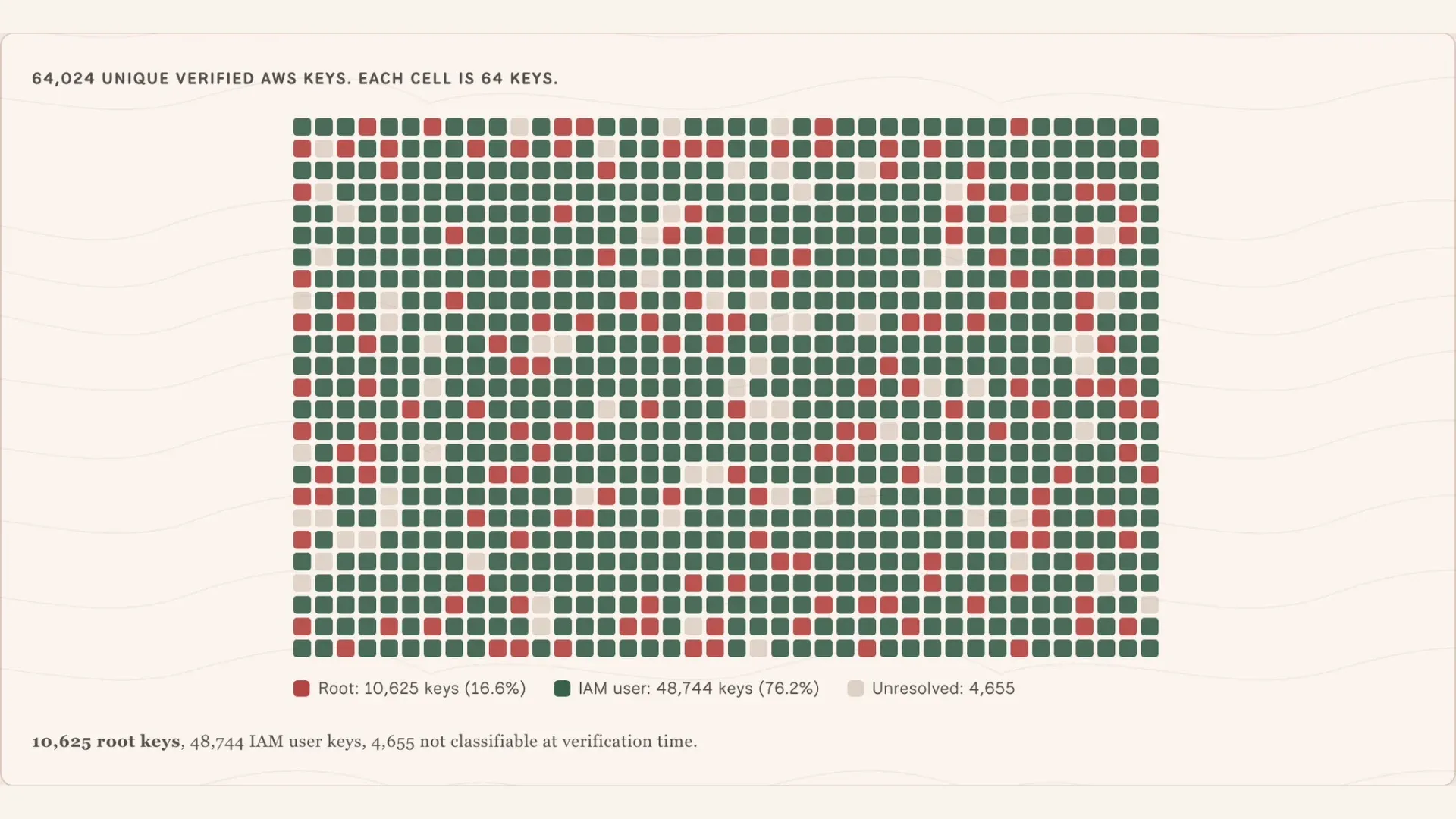
This capability is particularly relevant given the findings from Truffle Security Research, which identified 64,024 unique leaked AWS keys across public code, container images, and datasets. The research highlighted a significant security debt: the median leaked key had remained active for five years, and only 14% had ever been rotated. Furthermore, 84% of the closely researched keys carried full administrator access, while 1 in 6 was a root key. By providing access context alongside detection, TruffleHog AWS Analyze intends to help teams prioritize remediation based on the actual risk level of the exposed identity rather than just the existence of the leak itself.
Addressing Exposure in Multi-Cloud and AI Workflows
TruffleHog AWS Analyze expands the existing capabilities of TruffleHog Enterprise, which already identifies and verifies secrets across more than 800 types. The company is building a unified visibility layer for multi-cloud environments, as the platform now provides identity and access context for AWS, Google Cloud, and various SaaS platforms. This integration is designed to allow security teams to identify a leaked secret and immediately understand its reach across different cloud surfaces.
The urgency of this expansion is underscored by the proliferation of AI-driven development. Truffle Security CEO Dylan Ayrey noted that agentic workflows are creating and exposing AWS credentials at a pace that exceeds traditional tracking capabilities. This risk extends into the AI ecosystem; when TruffleHog scanned 7.6 petabytes of public AI training data on Hugging Face, it discovered 3,343 live AWS keys. Of those, more than 900 keys had the capability to list S3 buckets containing at least 51.7 TB of private data. By integrating AWS analysis into the enterprise workflow, Truffle Security is attempting to bridge the gap between simple notification and actionable remediation in increasingly automated and data-heavy environments.
Key Takeaways
- TruffleHog AWS Analyze provides identity and access context by mapping effective permissions and role-assumption capabilities for leaked AWS credentials.
- Research from Truffle Security found that 88% of 64,024 verified leaked AWS keys were still active, with a median lifespan of five years.
- A scan of 7.6 petabytes of Hugging Face training data revealed 3,343 live AWS keys, with over 900 capable of listing S3 buckets containing at least 51.7 TB of private data.
TechInsyte's Take
In our view, the launch of TruffleHog AWS Analyze highlights a systemic failure in current cloud security hygiene: the "detection-remediation gap." The fact that 929 credentials flagged by AWS’s own quarantine policy remained authenticated for up to three years suggests that simply knowing a key is leaked is insufficient for modern enterprise security. The real danger lies in the "blast radius"—the ability of a single leaked key to move laterally through IAM roles to access compute, storage, or databases. By shifting the focus from mere detection to permission mapping, Truffle Security is addressing the specific friction point that prevents rapid response. For CISOs, this signals that the next frontier of secret management isn't just finding leaks, but understanding the architectural implications of those leaks in real-time.
Questions & Answers
How does TruffleHog AWS Analyze change the remediation workflow for security teams?
Instead of requiring manual investigation into IAM relationships and permissions, the tool automatically identifies the AWS user or role, maps effective permissions, and reveals which roles can be assumed, allowing for risk-based prioritization.
What specific risks were identified regarding leaked keys in AI training datasets?
A scan of 7.6 petabytes of data on Hugging Face found 3,343 live AWS keys, where more than 900 keys could list S3 buckets holding at least 51.7 TB of private data.
Why is the "agentic workflow" mentioned as a growing security concern?
According to Truffle Security, agentic workflows create, use, and expose AWS credentials faster than teams can track, often leading to keys being copied and reused well beyond their original intended purpose.
What does the research reveal about the persistence of leaked AWS credentials?
The research found that 88% of verified leaked AWS keys remained active, with a median active duration of five years, and only 14% of those keys had ever been rotated.
Source: Businesswire