
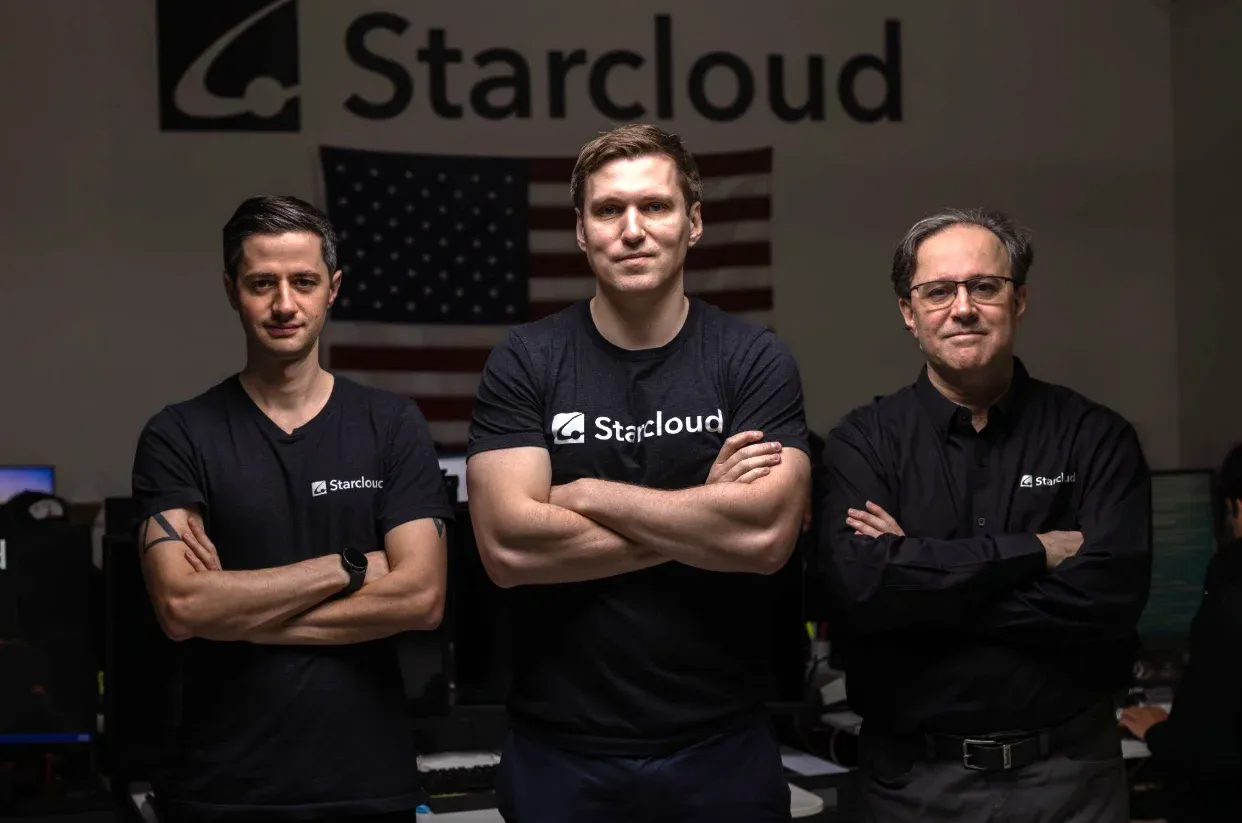
Starcloud is positioning orbital computing as a direct solution to the escalating energy constraints facing terrestrial AI development. The company announced a $250 million Series A extension funding round, which establishes a $2.3 billion post-money valuation. Led by Manhattan West, the round includes new strategic participation from NVIDIA and Cisco Investments. This capital injection brings Starcloud’s total funding to $450 million since its 2024 inception, providing the necessary liquidity to expand manufacturing and hardware deployment in space.
Starcloud $250M Series A Extension Details
The funding round, led by Manhattan West with partners Ken Abdalla and Lauren Selig, signals growing institutional interest in off-planet data infrastructure. Existing investors including Benchmark, EQT, Soma, NFX, and 776 participated alongside new backers such as Cisco Investments, Cedar Capital, Goanna Capital, and Standard Capital. Starcloud intends to utilize these funds to expand its 100,000-square-foot manufacturing facility in Woodinville, Washington, where it is developing production lines for the next-generation Starcloud-3 spacecraft. Beyond manufacturing, the capital is earmarked for engineering collaborations with NVIDIA and securing future launch allocations. This financial milestone follows a series of technical milestones, including the November 2025 deployment of the first NVIDIA H100 GPU via the Starcloud-1 satellite. By securing high-profile investors like Cisco, Starcloud is also attempting to integrate advanced networking and optical expertise into its orbital data center architecture, aiming to bridge the gap between terrestrial and space-based AI workloads.
NVIDIA Space-1 Vera Rubin Module Collaboration
Starcloud is moving beyond simple hardware deployment toward deep hardware-software integration through its collaboration with NVIDIA on the NVIDIA Space-1 Vera Rubin Module. This module is specifically engineered to withstand the extreme environmental stressors of space, including radiation exposure and the requirement for thermal management via large radiators. The project builds on flight data gathered from the Starcloud-1 mission, which successfully demonstrated high-powered inference, fine-tuning, and the first instance of training an AI model in orbit. The company is also positioning its satellites as early flight platforms for space-rated hardware. Looking toward long-term scale, Starcloud is pursuing a massive infrastructure roadmap that includes a constellation of 88,000 satellites. This architecture is designed to provide 20 gigawatts of orbital compute capacity, targeting the massive power requirements of generative AI. By testing advanced GPUs like the H100 and developing specialized modules, Starcloud is attempting to prove that high-performance computing can function reliably outside of Earth's atmosphere.
Key Takeaways
- Starcloud raised $250 million in a Series A extension, reaching a $2.3 billion post-money valuation.
- The company is collaborating with NVIDIA to develop the NVIDIA Space-1 Vera Rubin Module for extreme space environments.
- Starcloud aims to build a constellation of 88,000 satellites to provide 20 gigawatts of orbital compute capacity.
TechInsyte's Take
In our view, Starcloud’s massive capital raise and strategic partnerships with NVIDIA and Cisco suggest that the "AI energy bottleneck" is being viewed by investors as a legitimate driver for orbital infrastructure. By moving compute to space, Starcloud is not just testing a novelty; it is attempting to bypass the physical and regulatory constraints of terrestrial power grids. The involvement of Cisco Investments is particularly telling, as it indicates that the industry is beginning to treat orbital data centers as a serious networking and security challenge rather than just an aerospace one. If Starcloud can successfully scale its 88,000-satellite vision, it could fundamentally alter the economics of global AI compute.
Questions & Answers
How does Starcloud plan to address the energy requirements of large-scale AI?
Starcloud is targeting a massive scale of 20 gigawatts of orbital compute capacity through a planned constellation of 88,000 satellites, aiming to solve the energy bottlenecks currently facing terrestrial AI infrastructure.
What specific hardware challenges is the NVIDIA collaboration addressing?
The collaboration on the NVIDIA Space-1 Vera Rubin Module focuses on engineering components that can withstand radiation exposure and manage thermal requirements in space using large radiators.
What technical milestones has Starcloud already achieved in orbit?
Since the November 2025 launch of Starcloud-1, the company has trained the first AI model in space, run a version of Google's Gemini in orbit, and demonstrated high-powered inference and fine-tuning on flight hardware.
What is the current state of Starcloud's manufacturing capabilities?
The company is currently developing production lines for its next-generation Starcloud-3 spacecraft at a new 100,000-square-foot manufacturing facility located in Woodinville, Washington.
Source: Businesswire