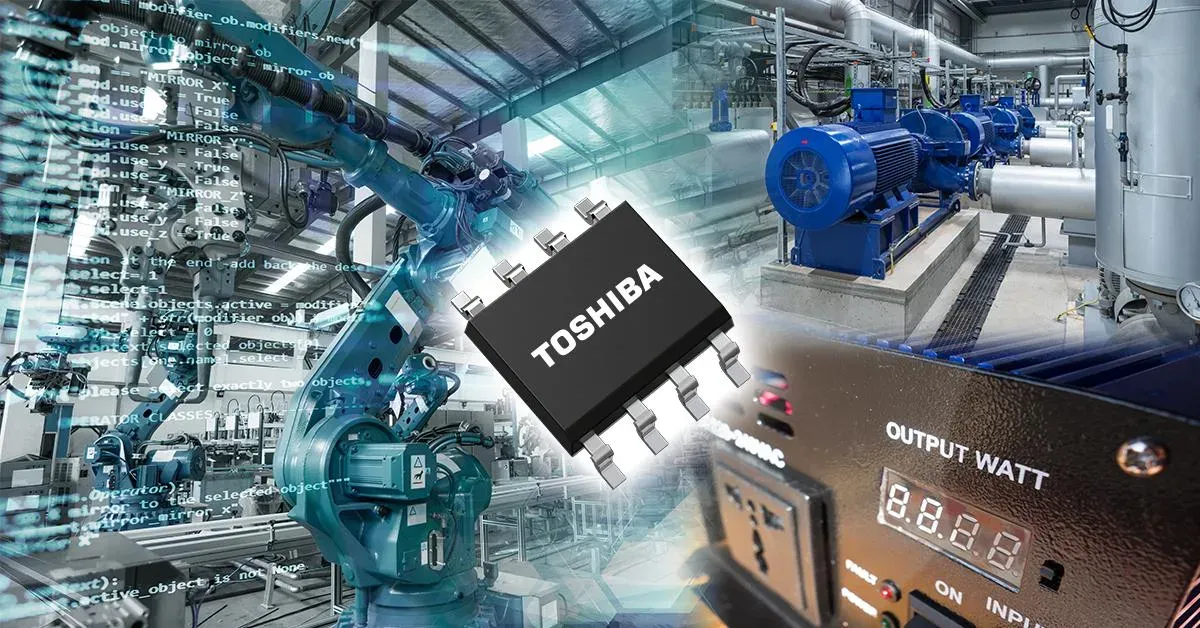
Toshiba Electronic Devices & Storage Corporation is targeting the industrial automation sector's push for energy efficiency and compact hardware by launching a new series of dual-channel digital isolators. The company is positioning the DCL32xx00 Series as a solution for reducing system-wide power consumption while maintaining the high-reliability signal transmission required in noisy industrial environments. By introducing these four new components, Toshiba is expanding its total low-power-consumption standard digital isolator portfolio for industrial equipment to ten products. This strategic expansion aims to provide engineers with greater design flexibility across various communication protocols and hardware footprints.
Toshiba Launches DCL32xx00 Series for Industrial Automation
The newly announced DCL32xx00 Series consists of four distinct models: the DCL320C00, DCL320D00, DCL321C00, and DCL321D00. These products are designed to facilitate electrical isolation between circuits operating at different potentials, such as high and low voltage, which is a critical requirement for preventing equipment failure and signal malfunction in devices like programmable logic controllers (PLCs), actuators, and inverters. Toshiba is utilizing its proprietary magnetic coupling isolation transmission technology to achieve this, a method that integrates modulation and demodulation chips with insulation layers into a single package to transmit signals via a magnetic field.
The lineup is divided by channel configuration to support different communication needs. The DCL320C00 and DCL320D00 feature two forward channels, making them suitable for unidirectional digital signal transmission, such as I2C communications. Conversely, the DCL321C00 and DCL321D00 provide one forward channel and one reverse channel, supporting bidirectional transmission like UART communications. All four devices are housed in an industry-standard SOIC8-N package, which Toshiba suggests meets the growing demand for more compact equipment designs. Volume shipments for the series have officially commenced.
Optimizing Power and Reliability in Noisy Environments
Toshiba is addressing the dual industrial pressures of carbon neutrality and hardware miniaturization through improved power metrics and thermal resilience. The new isolators achieve a typical low current consumption of 0.2mA per channel at a 1Mbps operating speed. While prioritizing low power, the series maintains mid-speed communication capabilities, supporting data transmission rates of up to 25Mbps (max). This balance is intended to support stable equipment operation even as device speeds increase and noise levels rise in industrial settings.
Technical specifications for the DCL32xx00 Series include an isolation voltage rating of 3000Vrms (min) and a wide operating temperature range spanning from -40 to 125°C. The devices also support a broad supply voltage range of 2.25 to 5.5V. By offering these specifications alongside existing high-speed series like the DCL54xx0B and automotive-focused models like the DCM34xx01, Toshiba is attempting to provide a comprehensive selection of isolation solutions that can be matched to specific application requirements, from motor control and inverters to switching power supplies and field device sensors.
Key Takeaways
- The DCL32xx00 Series achieves a typical low current consumption of 0.2mA per channel at 1Mbps.
- The lineup supports data transmission speeds of up to 25Mbps (max) and an isolation voltage of 3000Vrms (min).
- Toshiba’s new release expands its total low-power-consumption standard digital isolator lineup for industrial equipment to ten products.
TechInsyte's Take
In our view, Toshiba’s expansion of the DCL32xx00 Series is a calculated move to capture the "mid-tier" industrial automation market, where the extreme high-speed requirements of specialized computing meet the strict power and space constraints of edge devices. By focusing on the 0.2mA per channel metric, Toshiba is directly responding to the enterprise shift toward carbon neutrality and energy-efficient data infrastructure.
This isn't just about adding more parts to a catalog; it is about filling a specific gap between high-speed, high-power isolators and basic, low-performance components. The inclusion of both unidirectional (I2C) and bidirectional (UART) configurations in a standard SOIC8-N package suggests Toshiba is betting on the continued miniaturization of PLCs and field sensors. For enterprise IT and industrial operators, this signals a maturing component landscape where power efficiency is becoming as critical a design metric as raw data throughput.
Questions & Answers
How does the DCL32xx00 Series support different communication protocols?
The series offers two distinct configurations to match protocol needs: the DCL320C00 and DCL320D00 use two forward channels for unidirectional signals like I2C, while the DCL321C00 and DCL321D00 use one forward and one reverse channel for bidirectional signals like UART.
What specific technical protections do these isolators provide for industrial hardware?
The devices provide electrical isolation between circuits at different potentials to prevent malfunctions caused by noise. They are rated for an isolation voltage of 3000Vrms (min) and can operate in extreme temperatures ranging from -40 to 125°C.
What is the strategic significance of the 0.2mA current consumption figure?
The 0.2mA (typ.) per channel consumption at 1Mbps is positioned to help manufacturers reduce overall system power consumption, which Toshiba links to the broader industrial requirement of achieving carbon neutrality.
How does Toshiba's magnetic coupling technology differ from traditional methods?
According to the announcement, Toshiba's proprietary magnetic coupling technology integrates the modulation chip, demodulation chip, and insulation layers into a single package, using a magnetic field to transmit signals for high reliability and long service life.
Source: Toshiba