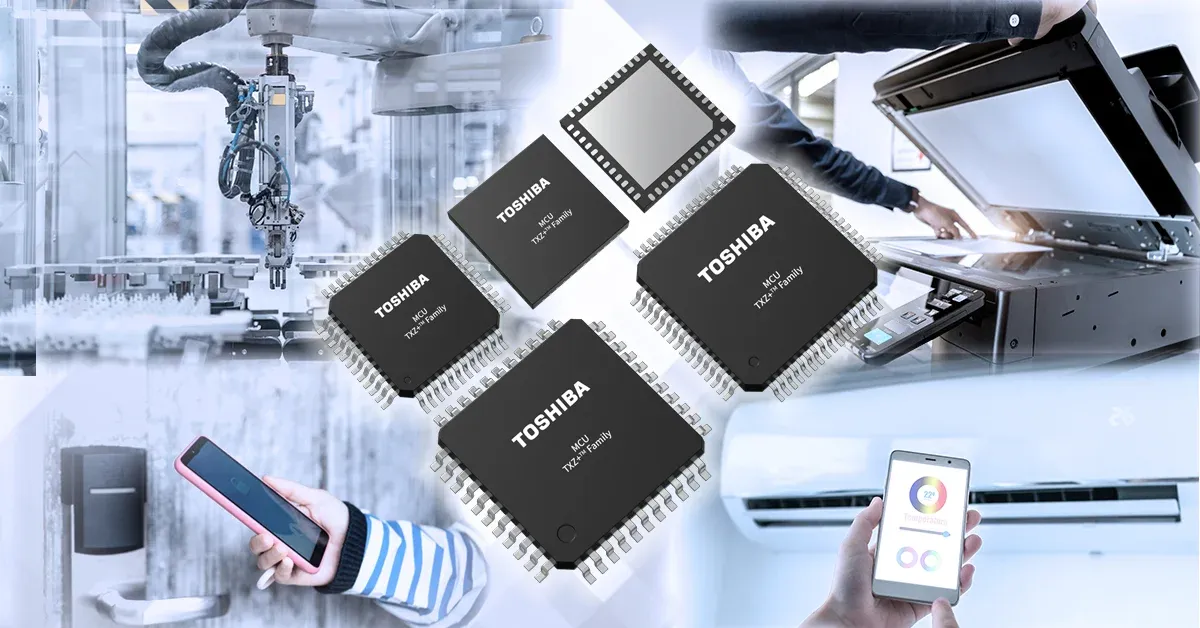
Toshiba Electronic Devices & Storage Corporation has officially announced the availability of engineering samples for its TXZ+™ Family Entry-Class M4V Group. This new series of standard microcontrollers is specifically engineered to address the escalating security and data management complexities inherent in modern connected environments. Built upon the high-performance Arm® Cortex®-M4 core, which includes a dedicated floating-point unit (FPU), these microcontrollers are designed to meet the surging industrial and consumer demand for robust protection in Internet of Things (IoT) devices and sophisticated industrial equipment.
As the industry moves toward a standard where constant network connectivity and over-the-air (OTA) firmware updates are mandatory, the M4V Group provides a sophisticated, multilayered security architecture. This framework is designed to defend against unauthorized access and program tampering, ensuring the integrity of the device. This strategic release underscores Toshiba’s commitment to supporting the entire product lifecycle—from the initial development phase through to end-of-life—for manufacturers specializing in smart appliances and advanced factory automation systems.
Advanced Security and Data Architecture in the M4V Group
The M4V Group microcontrollers are meticulously engineered to mitigate the various risks associated with remote monitoring and frequent device updating. To combat the growing threats of unauthorized access and malicious program tampering, Toshiba has implemented a hardware-level, multilayered security architecture. This system integrates advanced access control, memory protection, and execution control functions, providing a foundational layer of defense that protects software assets and ensures stable, uninterrupted system operation within increasingly complex and connected ecosystems.
In addition to its security capabilities, the M4V Group places a heavy emphasis on efficient data management through specialized, optimized memory configurations. Each microcontroller in the series integrates 128KB of code flash memory, 64KB of data flash memory, and 32KB of RAM. The inclusion of dedicated data flash is a critical feature for managing rewritable information, such as essential configuration settings and diagnostic log data, which is vital for maintaining operational integrity under fluctuating equipment conditions.
To accommodate the large-scale data requirements of modern IoT systems, these chips feature a Serial Memory Interface (SMIF) for seamless connection to external serial flash memory. This interface allows for direct memory mapping into the address space, facilitating high-speed data access with minimal CPU load. This specific capability is strategically positioned to support extensive firmware storage and comprehensive log data management, both of which are essential for OTA-enabled IoT ecosystems.
Technical Specifications for Industrial and IoT Control
Operating at frequencies reaching up to 80MHz, the M4V Group delivers the real-time computational performance required for complex, high-stakes system control applications. To ensure versatility across different hardware environments, the microcontrollers support a wide supply voltage range of 2.7V to 5.5V. This range ensures compatibility with both standard low-voltage electronics and the 5V power supplies commonly found in industrial settings. Furthermore, to enhance design flexibility and minimize the Bill of Materials (BOM) by reducing external component requirements, Toshiba has integrated a high-speed internal oscillator with a high precision of ±1% accuracy.
The hardware suite includes a comprehensive array of peripheral functions essential for precision motor and system control. Key integrated components include a 12-bit analog-to-digital converter (ADC), various timers, and standard communication interfaces including UART, SPI, and I²C. For specialized motion control applications, the microcontrollers incorporate the Advanced Programmable Motor Control Circuit 2 (A-PMD2), which provides dedicated support for brushless DC motor control.
To accommodate diverse engineering requirements, the product lineup is offered in four distinct package types: LQFP64, LQFP48, VQFN48, and LQFP44. This variety allows engineers to select the most efficient configuration based on specific mounting area constraints and assembly requirements. To facilitate rapid time-to-market, Toshiba provides a complete development ecosystem, including starter kits, sample software, and CMSIS-compliant drivers.
Key Takeaways
- High-Performance Processing: The M4V Group utilizes an Arm® Cortex®-M4 core with FPU, operating at up to 80MHz to support demanding real-time system control.
- Robust Security Framework: Security is managed through a multilayered architecture featuring Chip Protection (CPRO), Secure Access Memory (SAM), and Non-Releasable Flash Protection (NRFP).
- Optimized Memory Layout: Integrated memory includes 128KB of code flash, 64KB of data flash for rewritable logs, and 32KB of RAM.
TechInsyte's Take
In our view, Toshiba’s release of the TXZ+ M4V Group is a calculated response to the increasing vulnerability of the "edge" in industrial and consumer IoT. By integrating specialized data flash and a serial memory interface (SMIF), Toshiba is addressing a specific pain point for CTOs: the tension between high-volume data logging—required for diagnostics and OTA updates—and the limited memory footprints of entry-class microcontrollers. This architecture suggests that Toshiba is moving beyond simple processing power to focus on the "data lifecycle" of the device. For decision-makers in factory automation and smart appliances, this signals a shift toward hardware that treats security and data persistence as foundational requirements rather than optional add-ons. The inclusion of A-PMD2 for motor control further positions these chips as versatile workhorses for the next generation of connected, autonomous hardware.
Questions & Answers
How does the M4V Group protect against unauthorized firmware tampering during OTA updates?
The microcontrollers employ a multilayered security architecture that combines access control, memory protection, and execution control. Specifically, the hardware includes features such as Chip Protection (CPRO), Secure Access Memory (SAM), and Non-Releasable Flash Protection (NRFP) to ensure end-to-end protection against unauthorized access.
What hardware features facilitate efficient management of large-volume log data?
The M4V Group includes 64KB of dedicated data flash for rewritable configuration and log data. Additionally, the Serial Memory Interface (SMIF) allows for high-speed connection to external serial flash memory by mapping it directly into the address space, which enables large-scale data storage with minimal CPU overhead.
Which specific industrial applications are targeted by the M4V Group's motor control capabilities?
The integration of the Advanced Programmable Motor Control Circuit 2 (A-PMD2) specifically supports brushless DC motor control. This makes the microcontrollers suitable for control equipment such as inverters, pumps, and various factory automation systems that require precise motor management.
How does the M4V Group support design flexibility for different power environments?
The microcontrollers support a wide supply voltage range from 2.7V to 5.5V, ensuring compatibility with both low-voltage IoT sensors and standard 5V industrial power supplies. Furthermore, the integrated high-speed oscillator (±1% accuracy) reduces the need for external components, simplifying the Bill of Materials (BOM).
Source: BUSINESSWIRE