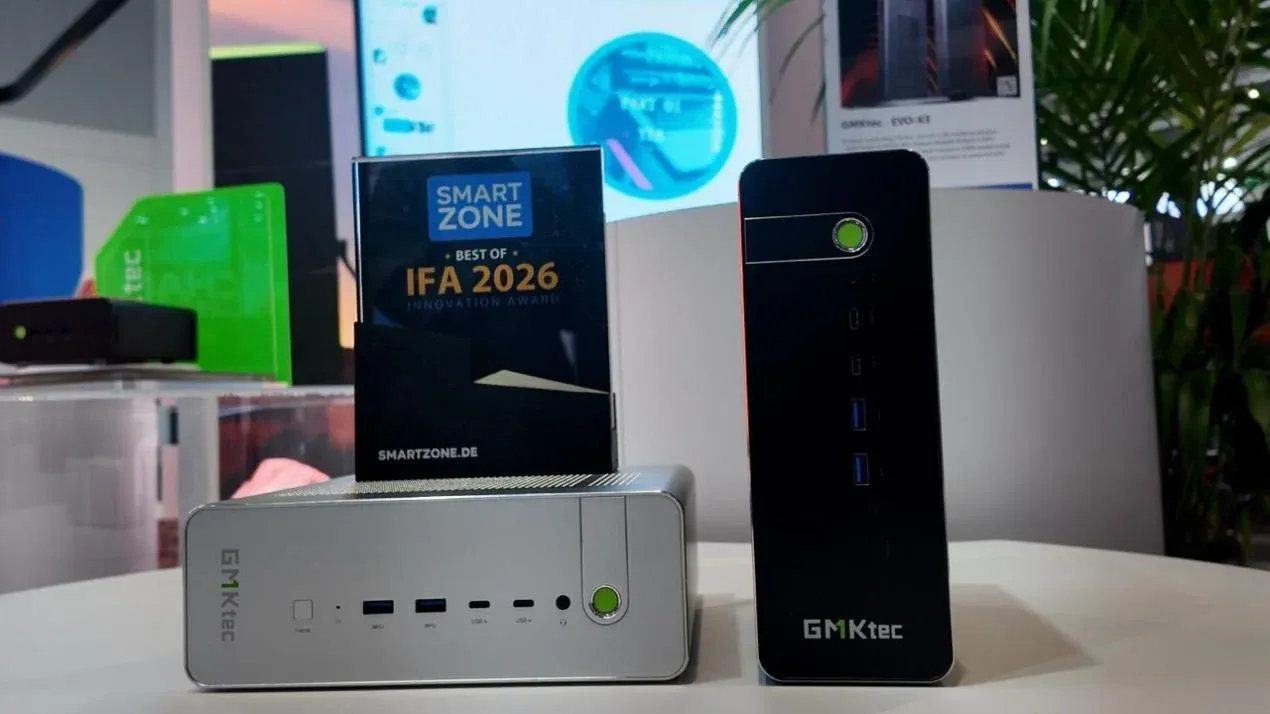
GMKtec is attempting to shift the paradigm of generative AI from centralized cloud dependency to localized, high-performance edge computing. At IFA 2026, the company unveiled the EVO-X5 Pro, a desktop system it positions as a "supercomputer" capable of running 300-billion-parameter large language models (LLMs) entirely offline. By integrating AMD’s Ryzen AI Max+ PRO 495 processor and a massive unified memory architecture, GMKtec aims to provide enterprise-grade AI performance within a compact form factor. This move targets a critical friction point for businesses: the tension between the massive computational requirements of advanced LLMs and the stringent data privacy and latency demands of modern enterprise environments.
AMD and GMKtec Target Localized Edge AI
The launch of the EVO-X5 Pro marks a deepening strategic alignment between GMKtec and AMD, focusing on the emerging "Agentic PC" category. Michael Nordquist, Vice President of Client Business at AMD, joined the IFA 2026 event to signal AMD's commitment to this hardware-software synergy. The EVO-X5 Pro utilizes the Ryzen AI Max+ PRO 495 processor, which features 16 Zen 5 CPU cores and an XDNA 2 NPU capable of delivering up to 55 TOPS of AI performance. To support the massive memory overhead required by large-scale models, the system supports up to 192GB of LPDDR5X-8533 unified memory, providing 273 GB/s of bandwidth.
Crucially, the architecture allows up to 160GB of this memory to be dynamically allocated as graphics memory. This specific configuration is what GMKtec claims enables the offline execution of 300B-parameter LLMs. By moving these workloads from the cloud to the desktop, the company suggests that enterprises can achieve lower latency and reduced operating costs while maintaining total control over sensitive data. The product, which received innovation awards from PCWELT and SmartZone at IFA, is scheduled for launch on September 28.
Enterprise Management and Security Frameworks
Beyond raw computational throughput, GMKtec is positioning the EVO-X5 Pro as a manageable asset for large-scale IT deployments. Recognizing that high-performance AI hardware often requires specialized oversight, the company has integrated the AMD DASH management framework. This includes an RJ45 DASH network adapter, which enables out-of-band (OOB) remote management that functions independently of the operating system. This feature is intended to allow IT administrators to deploy, monitor, and maintain fleets of AI-capable desktops across diverse software environments.
To address the security concerns inherent in local AI processing, the hardware includes a dedicated dTPM 2.0 security chip for hardware-level protection. The system is designed for 24/7 continuous enterprise operation, targeting developers, research institutions, and professional content creators who require workstation-class capabilities without the footprint of traditional server racks. GMKtec and AMD have indicated that future cooperation will extend into the ROCm software ecosystem and broader AI software optimization to further support the transition toward autonomous, agentic computing platforms.
Key Takeaways
- The EVO-X5 Pro features the AMD Ryzen AI Max+ PRO 495 processor with an XDNA 2 NPU delivering 55 TOPS of AI performance.
- The system supports up to 192GB of LPDDR5X-8533 unified memory, with up to 160GB available for dynamic graphics memory allocation.
- Hardware-level enterprise management is provided via the AMD DASH framework and a dedicated dTPM 2.0 security chip.
TechInsyte's Take
In our view, GMKtec’s move to target the 300B-parameter LLM threshold is a calculated attempt to bypass the "AI PC" marketing fatigue currently saturating the consumer market. While most current AI hardware focuses on small, task-specific models, the EVO-X5 Pro is betting that enterprise demand will gravitate toward high-parameter models that require massive memory bandwidth. By leveraging AMD's unified memory architecture, GMKtec is effectively attempting to shrink a data center capability into a desktop chassis. However, the success of this hardware will depend heavily on the maturity of the ROCm software ecosystem and whether developers can easily port complex workflows to this specific edge architecture. If successful, this signals a significant shift where "local AI" is no longer a compromise for privacy, but a high-performance alternative to the cloud.
Questions & Answers
How does the EVO-X5 Pro handle the massive memory requirements of 300B-parameter models?
The system utilizes up to 192GB of LPDDR5X-8533 unified memory with 273 GB/s of bandwidth, allowing up to 160GB to be dynamically allocated as graphics memory to accommodate large model weights.
What specific features are included to support enterprise IT administration?
The platform integrates the AMD DASH management framework with an RJ45 DASH network adapter for out-of-band remote management and includes a dedicated dTPM 2.0 security chip for hardware-level security.
What is the strategic goal of the "Agentic PC" vision mentioned by GMKtec?
The vision aims to transition personal computing from simple application execution to systems that can understand, reason, and act on behalf of users through local, high-performance AI agents.
When will the EVO-X5 Pro be available for purchase?
According to the announcement, the EVO-X5 Pro is scheduled to launch on September 28.
Source: Businesswire