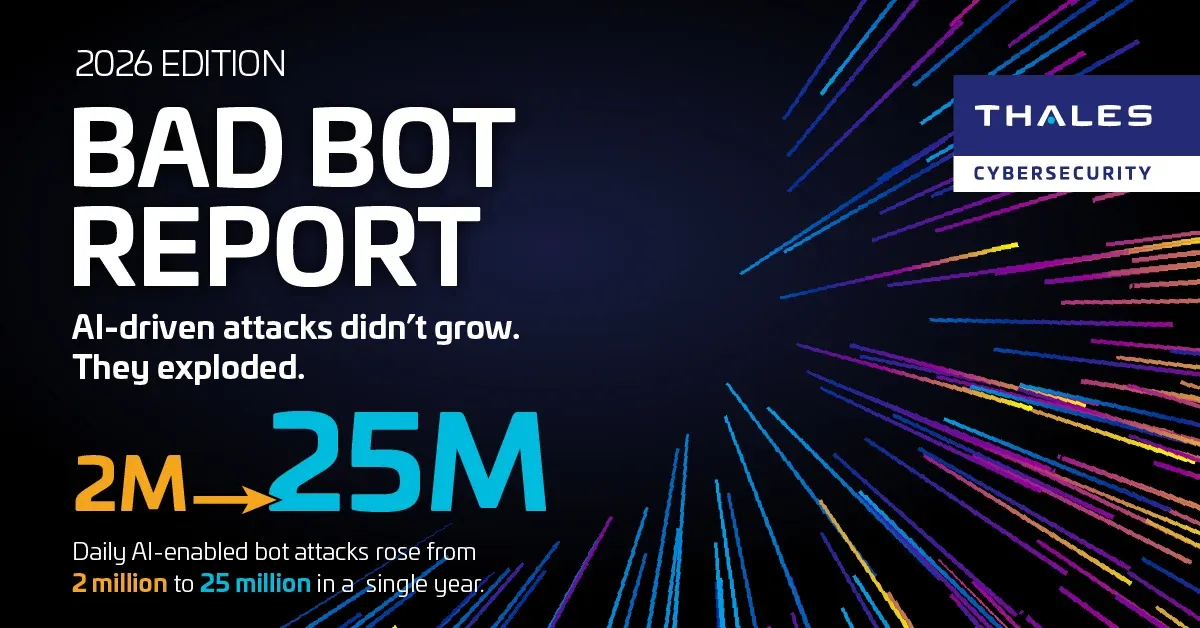
The composition of the internet has crossed a structural tipping point. According to the Thales 2026 Bad Bot Report, automated traffic now accounts for more than 53% of all web activity, officially outnumbering human users. While bot traffic has been a persistent nuisance for a decade, the integration of generative AI and autonomous agents has fundamentally altered the threat landscape.
For CIOs and CISOs, the challenge is no longer a simple binary of "blocking bots." The emergence of AI agents—which perform legitimate tasks like data retrieval and workflow automation—means that enterprise security must transition from identity-based filtering to intent-based governance.
The Industrialization of Malicious Automation
The most striking figure in the Thales report is the 12.5x surge in AI-driven bot attacks over the past year. This spike represents the industrialization of cyberattacks. Previously, sophisticated bot campaigns required significant manual configuration; today, AI allows attackers to generate polymorphic scripts that mimic human behavior with high fidelity.
This evolution has rendered traditional CAPTCHAs and basic rate-limiting tools largely obsolete. Because these bots can now simulate mouse movements, vary their typing speeds, and solve visual challenges, they bypass the perimeter defenses designed to distinguish machines from humans. The report notes that 40% of all internet traffic is now classified as "bad bots"—malicious automation designed to scrape proprietary data, hoard inventory, or execute credential stuffing.
APIs: The New Frontline for Machine-on-Machine Attacks
As enterprises modernize their stacks, the attack surface has shifted from the front-end user interface to the back-end API. The report finds that 27% of bot attacks now target APIs directly. By bypassing the browser or mobile app interface, bots can interact with core business logic at machine speed.
These attacks are particularly insidious because they often use valid authentication tokens and well-formed requests. They do not "break" the system in a traditional sense; instead, they exploit the business logic. For example, a bot might systematically query a pricing API to undercut a competitor in real-time or exhaust a loyalty point system through thousands of micro-transactions.
Financial services remain the primary target for these maneuvers. The sector accounted for 24% of all bot attacks and a staggering 46% of all account takeover (ATO) incidents. For leadership, this highlights a critical vulnerability: identity systems are being weaponized by automation to facilitate fraud at a scale that manual oversight cannot detect.
From Blocking to Governance: The Rise of AI Agents
The report introduces a third category of traffic that complicates the security mandate: AI agents. These are not necessarily "bad bots," but they are not human users either. They are autonomous programs—often deployed by partners, search engines, or AI aggregators—that interact with applications to perform tasks.
This "Agentic Age" creates a visibility gap. If an AI agent scrapes your site to train a competitor’s model, is that a security breach or a search engine optimization reality? If an agent automates a purchase on behalf of a customer, is it a legitimate transaction or a strain on infrastructure?
Tim Chang, Global VP at Thales, suggests that the focus must shift toward understanding whether automation aligns with business intent. For technology teams, this means moving away from reactive blocking and toward a governance-based model. This involves defining "allow-lists" for specific AI agents and implementing behavioral analysis that can flag when a "good" bot begins exhibiting "bad" patterns, such as aggressive data harvesting or unauthorized API probing.
Key Takeaways
- Automation Dominance: Bots now account for 53% of all internet traffic, meaning the majority of enterprise infrastructure costs are currently being driven by machine-on-machine interactions.
- API Vulnerability: Nearly 30% of bot attacks now bypass the UI to target APIs directly, necessitating security controls that reside at the data and logic layer rather than just the browser level.
- The Intent Challenge: With AI-driven attacks increasing 12.5x, the primary security hurdle is no longer identifying a bot, but determining the intent of the automation and its impact on business logic.
TechInsyte's Take
The transition to an agentic internet requires a fundamental recalibration of digital infrastructure. When machines outnumber humans, security strategies built on "human-centric" assumptions fail. Decision-makers must prioritize visibility into API traffic and invest in behavioral analytics that can parse intent in real-time. As AI agents become a permanent fixture of the digital ecosystem, the goal is no longer to eliminate automation, but to build a framework where legitimate agents can operate without opening the door to high-velocity, AI-driven exploitation.
Source: Businesswire