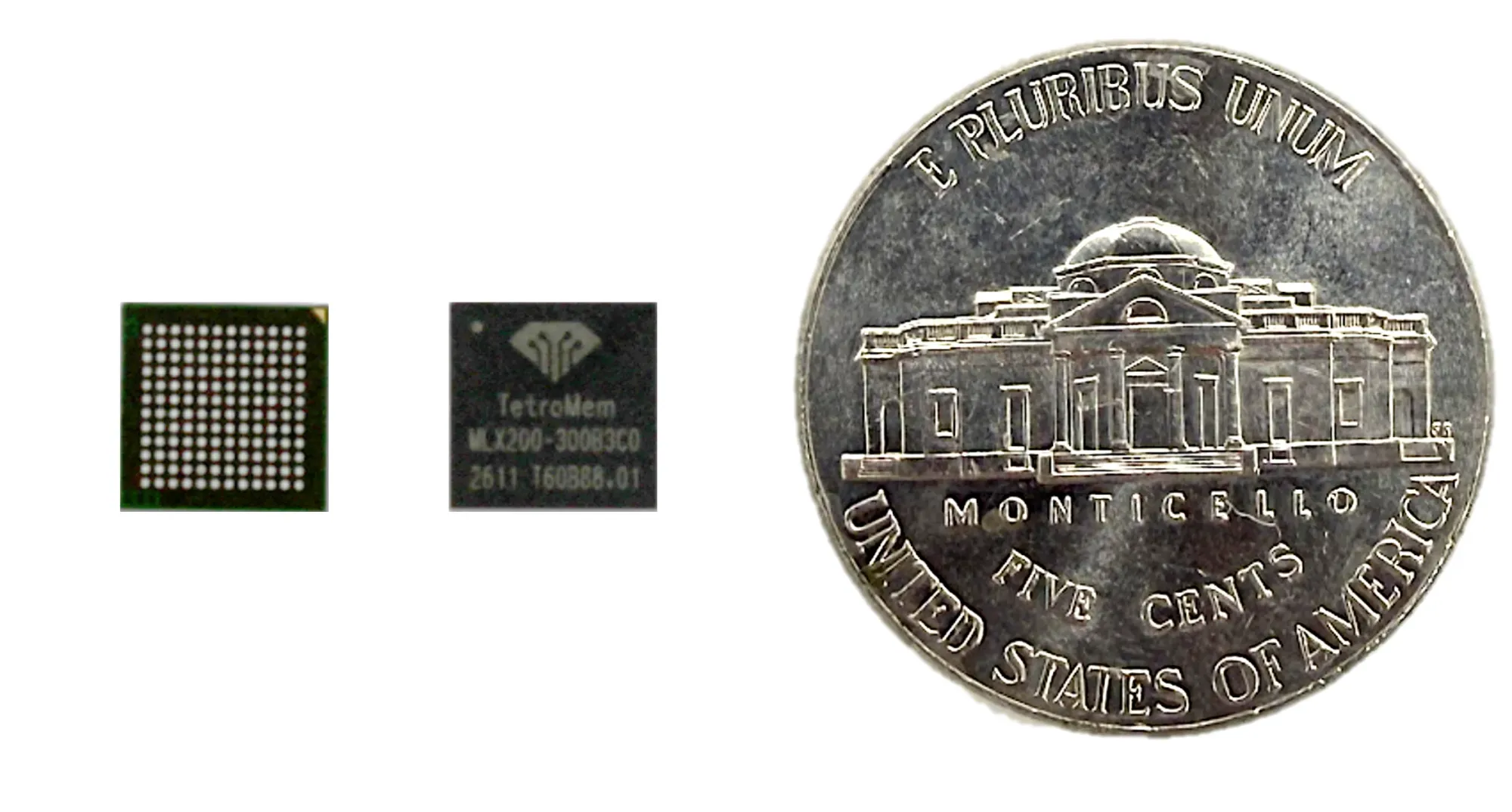
TetraMem Inc. has announced the successful tape-out, manufacturing, and initial silicon validation of its MLX200 platform, a 22nm multi-level Resistive Random-Access Memory (RRAM)-based analog in-memory computing (IMC) system-on-chip (SoC). This development represents a significant step towards the commercialization of analog computing architectures that leverage emerging non-volatile memory technologies to address critical challenges in modern AI systems, including data movement, power consumption, and thermal constraints.
Addressing AI's Data Movement Bottleneck
As artificial intelligence workloads continue to grow in complexity and scale, the efficiency of moving data between memory and processing units becomes a major performance bottleneck. Analog in-memory computing offers a paradigm shift by performing computations directly within memory arrays. This approach drastically reduces the need for data transfer, leading to substantial improvements in system-level efficiency. TetraMem's MLX200 platform integrates multi-level RRAM arrays with mixed-signal compute engines, enabling high-throughput vector-matrix operations to occur directly within the memory itself. This integration is achieved while maintaining compatibility with advanced CMOS manufacturing processes.
RRAM Technology on Advanced Nodes
The multi-level RRAM technology utilized in the TSMC 22nm process offers several advantages crucial for practical deployment. These include CMOS compatibility with minimal additional process complexity, operation at low voltages and currents, robust retention and endurance characteristics, and high multi-level capability. This high multi-level capability is key to enhancing memory and compute density. Initial silicon validation results demonstrate consistent functionality across the RRAM arrays, underscoring the viability of this approach for both embedded non-volatile memory and compute-in-memory applications.
This latest achievement builds upon TetraMem's prior work, including the MX100 platform fabricated on TSMC's 65nm CMOS process. That earlier project showcased multi-level RRAM devices capable of thousands of conductance levels, as reported in Nature in March 2023, and high-precision analog computing capabilities, detailed in Science in February 2024. These foundational studies established a strong scientific and engineering basis for scaling the technology to more advanced semiconductor nodes. TetraMem has collaborated closely with its foundry partner since 2019 to advance RRAM technology from research to manufacturable silicon, with the 22nm progress reflecting advancements in process integration, device uniformity, and system-level co-design.
Applications and Future Outlook
The MLX200 and MLX201 platforms are specifically engineered for power- and latency-sensitive edge AI applications. These include areas such as voice and audio processing, wearable devices, Internet of Things (IoT) systems, and always-on sensing applications. TetraMem anticipates that evaluated sampling for these platforms will commence in the second half of 2026. Additionally, the company is making its multi-level RRAM memory IP available for evaluation and potential licensing.
Dr. Glenn Ge, Co-founder and CEO of TetraMem, stated, "This milestone reflects years of close collaboration with our foundry partner TSMC and demonstrates the feasibility of bringing multi-level RRAM and analog in-memory computing from computing architecture breakthrough into advanced-node commercial silicon. We believe this approach provides a practical path to improving energy efficiency and scalability for next-generation AI systems." The successful realization of the MLX200 platform validates the potential of multi-level RRAM-based analog computing on advanced semiconductor processes, positioning TetraMem to support emerging AI workloads with enhanced energy efficiency and system scalability.
Key Takeaways
- TetraMem has successfully manufactured and validated its 22nm MLX200 analog in-memory computing SoC using multi-level RRAM technology.
- The technology aims to reduce data movement and improve power efficiency in AI systems by performing computations within memory arrays.
- The MLX200 platform is designed for edge AI applications and is expected to be available for sampling in the second half of 2026.
TechInsyte's Take
TetraMem's achievement at the 22nm node signifies a crucial step in bridging the gap between advanced RRAM research and commercial deployment for analog in-memory computing. This development offers a tangible pathway for enterprises seeking to enhance the performance and energy efficiency of their AI infrastructure, particularly for demanding edge computing scenarios. Decision-makers in AI, cloud, and infrastructure should monitor the progress of this technology as it moves towards sampling and potential wider adoption.
Source: Businesswire