Power Integrations (NASDAQ: POWI) announced two new ultra‑compact auxiliary power‑supply reference designs—15 W and 35 W—that target NVIDIA’s Kyber 800 VDC AI data‑center platform. The designs use the company’s 1700 V‑rated PowiGaN™ single‑HEMT ICs, occupy a 30 mm × 30 mm × 7 mm or 80 mm × 60 mm × 8 mm footprint, and claim up to 88 percent efficiency while reducing board space and bill‑of‑materials (BOM) count.
New Ultra‑Slim Reference Designs for High‑Voltage AI Servers
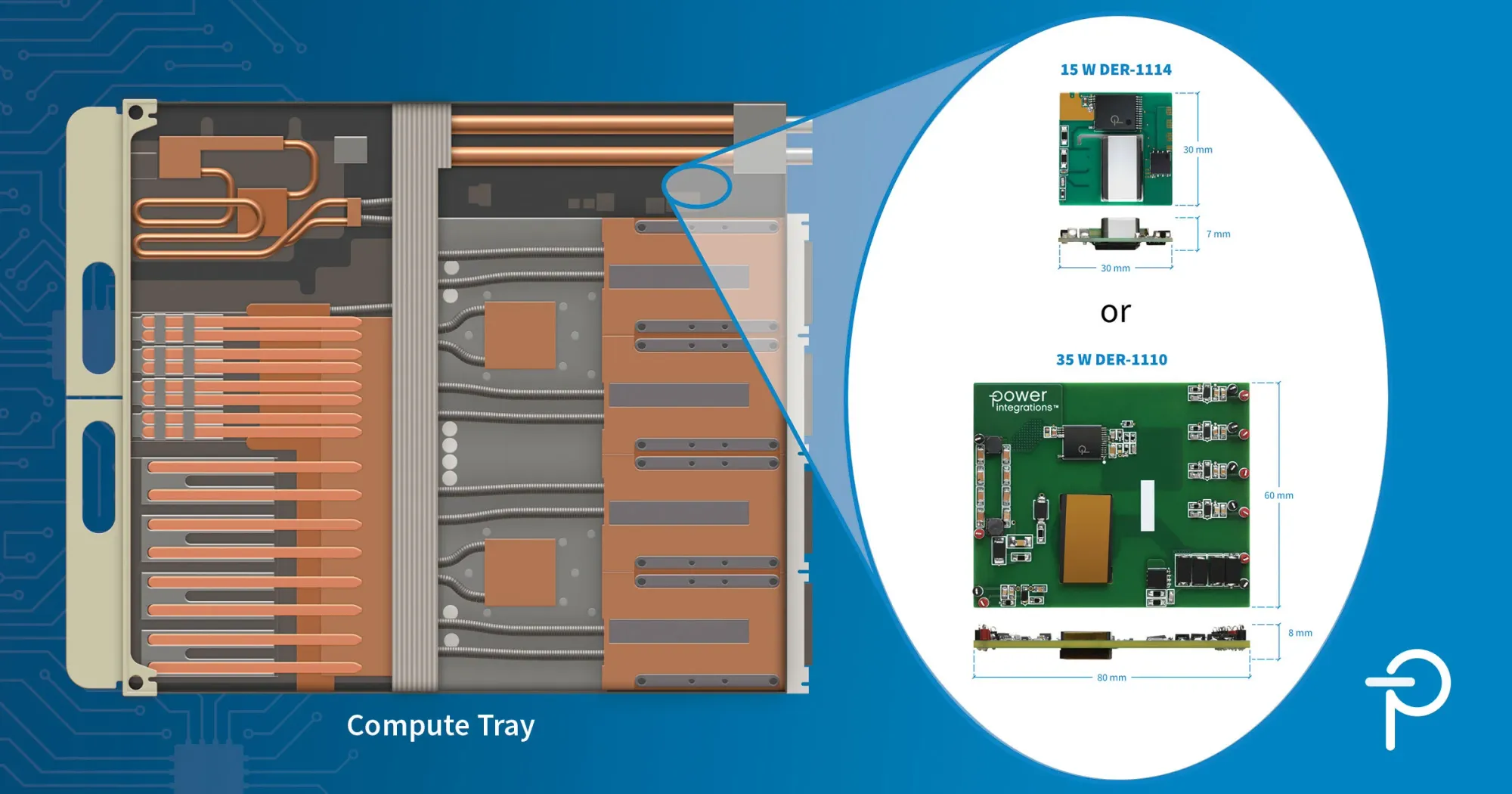
Power Integrations introduced a single‑output 15 W design (30 mm × 30 mm, 7 mm profile) and an isolated six‑rail 35 W design (80 mm × 60 mm, 8 mm profile). Both are built around the InnoMux‑2 IC family, which incorporates a 1700 V PowiGaN™ gallium‑nitride device. In flyback configuration, the IC supports a nominal 1000 VDC input and can maintain flat efficiency of 90 percent in discontinuous conduction mode. The company states the designs free up roughly 30 percent of space on densely packed main power‑distribution boards and cut BOM count by an estimated 30 percent. Efficiency is reported at a minimum of 88 percent across line and load conditions.
The reference designs are documented in two downloadable design‑example reports—DER‑1110 (35 W, multi‑output) and DER‑1114 (15 W, single‑output). They supply auxiliary power for internal components such as microcontrollers, gate drivers, and operational amplifiers that perform “control and housekeeping” functions essential to system reliability and safety.
Alignment with NVIDIA Kyber Blade‑Rack Architecture
The auxiliary PSUs are optimized for NVIDIA’s Kyber liquid‑cooled, blade‑rack architecture, which operates on an 800 VDC bus. By using a single‑HEMT 1700 V GaN device, Power Integrations claims to achieve “best‑in‑class, highly efficient flyback converters” while preserving wide safety margins on the high‑voltage bus. Jason Yan, Senior Training Manager at Power Integrations, contrasted the solution with discrete silicon‑carbide (SiC) alternatives, noting that SiC approaches require about 30 percent more components and board space.
The compact form factor and reduced component count are intended to simplify integration into the tightly packed power‑distribution boards typical of AI data‑center racks. This could ease thermal management and mechanical design constraints for OEMs building Kyber‑based systems.
Availability and Distribution
Both reference designs are available for free download from Power Integrations’ website (power.com). The company also listed its authorized worldwide distributors—DigiKey, Newark, Mouser, and RS Components—for procurement of the InnoMux‑2 ICs and related parts. No pricing or production‑timeline details were disclosed in the announcement.
Key Takeaways
- Power Integrations released 15 W (30 mm × 30 mm × 7 mm) and 35 W (80 mm × 60 mm × 8 mm) ultra‑slim auxiliary PSU reference designs for NVIDIA Kyber 800 VDC AI data‑center platforms.
- The designs use 1700 V PowiGaN™ single‑HEMT InnoMux‑2 ICs, achieve at least 88 percent efficiency, and claim a 30 percent reduction in board space and BOM count.
- Reference design documents (DER‑1110 and DER‑1114) are freely downloadable, and the ICs are sold through DigiKey, Newark, Mouser, and RS Components.
TechInsyte's Take
These reference designs demonstrate a concrete path for integrating high‑voltage GaN power conversion into dense AI server racks, potentially easing layout and component‑sourcing challenges for OEMs. However, without disclosed cost data or field‑performance results, buyers will need to validate the claimed space and BOM savings against their own design constraints before committing to the solution. Monitoring early adopters’ feedback on reliability and thermal behavior will be essential for assessing broader applicability.
Source: Businesswire