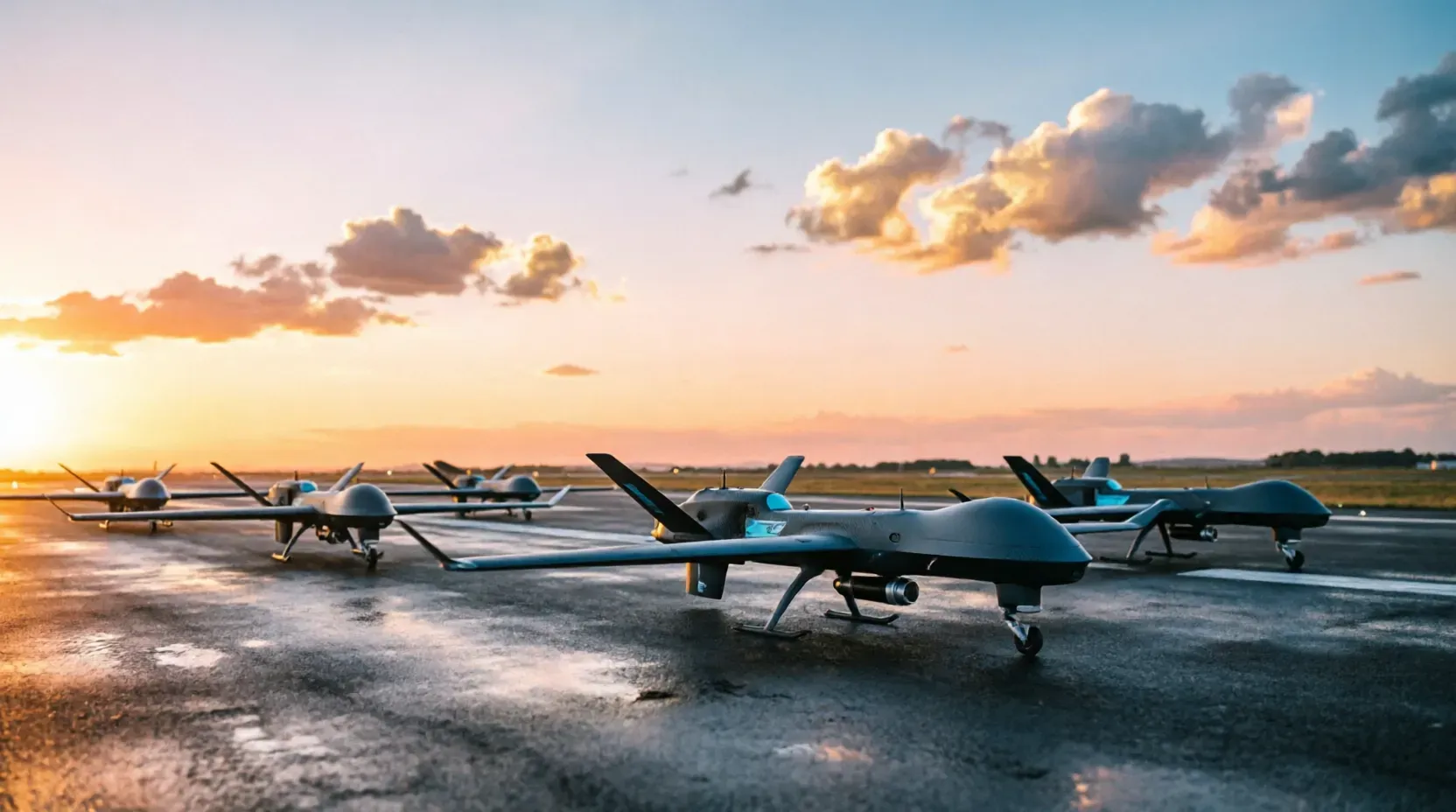
Palladyne AI (NASDAQ: PDYN) demonstrated its SwarmOS™ autonomous drone‑swarming software, together with the Gremlin‑X reusable mini‑bomber, during the U.S. Army’s 4th Infantry Division Ivy Mass live‑fire exercise. Ivy Mass is a multi‑domain fire‑support and command‑and‑control drill that brings together thousands of troops to test the integration of traditional combat skills with modern digital command systems, data networks, and upgraded operational architectures. In this context, Palladyne AI integrated SwarmOS with the Army’s Next‑Generation Command and Control (NGC2) prototype, allowing a single soldier to command a heterogeneous fleet of ISR drones and a mini‑bomber from a single interface. The demonstration highlighted edge‑native operation in communications‑contested environments—a capability that resonates directly with enterprise‑level AI, edge computing, and secure command systems, where bandwidth constraints and data‑sovereignty concerns are increasingly critical.
SwarmOS and Gremlin‑X Operate in Ivy Mass
During Ivy Mass, Palladyne AI’s SwarmOS was embedded in the NGC2 prototype ecosystem, enabling real‑time, cross‑platform collaboration among a mixed swarm of OEM Intelligence, Surveillance, and Reconnaissance (ISR) drones and the Gremlin‑X reusable mini‑bomber. The software orchestrated decentralized decision‑making, allowing each drone to process sensor data locally and adjust its flight path without waiting for a central server. According to the company, the system performed real‑time mission adaptation, sensor‑to‑shooter data streaming, and autonomous target engagement while operating entirely on size‑, weight‑, and power‑constrained compute hardware mounted on the airframes.
Dr. Denis Garagić, Chief Technology Officer and co‑founder, emphasized that SwarmOS “cleared a fundamental technical threshold for battlefield autonomy” by sustaining operations in communications‑contested environments and autonomously adapting within the Army’s own command‑and‑control framework. The press release notes that the swarm could maintain coordinated flight and target tracking even when the data link was degraded, showcasing the platform’s resilience to jamming or bandwidth loss—conditions that are common in contested electromagnetic spectra.
Doug Dynes, President of Palladyne Aerospace and Defense, added that the live exercise placed the autonomy stack directly in the hands of soldiers, allowing a single operator with minimal training to command multiple drones, stream live target tracks into the NGC2 prototype, and compress the sensor‑to‑shooter timeline. This operational simplicity translates into a faster, more lethal kill chain that the Department of War is actively investing in for near‑term fielding.
Security and Communications Resilience
SwarmOS is purpose‑built to run on edge‑mounted compute platforms that meet the stringent size, weight, and power (SWaP) constraints of tactical UAVs. By eliminating reliance on external cloud services, the software reduces latency, mitigates exposure to network‑based attacks, and satisfies data‑sovereignty requirements embedded in U.S. government contracts. The press release highlights “degraded‑communications resilience,” meaning that even when the communication link is intermittent or partially jammed, each drone continues to execute its mission autonomously, sharing only essential updates when bandwidth permits.
The platform‑agnostic stack supports secure, American‑developed and operated hardware, aligning with Department of War standards for data security, encryption, and compliance. Palladyne AI’s emphasis on a secure, domestically produced solution addresses the growing demand for trusted AI systems that can operate in high‑risk, contested environments without compromising classified or sensitive information.
Operational Relevance for Enterprise Users
The Ivy Mass demonstration illustrated how a single, lightly trained operator can manage a coordinated swarm, dramatically reducing operator burden and shifting focus from technology management to mission execution. This model is directly applicable to enterprise contexts where distributed autonomous assets—such as industrial inspection drones, security patrol UAVs, or large‑scale IoT sensor networks—must be orchestrated from a central console while retaining edge‑level decision‑making.
For enterprise decision‑makers, the key takeaways are threefold:
- Edge‑Native Processing: SwarmOS processes sensor fusion, AI inference, and flight control on the drone itself, removing the need for constant back‑haul to a data center.
- Resilient Communications: The system’s ability to operate under degraded or contested links ensures continuity of operation in environments where network reliability cannot be guaranteed.
- Scalable Human‑On‑The‑Loop Control: A single interface can command multiple heterogeneous assets, enabling rapid scaling of autonomous fleets without proportional increases in personnel or training overhead.
These capabilities suggest a practical deployment pathway for sectors such as energy (pipeline inspection), logistics (last‑mile delivery), and critical infrastructure protection, where real‑time edge analytics and secure, low‑latency command are essential.
Key Takeaways
- SwarmOS and the Gremlin‑X mini‑bomber were integrated with the Army’s Next‑Generation Command and Control prototype during the Ivy Mass exercise.
- The software operated on edge‑mounted compute hardware without cloud dependency, maintaining functionality in communications‑contested environments.
- A single operator could command multiple ISR drones and a mini‑bomber with minimal training, reducing operator workload and accelerating the sensor‑to‑shooter timeline.
TechInsyte's Take
The live demonstration confirms that Palladyne AI’s edge‑native autonomy stack can meet the Army’s immediate operational requirements, suggesting a near‑term path to force inclusion. Buyers should monitor the company’s follow‑on Department of War programs and any updates to the NGC2 prototype that could broaden integration scenarios. Uncertainty remains around scaling the solution across larger, more diverse fleets and the timeline for formal procurement.
Source: Businesswire