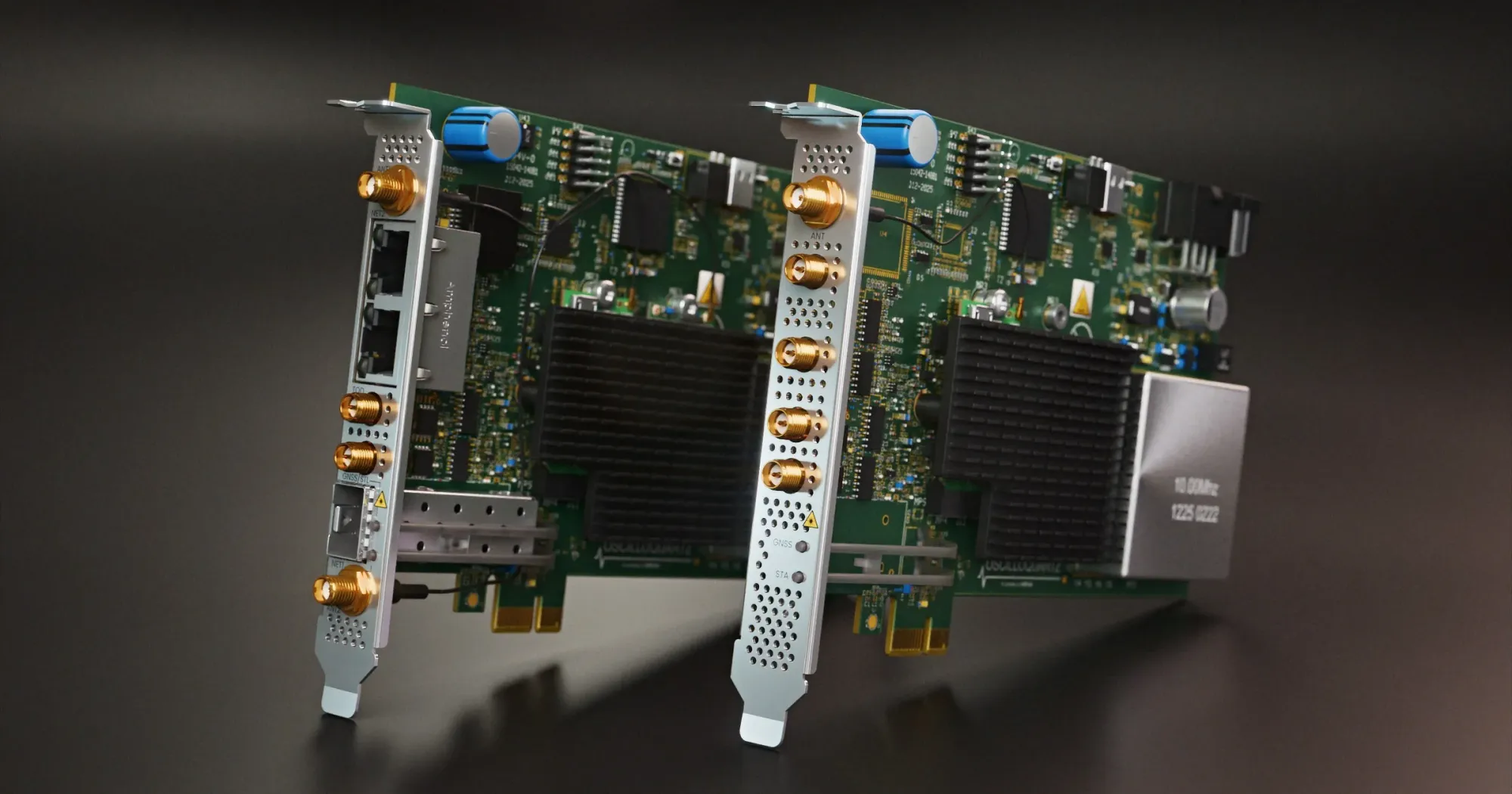
Oscilloquartz is shifting high-performance synchronization from external appliances directly into the server architecture to address growing demands for localized, resilient timing. By expanding its OSAinside™ Series OSA 5400 TimeCard™, the company is enabling organizations to embed precise synchronization into commercial off-the-shelf (COTS) and purpose-built servers. This development targets sectors where timing accuracy is critical, including defense, telecommunications, data centers, and financial services.
OSA 5400 TimeCard Expansion
The company is positioning the enhanced OSA 5400 TimeCard™ and the OSA 5400 TAP TimeCard™ as tools to reduce reliance on dedicated external timing hardware. The platform introduces PCIe Precision Time Measurement (PTM) and supports multi-band L1/L5 GNSS, including NavIC and Galileo OSNMA. To bolster resilience in GNSS-challenged environments, Oscilloquartz is offering optional Iridium® PNT as an alternative timing source. The hardware is also designed to support White Rabbit technology via a future firmware upgrade. These features aim to provide advanced jamming and spoofing detection, ensuring synchronization remains stable even under interference.
Diverse Deployment Architectures
Oscilloquartz is providing multiple technical pathways for server integration depending on specific enterprise requirements. The OSA 5400 TAP TimeCard™ is built to support the OCP-TAP architecture and utilizes Linux-based management. Meanwhile, the standard OSA 5400 TimeCard™ adds PTP grandmaster, boundary clock, and slave clock capabilities, alongside NTP support. The platform accommodates various timing interfaces and timecode formats, such as IRIG-B, STANAG 4430, and NMEA-0183. According to VP of product management Igal Pinhasov, these enhancements bring advanced timing capabilities directly into the host system to meet the performance and resilience requirements of demanding synchronization applications.
Key Takeaways
- The OSA 5400 TimeCard™ enables synchronization integration into COTS and purpose-built servers.
- Enhanced capabilities include PCIe PTM, multi-band GNSS (NavIC/Galileo OSNMA), and optional Iridium® PNT.
- The platform supports multiple timecode formats, including IRIG-B, STANAG 4430, and NMEA-0183.
TechInsyte's Take
In our view, Oscilloquartz is responding to a fundamental shift where timing requirements are moving deeper into the compute stack. By moving synchronization from the network edge into the server itself, the company is addressing the vulnerabilities of centralized timing architectures. This integration into COTS hardware suggests a move toward more modular, scalable, and resilient digital infrastructure. For enterprise leaders in defense or finance, this reduces the physical footprint of timing hardware while potentially increasing the speed and security of time-sensitive data processing.
Questions & Answers
How does this integration affect hardware dependency for enterprise IT?
The OSA 5400 TimeCard™ allows organizations to integrate synchronization directly into COTS and purpose-built servers, which the company says reduces the need for dedicated external timing appliances.
What measures are included to protect against GNSS interference?
The platform includes advanced jamming and spoofing detection, supports multi-band L1/L5 GNSS (including NavIC and Galileo OSNMA), and offers optional Iridium® PNT for resilience in GNSS-challenged environments.
Which specific architectures and management systems are supported?
The OSA 5400 TAP TimeCard™ supports the OCP-TAP architecture and Linux-based management, while the standard OSA 5400 TimeCard™ provides PTP grandmaster, boundary clock, and slave clock capabilities.
Source: Oscilloquartz