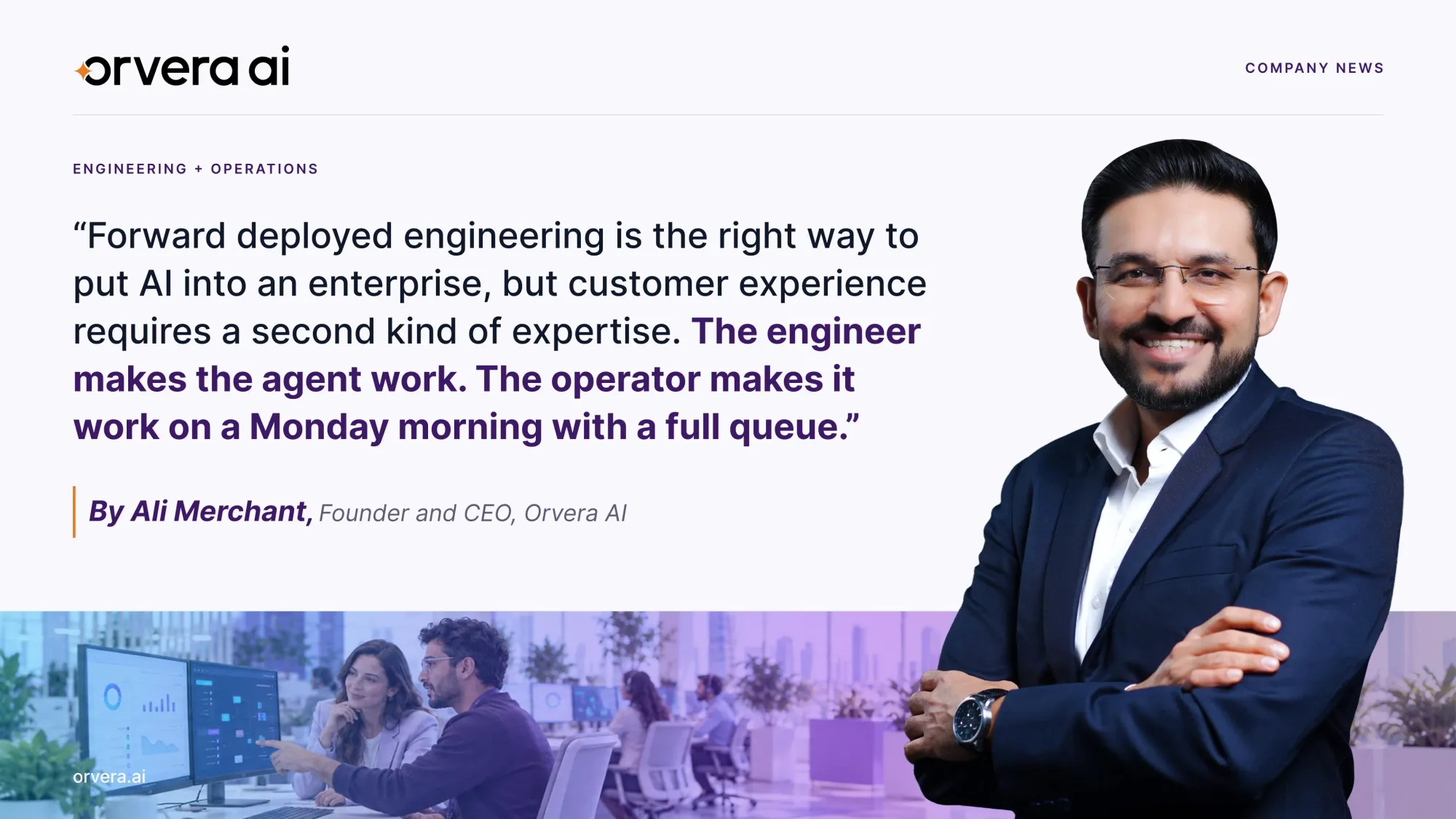
Orvera AI is attempting to bridge the gap between technical AI functionality and real-world contact center utility by restructuring its deployment methodology. The San Francisco-based agentic AI platform is now pairing every Forward Deployed Engineer with a Forward Deployed Ops Expert for all enterprise deployments. This strategic shift addresses a recurring failure point in enterprise AI: the tendency for agents to function technically within a sandbox while failing to meet the chaotic, high-pressure operational demands of a live contact center floor. By integrating specialized operational knowledge directly into the technical deployment phase, Orvera AI aims to ensure that AI agents can navigate complex service-level requirements and compliance nuances that are often absent from formal technical specifications.
Orvera AI Integrates Operational Expertise into Deployment Teams
The company is moving away from a purely engineering-centric deployment model to a dual-specialist approach that spans from initial scoping through go-live and ongoing operations. Under this new structure, the Forward Deployed Engineer remains responsible for technical execution, including integrations, event flow, technical orchestration, and failure handling. However, the newly introduced Forward Deployed Ops Expert focuses on the operational layer, managing how the AI interacts with existing contact center workflows, service levels, and quality scorecards.
Orvera AI is positioning this model as a solution to the "unwritten" requirements of customer experience. According to CEO Ali Merchant, while engineers ensure the agent works, operators ensure it functions effectively during high-volume periods, such as a "Monday morning with a full queue." These Ops Experts are selected based on their direct experience managing queues, grading conversations against quality rubrics, and maintaining accountability for service-level performance. During the scoping phase, these specialists identify system-of-record owners and operational dependencies to ensure that the technical team has the necessary inputs to validate business outcomes early in the deployment lifecycle.
Validating AI Performance Through System-of-Record Evidence
Orvera AI is also applying this dual-specialist logic to how it measures the success of its agentic AI. The company notes that a conversation transcript may appear successful even if the underlying business task remains unfulfilled, such as a failed credit application, an incorrect case disposition, or a missed scheduled callback. To combat this, Orvera AI evaluates both the verbal content of a conversation and the actual technical actions taken by the AI.
The Forward Deployed Engineer facilitates this by connecting evidence across various enterprise systems, while the Forward Deployed Ops Expert identifies which specific records, fields, and operational signals serve as proof of work completion. This approach allows Orvera AI to translate a customer’s existing manual evaluation forms into automated AI scorecards. These scorecards are then calibrated against real conversations and the customer’s own quality analysts, allowing the AI to learn and apply the enterprise's specific definition of quality. This calibration process is designed to be repeatable, adjusting as operational requirements or quality standards evolve over time.
Key Takeaways
- Orvera AI is pairing a Forward Deployed Ops Expert with a Forward Deployed Engineer for every enterprise deployment to manage both technical and operational requirements.
- The company evaluates AI performance by comparing conversation transcripts against system-of-record evidence to ensure business actions, such as case updates or scheduled callbacks, are actually completed.
- Orvera AI offers a model-agnostic platform that orchestrates third-party models within a governed layer, aiming for full deployment within a three-to-six-week window.
TechInsyte's Take
In our view, Orvera AI’s decision to embed contact center veterans into the engineering workflow is a pragmatic response to the "last mile" problem in enterprise AI. Many organizations struggle with AI deployments that pass technical validation but fail to survive the nuances of real-world exceptions, compliance mandates, and service-level pressures. By treating operational knowledge—such as queue behavior and escalation protocols—as a core deployment requirement rather than an afterthought, Orvera is attempting to de-risk the transition from sandbox to production. This signals a growing recognition in the enterprise software market that technical integration is only half the battle; the true value of agentic AI lies in its ability to execute verifiable business outcomes within existing, often messy, operational frameworks. For CIOs, this approach suggests that the success of AI agents may depend as much on operational calibration as it does on the underlying large language models.
Questions & Answers
How does Orvera AI distinguish between technical success and operational success in its AI agents?
Technical success is defined by the engineer's ability to manage integrations, event flows, and orchestration. Operational success is defined by the agent's ability to meet service levels, follow compliance protocols, and complete actual business tasks—such as updating a case or applying a credit—which Orvera verifies by comparing conversation data against system-of-record evidence.
What specific roles do the Forward Deployed Ops Experts play during the initial scoping phase?
During scoping, Ops Experts identify the owners of various systems-of-record and determine the operational dependencies required to validate business outcomes. This ensures that the technical deployment team has access to the necessary data inputs and system access points required to prove the AI is performing its intended tasks.
Can Orvera AI's automated quality scorecards be adjusted as company standards change?
Yes. Orvera AI designs its scorecards to be calibrated against a customer's existing quality analysts and real conversations. The company states that this calibration can be repeated, allowing the AI to adapt its definition of quality as the enterprise's operational requirements or evaluation forms evolve.
What is the intended deployment timeline for Orvera AI's managed service?
Orvera AI aims to complete full deployments within a timeframe of three to six weeks, utilizing its model-agnostic platform to orchestrate third-party models on a customer's existing technology stack.
Source: Orvera AI