
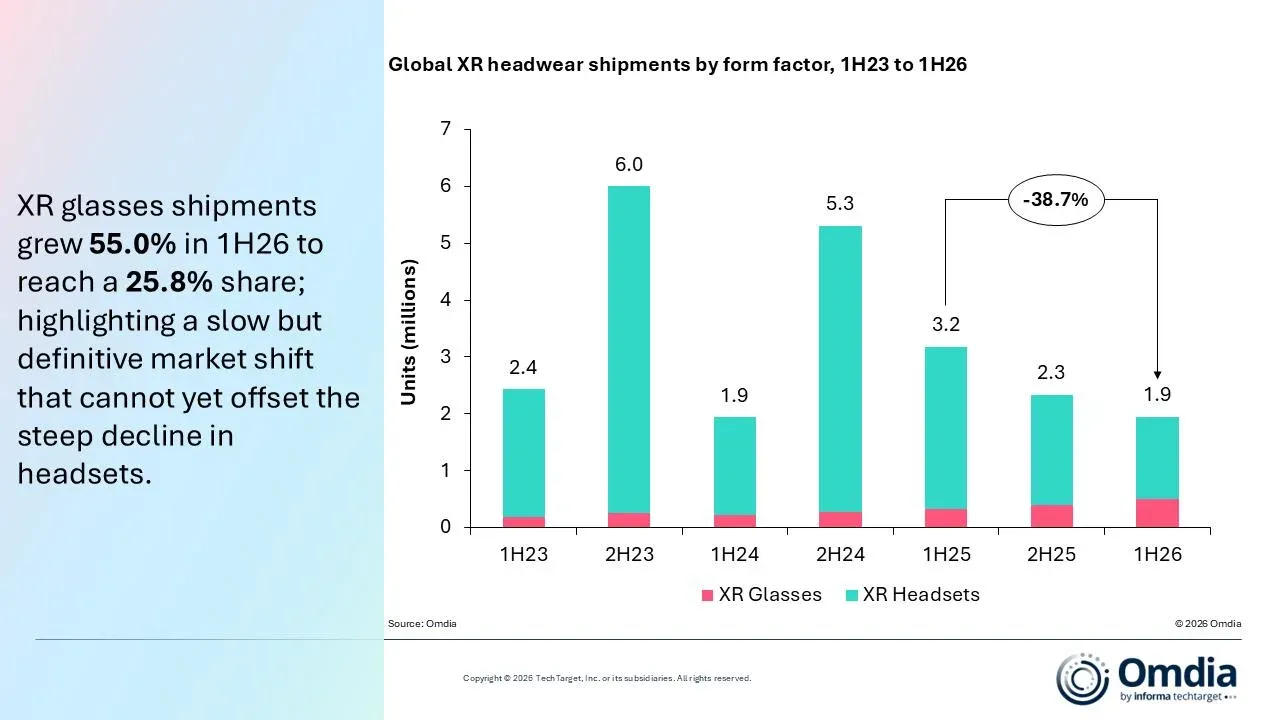
The extended slump in immersive hardware continues to challenge the extended reality market, as declining headset demand outweighs the emergence of lighter wearable alternatives. Global XR headwear shipments fell 38.7% year-on-year to 1.9 million units during the first half of 2026, according to Omdia. This contraction marks the fourth consecutive year of market decline following the 2021 pandemic peak, signaling a difficult period for high-immersion hardware providers.
XR Glasses Gain Share Amid Headset Slump
While the broader market contracted, XR glasses expanded their share of total shipments to 25.8% in 1H26, up from 10.2% in 1H25. This growth is primarily driven by the tethered display glasses segment, where RayNeo, VITURE, and XREAL collectively captured 93.1% of the market. Strong demand for specific hardware, such as the RayNeo Air 4 and VITURE Beast series, propelled RayNeo and VITURE into second and third place in the overall XR headwear market, holding 9.9% and 8.6% shares, respectively. Omdia analyst Qiran Ju suggests consumers are increasingly willing to trade immersion for reduced friction, utilizing lighter designs for familiar use cases like gaming and video viewing.
Meta Market Share Declines as Headset Demand Weakens
Meta remains the overall market leader but saw its share drop sharply from 71.3% in 1H25 to 48.2% in 1H26. This decline follows weakening demand for the Meta Quest 3 and 3S. Despite offering improved specifications at accessible price points, these devices have failed to trigger a major upgrade cycle or expand the user base beyond enthusiasts. Regionally, North America maintains the largest shipment share at 43.9%, while Western Europe follows at 23.8%. Notably, Greater China saw its global shipment share grow from 11.9% in 2025 to 16.3% in 1H26, overtaking the Rest of Asia-Pacific as the third-largest market due to domestic uptake of tethered glasses.
Key Takeaways
- Global XR headwear shipments fell 38.7% year-on-year to 1.9 million units in 1H26.
- XR glasses increased their shipment share from 10.2% in 1H25 to 25.8% in 1H26.
- Meta's market share decreased from 71.3% in 1H25 to 48.2% in 1H26.
TechInsyte's Take
In our view, the data suggests a fundamental shift in the XR value proposition. The market is moving away from isolated, high-immersion virtual environments toward "light-touch" interactions. Meta’s struggle to replicate the Quest 2's success indicates that even improved specs cannot overcome the inherent friction of bulky headwear. For enterprise leaders, this signals that the next phase of spatial computing will likely prioritize AI-integrated, everyday wearables over dedicated VR headsets, as the industry attempts to move beyond a niche enthusiast base into broader consumer adoption.
Questions & Answers
How is the competitive landscape shifting between headsets and glasses?
The market is seeing a pivot toward lighter, tethered display glasses. While Meta still leads the total market with a 48.2% share, specialized players like RayNeo and VITURE are capturing significant ground in the growing glasses segment, which now accounts for over a quarter of all shipments.
What is driving the growth in the Greater China XR market?
Greater China's shipment share rose to 16.3% in 1H26, up from 11.9% in 2025. This growth is being supported by strong domestic demand for tethered display glasses, allowing the region to surpass the Rest of Asia-Pacific as the third-largest market.
Why has Meta's market dominance decreased?
Meta's share fell from 71.3% to 48.2% because demand for the Meta Quest 3 and 3S has weakened. Analysts suggest that despite better specs and accessible pricing, these headsets have failed to drive a significant upgrade cycle or expand the audience beyond core enthusiasts.
What does the current shipment trend indicate about XR hardware design?
The 38.7% decline in total shipments and the rise of XR glasses suggest that "bulky headwear" is a barrier to adoption. The market is trending toward devices that offer less friction and more natural, everyday use cases rather than closed-off, immersive sessions.
Source: Businesswire