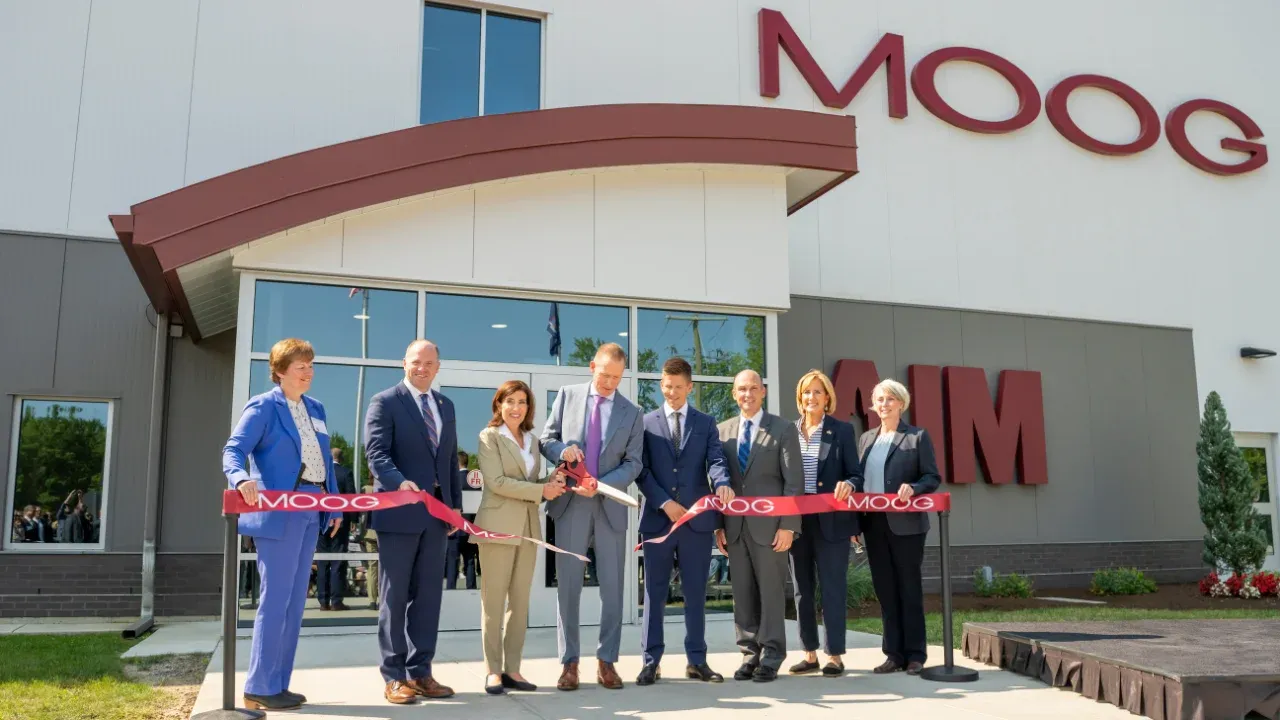
Moog Inc. has officially opened its new Advanced Integrated Manufacturing (AIM) facility in East Aurora, New York, marking a significant milestone alongside the company's 75th anniversary. This $150 million investment establishes a 150,000-square-foot manufacturing center designed to expand production capabilities and enhance operational efficiency through advanced technology. By integrating automation, robotics, and sophisticated inspection systems, the AIM facility aims to strengthen the U.S. defense manufacturing sector and support critical military aircraft programs. This expansion is part of a broader $300 million regional investment strategy by Moog over the last five years, reinforcing its commitment to Western New York as a primary global hub for precision motion control and aerospace engineering.
Moog’s $150M AIM Facility and Production Expansion
The newly inaugurated AIM facility represents a substantial increase in physical capacity, providing nearly 50 percent more space than the operation it is replacing. To drive modern manufacturing standards, the center features advanced machining, automation, and robotics technologies. These technical integrations are intended to improve product flow, safety, and quality control for high-stakes applications. Over the coming years, Moog plans to transition approximately 1,500 parts into the AIM facility, prioritizing the company's highest-volume products to maximize immediate throughput.
This facility serves as a cornerstone for Moog’s mission to support critical military aircraft programs and next-generation technologies. The investment follows other significant regional developments, such as the 120,000-square-foot Space Actuation and Avionics center in East Aurora and a new propulsion clean room in Niagara Falls. The Niagara Falls site is specifically designed to increase production capacity by more than 80 percent to meet the rising demand for satellite and missile propulsion technologies. By centralizing these advanced capabilities, Moog is positioning its Western New York operations to handle increasingly complex requirements for launch vehicles, spacecraft, and defense-related hardware.
Strengthening the Defense Industrial Base and Workforce
Moog’s strategic expansion is deeply tied to its regional workforce and the broader U.S. defense industrial base. The company currently employs over 4,300 people in Western New York, which accounts for approximately 30 percent of its total global workforce. To sustain this specialized labor pool, Moog recently opened a 13,000-square-foot Operations Training Center to provide hands-on career development. Furthermore, to address long-term talent pipelines, the company announced a STEM scholarship initiative to fund 75 scholarships of $1,951 each through local organizations like Buffalo Prep and Say Yes Buffalo.
The economic footprint of these investments is significant. Last year, Moog provided nearly $500 million in local wages and spent approximately $40 million with more than 200 local suppliers. By upgrading its manufacturing infrastructure, Moog is not only increasing its own technical capacity but also reinforcing the regional economy and the national security supply chain. The AIM facility is designed to provide the flexibility required to adapt to evolving defense needs, ensuring that the company can deliver safety-critical products while maintaining a competitive edge in the global aerospace and motion control markets.
Key Takeaways
- Moog invested $150 million in a new 150,000-square-foot Advanced Integrated Manufacturing (AIM) facility in East Aurora, NY.
- The AIM facility will transition nearly 1,500 parts into its operations, starting with high-volume products to support military aircraft programs.
- To support future engineering talent, Moog is funding 75 STEM scholarships valued at $1,951 each through four Western New York organizations.
TechInsyte's Take
In our view, Moog’s $150 million AIM investment is a calculated move to de-risk its supply chain for high-growth defense and space sectors. By significantly expanding its footprint and integrating robotics and automation, Moog is addressing the dual challenges of increasing demand for missile and satellite propulsion and the persistent scarcity of specialized technical labor. The decision to tie massive capital expenditures to localized workforce development—specifically through the new Operations Training Center and STEM scholarships—suggests that Moog views human capital as a critical component of its manufacturing scalability. This integrated approach to facility expansion and talent pipeline management signals a long-term strategy to maintain dominance in the precision motion control market while insulating its operations from the volatility often seen in the broader aerospace and defense industrial base.
Questions & Answers
How will the new AIM facility impact Moog's production of defense-related components?
The AIM facility will increase production capabilities through advanced machining, automation, and robotics. It is specifically designed to support current military aircraft programs and will eventually house nearly 1,500 different parts, beginning with the company's highest-volume products to improve efficiency and quality.
What is the scale of Moog's recent capital investment in the Western New York region?
Moog has invested more than $300 million in Western New York over the last five years. This includes the $150 million AIM facility, the 120,000-square-foot Space Actuation and Avionics center, a new propulsion clean room in Niagara Falls, and a 13,000-square-foot Operations Training Center.
How is Moog addressing the long-term availability of a skilled manufacturing workforce?
Moog is utilizing a multi-pronged approach: establishing a 13,000-square-foot Operations Training Center for hands-on career development and launching a STEM scholarship initiative that provides 75 scholarships of $1,951 each to local students through partner organizations.
What specific capacity increases are expected from Moog's recent infrastructure projects?
While the AIM facility provides 50 percent more space than its predecessor, the new propulsion clean room in Niagara Falls is specifically noted for its ability to increase production capacity by more than 80 percent to meet demand for satellite and missile propulsion technologies.
Source: Moog