JFrog is attempting to close a critical visibility gap in the software supply chain by moving security enforcement from the development pipeline directly to the network edge. By integrating its new Traffic Controller solution with major Secure Access Service Edge (SASE) providers, the company aims to intercept software package requests before they reach end-user machines or autonomous AI agents. This strategic shift targets the growing risk of "shadow" dependencies—packages pulled directly from public registries by tools that bypass traditional enterprise proxies and security gates. As AI coding agents like Claude Code and GitHub Copilot begin to autonomously manage dependencies, JFrog is positioning its platform as the mandatory checkpoint for all outbound software requests. This integration with Zscaler, Cloudflare, and Netskope seeks to ensure that even unmonitored AI sessions must flow through a governed system of record, effectively turning the network perimeter into an extension of the secure development pipeline.
JFrog Traffic Controller Targets AI-Driven Supply Chain Risks
The motivation behind the JFrog Traffic Controller launch is a documented surge in sophisticated supply chain threats. According to JFrog’s 2026 Software Supply Chain Security State of the Union, malicious packages increased by 451% year-over-year, totaling more than 171,000 unique instances. Despite this escalation, the company notes that only 40% of organizations currently possess malicious package detection capabilities, while secrets detection is active in only 28% of enterprises. This coverage gap is particularly acute in the context of generative AI. Modern AI coding agents, including Cursor and Kiro, operate directly on developer workstations and often pull libraries or install dependencies without human oversight or adherence to standard proxy configurations.
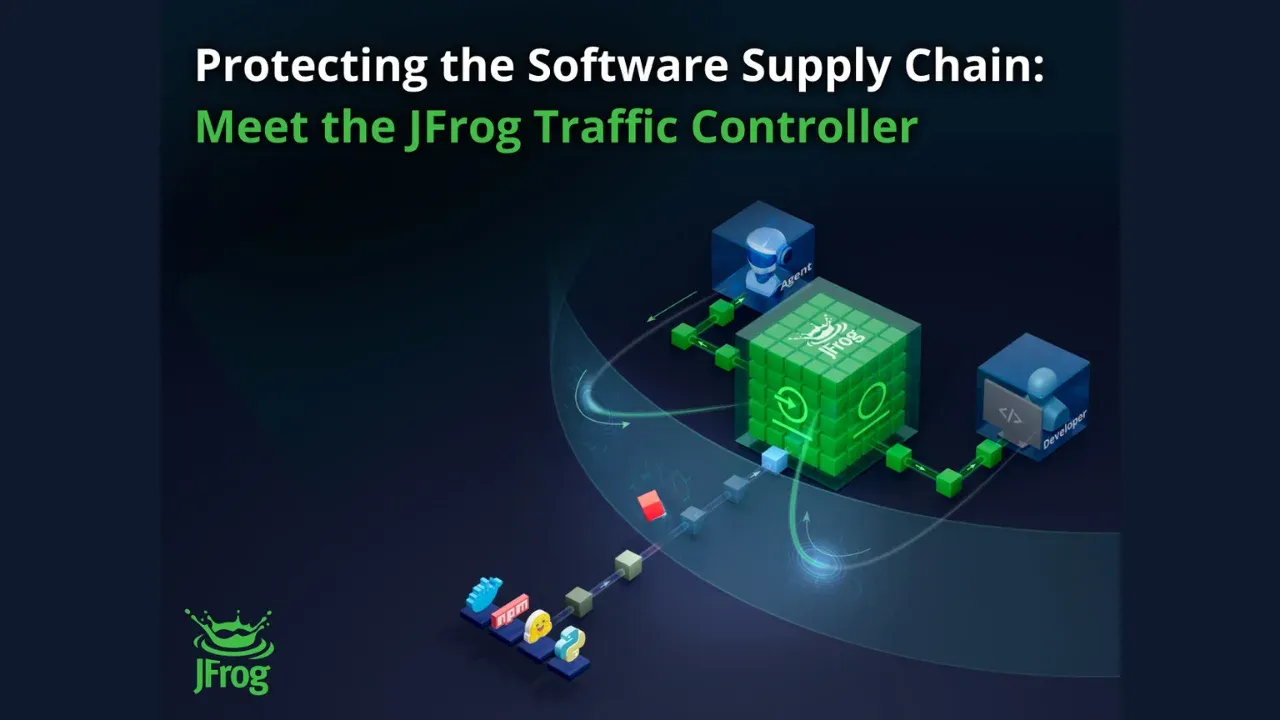
To address this, JFrog is deploying a rerouting mechanism rather than a simple blocking tool. The Traffic Controller works in tandem with JFrog Curation to intercept outbound requests at the network layer. When a developer or an AI agent attempts to download a package from a public registry, the SASE-integrated solution transparently redirects that request to JFrog Artifactory. Once inside Artifactory, the package undergoes inspection against established security, license, and quality policies. If a package is deemed compliant, it is delivered to the user; if it is malicious, the system stops the download and, where possible, automatically serves a safe, approved version. This approach is designed to maintain developer velocity by preventing the "hard blocks" that typically disrupt automated workflows, while still enforcing a single, auditable source of truth for all software artifacts and AI assets.
SASE Integration and the Expansion of Network-Layer Enforcement
The technical implementation of the Traffic Controller relies on deep integration with established SASE providers to achieve universal enforcement. JFrog has confirmed immediate support for three key industry players, each handling the redirection through different technical mechanisms. Zscaler Internet Access (ZIA) is utilized to identify and curate supply chain traffic through the JFrog platform. Cloudflare Gateway can be configured to perform TLS inspection on public registry traffic, allowing it to apply firewall policies that redirect package requests to JFrog Artifactory. Netskope One SSE applies real-time protection policies to redirect package manager traffic, utilizing browser passthrough to minimize the impact on the end-user experience.
This multi-vendor strategy suggests that JFrog is positioning its platform as a universal control point that does not require organizations to replace their existing security infrastructure. By embedding package intelligence into the existing SASE layer, the company aims to capture traffic from non-engineering employees and automated build tools that might otherwise bypass pipeline-level controls. This is particularly relevant as the window between vulnerability disclosure and active exploitation continues to shrink, sometimes to just a few hours. By enforcing policy at the network edge, JFrog intends to provide the visibility necessary to answer whether an organization is exposed to a new threat before an attacker can exploit it. The company has indicated that support for additional SASE partners is expected to follow this initial rollout.
Key Takeaways
- JFrog reported a 451% year-over-year increase in malicious packages, reaching over 171,000 unique instances.
- The Traffic Controller solution integrates with Zscaler, Cloudflare, and Netskope to reroute package requests through JFrog Artifactory for inspection.
- Only 40% of organizations currently have malicious package detection capabilities in place, according to JFrog's research.
TechInsyte's Take
In our view, JFrog is making a calculated bet that the primary frontier of software supply chain security has shifted from the CI/CD pipeline to the autonomous agent. For years, enterprise security focused on "locking down the build," assuming that if the pipeline was secure, the software was safe. However, the rise of AI coding agents—which act as unmonitored, high-velocity users of the network—renders pipeline-only security insufficient.
By partnering with SASE providers, JFrog is effectively attempting to "claim" the network edge as a security checkpoint. This is a sophisticated move to capture the "shadow IT" of the AI era: the autonomous dependencies pulled by agents that never touch a formal build server. If successful, this integration could transform SASE from a general web-filtering tool into a specialized gatekeeper for the software development lifecycle. For CIOs, this signals a move toward a more unified security model where network-layer enforcement and developer-layer governance are no longer siloed, but are instead part of a single, continuous loop of trust.
Questions & Answers
How does the Traffic Controller prevent AI agents from bypassing security protocols?
The Traffic Controller works at the network layer via SASE integrations (Zscaler, Cloudflare, and Netskope) to intercept outbound requests. Because it operates at the network edge, it can redirect traffic from autonomous agents that do not follow standard proxy configurations or approved package lists, forcing them to route through JFrog Artifactory for policy enforcement.
What is the functional difference between "blocking" and the "rerouting" approach used by JFrog?
Unlike traditional security tools that simply block out-of-policy requests—which can disrupt automated workflows—the Traffic Controller transparently reroutes requests to JFrog Artifactory. This allows the system to inspect the package via JFrog Curation and, if a safe, approved version is available, serve that version automatically to ensure development continues without interruption.
Which specific SASE providers currently support this new integration?
The solution is immediately available through Zscaler Internet Access (ZIA), Cloudflare Gateway (via TLS inspection), and Netskope One SSE. JFrog has stated that support for additional SASE partners is expected in the future.
Why is the rise of AI coding agents considered a specific risk to the software supply chain?
AI agents like Claude Code and Cursor can autonomously pull dependencies and install libraries directly on developer machines. Because these agents often operate outside of traditional, human-monitored pipelines, they create unmonitored entry points where malicious or unvetted packages can enter the organization's ecosystem without an audit trail.
Source: Businesswire