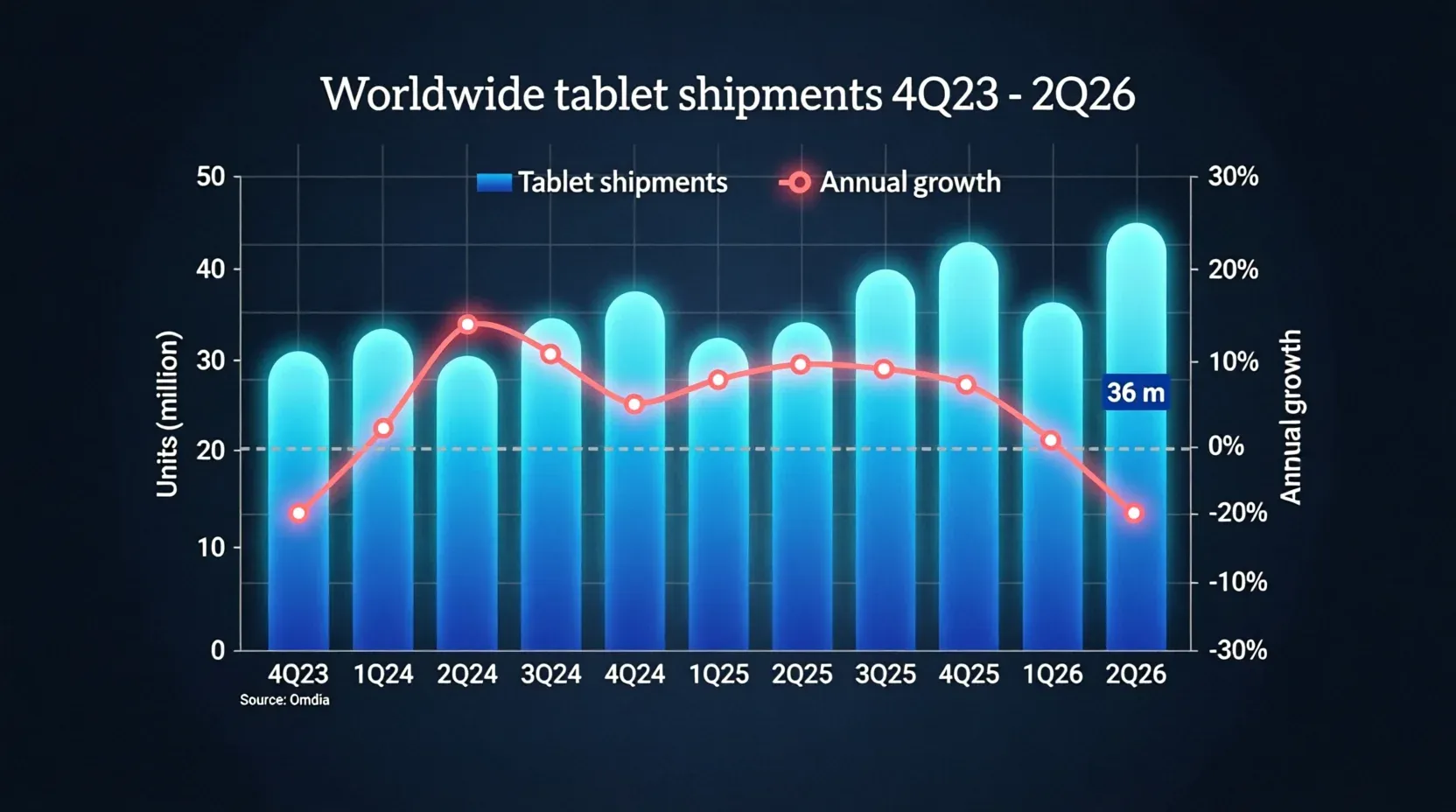
The global tablet market entered a period of significant contraction in the second quarter of 2026, with total shipments falling 10% year-on-year to reach 36 million units. According to the latest research from Omdia, this downturn represents one of the most aggressive market contractions observed within the last two years. Notably, the quarter defied traditional seasonal trends; the industry failed to realize the typical sequential increase usually catalyzed by the back-to-school demand cycle. This unexpected shift suggests a complex and volatile interplay between persistent supply chain constraints and evolving consumer purchasing behaviors. While tablets continue to maintain their status as integral household devices—increasingly serving as viable replacements for traditional PCs in specific use cases—the broader market is currently grappling with significant headwinds stemming from rising component costs and limited availability.
Omdia Reports Steepest Tablet Market Decline in Two Years
The Q2 2026 data paints a picture of a sector struggling to maintain momentum against mounting economic pressures. Omdia Research Manager Himani Mukka noted that while the slowdown was anticipated by industry analysts, the market had previously demonstrated a level of resilience that exceeded expectations. The current decline is being driven by a dual-pronged issue: the constrained availability of lower-priced tablet models and a growing trend of consumers delaying hardware upgrades in response to escalating retail costs.
This contraction is particularly pronounced within the Chromebook segment, which witnessed an 8.6% decline in shipments. The vulnerability of this category is largely structural; in the Chromebook market, memory costs have become a disproportionately large component of the total bill of materials (BOM) for budget-tier and education-focused devices. As these essential components become more expensive and harder to source, the profitability of entry-level devices is being squeezed, forcing a market-wide recalibration.
Despite the overarching downward trend, certain vendors have demonstrated an ability to navigate this volatility through strategic positioning. Lenovo emerged as a significant outlier in an otherwise declining market, recording a remarkable 27.1% year-on-year growth in shipments. This expansion was fueled by a combination of genuine end-user demand and highly effective strategic channel sell-in. By moving inventory ahead of anticipated price hikes and major retail promotional events, Lenovo successfully captured market share while competitors faltered.
In stark contrast, other industry titans faced notable setbacks. Samsung experienced a 13% decline in shipments, while Huawei saw its volume drop by 15.6%. Apple, despite maintaining its dominant position as the market leader, also succumbed to the downward trend, reporting an 8% year-on-year decline with total shipments amounting to 13.5 million units.
Shift Toward Premium Models and Service-Based Revenue
As component supply constraints persist, the strategic focus of hardware manufacturers is undergoing a fundamental transformation. Rather than attempting to sustain volume across the entire tablet category, vendors are expected to concentrate their limited resources on flagship and premium models to safeguard profit margins. This indicates a decisive move away from the high-volume, low-margin device strategy that previously drove market scale. Samsung, for example, is expected to dynamically adjust its product mix, prioritizing higher-margin models to ensure corporate profitability amidst rising costs.
This hardware-centric pivot is being accompanied by a broader evolution in vendor business models. To differentiate their offerings and generate consistent revenue amidst declining hardware volumes, tablet vendors are increasingly pivoting toward services, sophisticated AI integration strategies, and the development of new use-cases. This evolution suggests that the value proposition of the tablet is migrating away from simple hardware utility and toward integrated software and service ecosystems. For enterprise and institutional buyers, this signals a transition where the device is increasingly viewed as a sophisticated platform for specialized services rather than a standalone commodity.
Key Takeaways
- Market Contraction: Global tablet shipments fell 10% year-on-year to 36 million units in Q2 2026.
- Lenovo’s Outperformance: Lenovo was the only leading tablet vendor to record growth, with shipments increasing 27.1% year-on-year.
- Chromebook Surge: Asus saw a 66% surge in Chromebook shipments, driven by the US K–12 education refresh cycle and the GIGA 2.0 initiative.
TechInsyte's Take
In our view, the Q2 2026 data signals a fundamental pivot in the tablet and Chromebook sectors from volume-driven growth to margin-driven sustainability. The decision by major vendors to deprioritize low-profitability, budget-tier devices in favor of premium models is a direct response to the rising costs of critical components like memory. This creates a bifurcated market: a high-end segment focused on premium features and AI integration, and a struggling low-end segment facing supply and price hurdles. For decision-makers, this means the era of cheap, entry-level tablets may be facing a period of scarcity. We expect vendors to lean heavily into service-based revenue and AI-driven differentiation to offset the volatility in hardware shipments, making the software ecosystem as critical as the hardware itself.
Questions & Answers
How are supply constraints affecting the product mix of major tablet vendors?
Vendors are expected to prioritize flagship and premium models over lower-priced devices to protect their margins. This shift is a strategic response to the current component supply-constrained environment, where limited resources are being directed toward higher-margin hardware.
Why did Lenovo experience growth while other major vendors saw declines?
Lenovo's 27.1% growth in tablet shipments was driven by a combination of genuine end-user demand and strategic channel sell-in. This sell-in occurred ahead of anticipated price increases and major retail promotional events, allowing them to capture volume that others missed.
What is driving the decline in the Chromebook market?
The Chromebook decline is driven by rising memory costs, which represent a disproportionately large share of the bill of materials for budget and education-tier devices. Additionally, vendors are deprioritizing the category due to low profitability, and some institutional deployments have faced delays.
Which vendor is seeing significant growth in the Chromebook segment?
Asus is the standout performer in the Chromebook market, with shipments growing 66% year-on-year. This growth is attributed to its role as a key supplier for the US K–12 education refresh cycle and the GIGA 2.0 program.
Source: BUSINESSWIRE