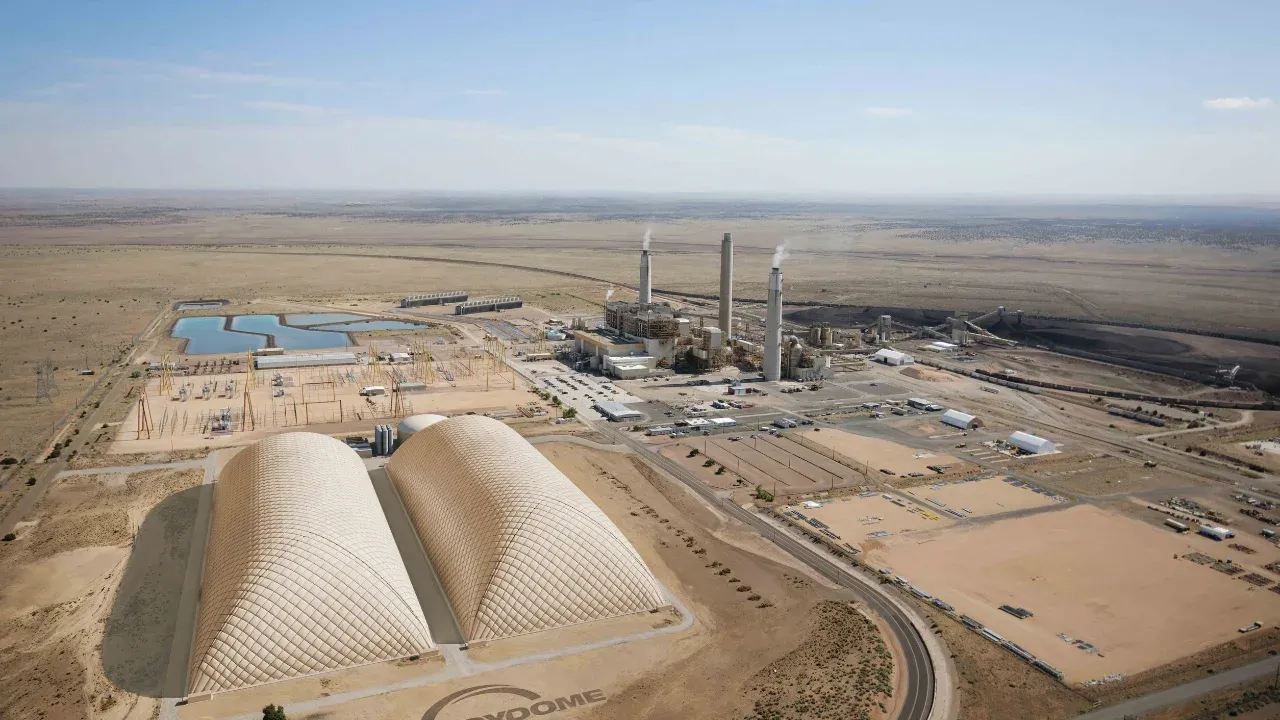
Energy Dome, a provider of capacity solutions for utilities and AI infrastructure, and Salt River Project (SRP), a not-for-profit public power utility serving the greater Phoenix metropolitan area, have agreed to add a 19 megawatt (MW), 10-hour carbon dioxide-based (CO2) battery system to the grid. This project is part of a strategic effort between SRP and Google to advance and deploy non-lithium-ion long-duration energy storage (LDES) technologies. By testing these alternatives, the partners aim to support grid reliability, affordability, and sustainability to meet the rising energy demands of the Phoenix metropolitan area.
Energy Dome and SRP Project at Coronado Generating Station
The CO2 battery system will be co-located at SRP’s Coronado Generating Station (CGS) in St. Johns, Arizona. Developed under a 20-year tolling agreement, Energy Dome will own and operate the facility while SRP will dispatch the output. The project was selected through a Request for Proposals for LDES pilots issued by SRP in 2024 and is expected to come online in 2029.
The system is designed to store enough energy to power approximately 4,275 homes for 10 hours. To ensure factual performance tracking, SRP and Energy Dome will collaborate with EPRI, an independent non-profit energy R&D institute, to monitor the project's performance data. According to Chico Hunter, SRP Manager of Innovation and Development, the project allows the utility to test the real-world performance of Energy Dome's technology specifically within the Arizona climate.
Energy Dome CO2 Battery Technology and Process
The project utilizes Energy Dome’s proprietary thermomechanical long-duration energy storage process. The system operates by using grid power to compress and store CO2; when energy is required, the CO2 is expanded through a turbine to generate electricity for the grid. According to Energy Dome CEO Claudio Spadacini, the solution is designed to be manufactured domestically and built quickly to provide the scalable, dispatchable capacity needed to strengthen U.S. energy dominance amidst AI growth and rising demand.
The deployment is part of a broader effort to diversify battery energy storage portfolios away from lithium-ion dependencies. Energy Dome stated that this project has accelerated its investment in U.S. supply chain development to support its mission of providing affordable, reliable energy to U.S. customers and creating American jobs.
Google and SRP Collaboration for Grid Resilience
The project represents the second milestone in a collaboration between Google and SRP to accelerate the deployment of LDES technologies. Google is funding a portion of the project through a cost-sharing agreement with SRP. Lucia Tian, Director of Advanced Energy Technologies at Google, stated the partnership is intended to bolster grid resilience and introduce vital new capacity to the system, building on a long-term partnership with Energy Dome to deliver cost-effective and sustainable energy for Arizona’s ratepayers.
The initiative aligns with SRP's broader infrastructure goals. The utility is working to at least double the number of generating resources on its power system by 2035 to meet the increasing energy demand of the Phoenix metropolitan area, with energy storage serving as an important part of that effort.
Key Takeaways
- The project features a 19 MW, 10-hour CO2 battery system expected to be operational by 2029.
- The facility will be located at the Coronado Generating Station in St. Johns, Arizona, under a 20-year tolling agreement.
- Google is providing partial funding via a cost-sharing agreement with SRP to test non-lithium-ion storage alternatives.
TechInsyte's Take
This project signals a shift toward diversifying energy storage beyond lithium-ion to meet the high-capacity demands of AI infrastructure and urban growth. Executives should monitor the 2029 deployment and EPRI's performance data to determine if thermomechanical CO2 storage can scale as a cost-effective alternative for utility-scale resilience. The primary uncertainty remains the real-world efficiency of this specific CO2 process within the Arizona climate.
Source: Businesswire