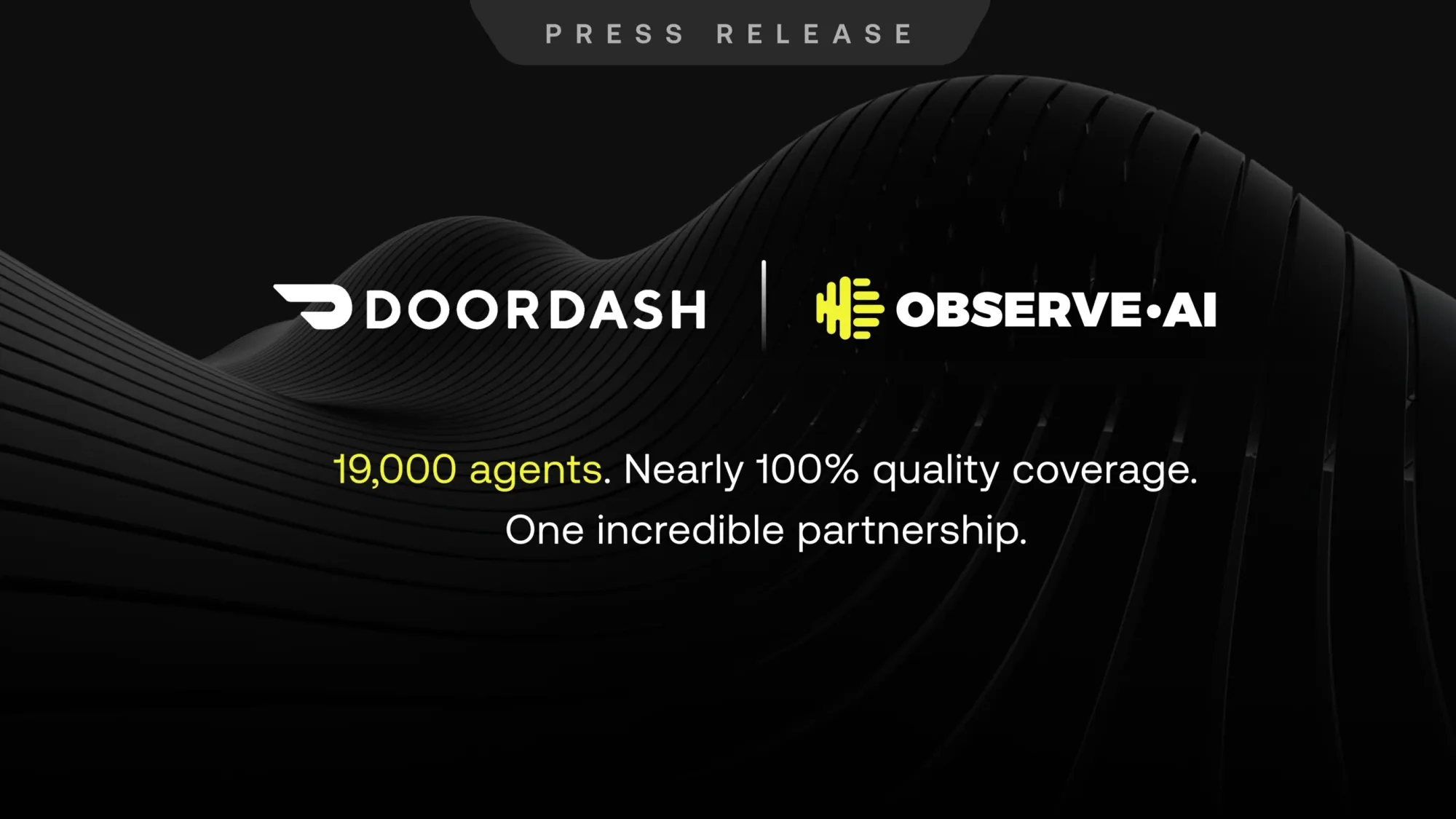
DoorDash has implemented a conversational intelligence platform to transform its customer support operations, utilizing a strategic collaboration with Observe.AI and Amazon Web Services (AWS). By leveraging AWS transcription and AI model infrastructure, the company has achieved nearly 100% automated interaction evaluations across its 19,000 agents. This shift moves the organization away from traditional, manual quality assurance processes that relied on limited sampling and binary scoring. Instead, the new framework provides real-time insight and deeper sentiment visibility, allowing DoorDash to identify customer pain points and behavioral drivers at an unprecedented enterprise scale.
DoorDash Automates 19,000 Agent Interactions
The transition from manual quality assurance to automated conversational intelligence allows DoorDash to move beyond simple compliance checks. Previously, the company relied on limited sampling, which made it difficult to uncover the true behavioral drivers behind customer dissatisfaction. By partnering with Observe.AI, DoorDash now evaluates nearly 100% of customer interactions automatically. This automation enables human quality teams to pivot from repetitive manual scoring toward high-value analysis, such as identifying subjective issues and ensuring customer safety and fairness. According to Xenia Strunnikova, Head of Customer Experience, Fraud, Trust & Safety S&O at DoorDash, the goal was to understand customer sentiment rather than adopting automation for its own sake. This approach positions customer experience at the center of their broader AI strategy, ensuring that operational innovation remains focused on meaningful, diagnostic insights rather than just increasing volume or speed.
Real-Time Hotspot Detection via AWS Infrastructure
The integration of Observe.AI and AWS infrastructure has fundamentally changed how DoorDash detects emerging product friction. By utilizing signals such as sentiment, comprehension metrics, and behavioral indicators, the platform can infer customer satisfaction even in the absence of explicit feedback. This capability has significantly accelerated the identification of "hotspots," such as concerns regarding DashPass or new feature launches. Joaquin Dufeu, Director of Strategy & Operations for CXI at DoorDash, noted that issues that previously required days or weeks to uncover are now surfaced in near real time. This shift supports a long-term ambition for real-time operational response and faster product iteration. The platform was developed through an iterative co-creation process between the three entities, ensuring the signals reflect specific operational realities. This collaborative model aims to provide objective signals that augment human judgment, creating more consistent coaching and stronger accountability across BPO relationships.
Key Takeaways
- DoorDash achieved nearly 100% automated quality coverage across its 19,000 customer support agents.
- The conversational intelligence platform utilizes AWS transcription and AI model infrastructure to detect product friction points in near real time.
- The initiative allows human quality teams to shift from manual binary scoring to high-value behavioral and safety analysis.
TechInsyte's Take
In our view, this deployment signals a critical shift in how enterprise leaders approach AI implementation: moving from "efficiency-first" automation to "insight-first" intelligence. DoorDash is not merely using AI to replace human oversight but is using it to solve the "sampling problem" that plagues large-scale BPO operations. By achieving near-total coverage, they have turned their support center into a real-time data engine for product development. This suggests that for CIOs and CTOs, the true value of generative and conversational AI lies in its ability to provide diagnostic depth that manual processes cannot reach, effectively turning customer friction into actionable engineering intelligence.
Source: PRNewswire