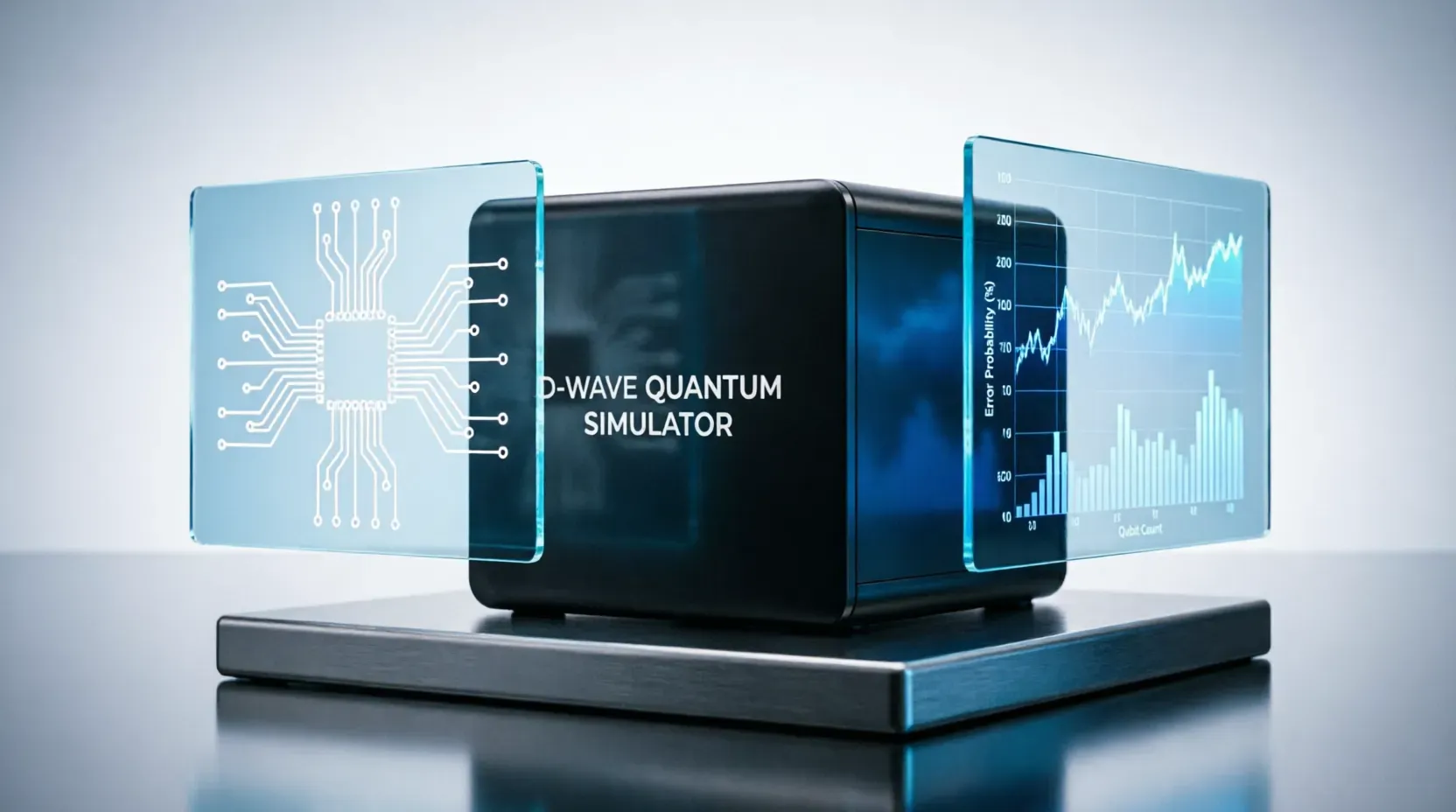
D‑Wave Quantum Inc. (NYSE: QBTS) announced a forthcoming gate‑model quantum computing simulator that it claims is the world’s first designed specifically for error‑aware programming. The simulator will be delivered through D‑Wave’s Leap™ cloud platform beginning in September 2026 and is positioned to help enterprise developers prototype applications, model processor behavior, and explore advanced workflows ahead of access to D‑Wave’s upcoming gate‑model hardware. By embedding error detection and real‑time control into the simulation environment, D‑Wave aims to give developers the same visibility they will eventually have on physical processors, thereby shortening the learning curve and accelerating the transition from algorithm design to production‑ready quantum software.
D‑Wave Announces World’s First Gate‑Model Quantum Computing Simulator
The company said the new simulator is built around its dual‑rail technology, a hardware‑level architecture that physically duplicates qubit pathways so that any deviation between the two rails can be identified as an error. According to D‑Wave, this approach gives developers continuous insight into error sources, enabling them to design applications that respond dynamically to the kinds of noise and decoherence that will be present on real gate‑model processors. “Error awareness is built into the architecture through dual‑rail technology, giving developers access to error‑detection data and real‑time control capabilities that can help them design more resilient quantum applications,” said Dr. Trevor Lanting, chief development officer at D‑Wave.
The simulator will support up to 21 qubits, matching the qubit count announced for D‑Wave’s first gate‑model hardware generation. It offers two distinct operating modes: an ideal mode that assumes perfect, noiseless qubits for algorithmic validation, and a hardware‑emulation mode that injects realistic error profiles derived from the dual‑rail architecture. In hardware‑emulation mode, the platform runs Monte Carlo simulations of real‑time quantum system dynamics, allowing developers to observe how stochastic error events propagate through circuits and to test error‑correction routines before any physical device is available.
Integration with D‑Wave’s Ocean™ SDK ensures that users can continue to work with familiar Python‑based tools, such as dimod and dwave‑system, while accessing the new error‑aware features. The SDK’s existing abstractions for problem formulation and embedding are extended to expose error‑detection flags and control knobs, so developers can programmatically adjust error mitigation strategies on a per‑circuit basis. This tight coupling of simulation and development environment is intended to reduce the friction that typically arises when moving from a classical simulation workflow to a quantum hardware testbed.
Integration with Leap Cloud and Quantum Development Bundles
Access to the simulator will be delivered via D‑Wave’s Leap™ cloud service, which the company markets with 99.9 % availability and uptime. To streamline onboarding and provide predictable budgeting, D‑Wave is introducing two quantum development bundles—Starter and Premium. Both bundles allocate a monthly quota of simulator runtime and include direct guidance from D‑Wave’s team of experts, who can assist with environment setup, workflow optimization, and troubleshooting of error‑aware code. Pricing for the bundles is available on request, reflecting D‑Wave’s intent to tailor costs to the scale and intensity of each customer’s R&D program.
The bundles are designed to support a spectrum of needs: the Starter package targets organizations that are beginning to explore gate‑model concepts, offering enough compute time to run small‑scale experiments and become familiar with dual‑rail error data. The Premium package expands the monthly allocation, provides priority support, and adds optional consulting sessions that can help teams design and validate custom error‑correction protocols. By bundling access with expert assistance, D‑Wave hopes to lower the barrier to entry for enterprises that lack deep quantum‑hardware expertise but wish to build quantum‑ready applications.
Customers can request future access through a sign‑up link included in the announcement. While the press release does not disclose specific capacity limits for each bundle, it emphasizes that the offering is intended to give customers “budget predictability and dedicated access needed to run more workloads, iterate more freely and accelerate quantum application progress.”
Capabilities Targeted at Enterprise R&D
The simulator’s error‑aware programming model is designed to help organizations develop and test error‑correction routines before hardware becomes generally available. By exposing error‑detection data and offering real‑time control, the tool aims to reduce the time developers spend debugging quantum code on actual processors. D‑Wave states that the simulator will allow users to “model quantum processor behavior, error detection and real‑time control,” which could be valuable for teams building quantum‑ready applications in sectors such as finance, materials science, and logistics.
In practice, an enterprise R&D team could use the simulator to benchmark different error‑mitigation techniques—such as dynamical decoupling, logical qubit encoding, or post‑selection—under realistic noise conditions derived from the dual‑rail architecture. The Monte Carlo engine can generate statistically significant error distributions, enabling developers to quantify the trade‑offs between circuit depth, gate fidelity, and overall success probability. This data can then inform hardware‑agnostic algorithm design decisions, ensuring that once D‑Wave’s physical gate‑model systems are released, the software stack will already be optimized for the expected error landscape.
The announcement follows D‑Wave’s recent outline of its differentiated approach to fault‑tolerant quantum computing, which emphasizes hardware‑level error detection as a foundation for scalable quantum error correction. While the company emphasizes that the simulator is a step toward its gate‑model roadmap, it did not provide a timeline for the release of the physical gate‑model systems themselves. Nonetheless, the simulator serves as a concrete bridge for customers who wish to start building quantum expertise now, rather than waiting for the hardware to arrive.
Key Takeaways
- D‑Wave’s upcoming gate‑model simulator, built on dual‑rail technology, is marketed as the first error‑aware programming platform and will support up to 21 qubits.
- The simulator will be accessible through the Leap™ cloud platform starting September 2026, with Starter and Premium development bundles offered on a request‑based pricing model.
- Integrated tools include Monte Carlo simulation, hardware‑emulation modes, and compatibility with the Ocean™ SDK, aimed at helping enterprise teams prototype and test quantum applications before hardware availability.
TechInsyte's Take
The simulator provides a concrete entry point for enterprises that need to evaluate quantum algorithms while awaiting mature gate‑model hardware. Its error‑aware focus could shorten the learning curve for development teams, but the impact will depend on how closely the simulated error profiles match future physical processors. CIOs and CTOs should monitor the September 2026 launch and assess whether the bundled support aligns with their R&D timelines and budget constraints.
Source: Businesswire