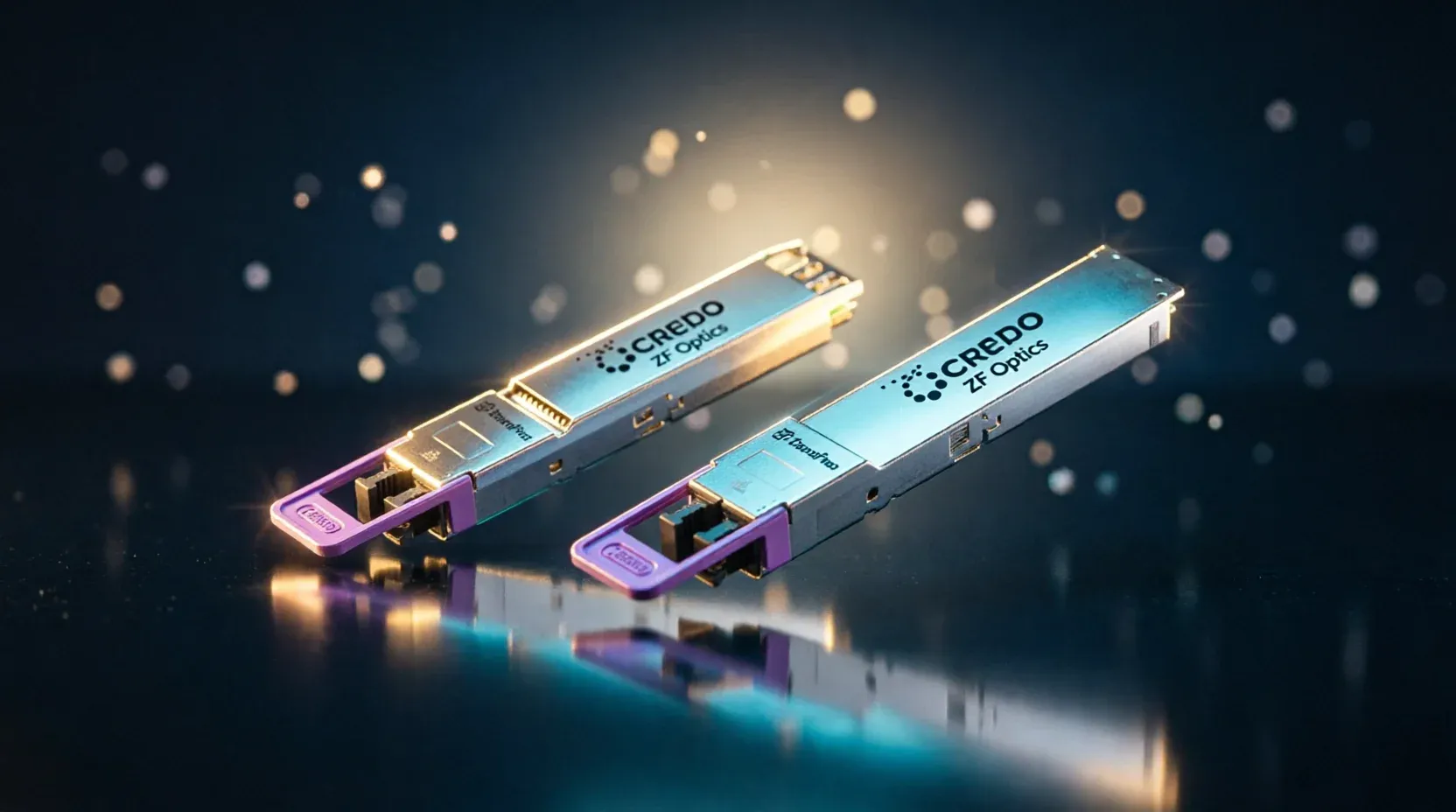
Credo Technology Group is positioning its high-speed connectivity roadmap to address the escalating bandwidth requirements of AI-driven data centers. The company plans to demonstrate its latest optical and silicon photonics innovations at the ECOC 2026 conference in Málaga, Spain, from September 21-23. This showcase targets the critical need for scalable, energy-efficient infrastructure within massive AI scale-out fabrics.
Credo 1.6T and Silicon Photonics Demonstrations
At ECOC 2026, Credo intends to present its 1.6T 2xDR4 fully retimed module, a solution designed to support the intensifying throughput demands of cloud and AI environments. This specific module utilizes the company's Cardinal 802 1.6T DSP alongside the Kfir 200G silicon photonics PIC. Additionally, the company will highlight its 800G and 1.6T ZeroFlap optics. These high-performance interconnects are integrated with the Credo PILOT observability platform, which aims to provide real-time link health monitoring and root-cause diagnostics. By combining hardware with the PILOT software, Credo is attempting to offer greater visibility and reliability for operators managing complex AI clusters.
Scaling Bandwidth and Optical Reliability
The company's technical agenda at the event includes deep dives into the architectural challenges of scaling optical networks. Mohsen Asad, Senior Director of Core Technology, is scheduled to lead a workshop titled "Can Fast Narrow Channels Keep Rising Without Limit or Will Slow and Wide Become the Winner?" This session addresses fundamental questions regarding channel architecture. Furthermore, Rajan Pai, Vice President of Optical Solutions, will present on "Scaling Optical Reliability with Bandwidth Across AI Clusters." These presentations suggest Credo is focusing on the intersection of raw bandwidth capacity and the operational stability required to maintain massive, interconnected AI compute environments.
Key Takeaways
- Credo will demonstrate a 1.6T 2xDR4 fully retimed module powered by the Cardinal 802 1.6T DSP and Kfir 200G silicon photonics PIC.
- The company is showcasing 800G and 1.6T ZeroFlap optics integrated with the PILOT observability platform for real-time diagnostics.
- Technical sessions at ECOC 2026 will address channel architecture and optical reliability within AI clusters.
TechInsyte's Take
In our view, Credo’s focus on 1.6T connectivity and the PILOT observability platform signals a strategic shift toward managing the complexity of AI scale-out fabrics. It is no longer enough to simply increase raw bandwidth; enterprise operators now require integrated diagnostic tools to maintain uptime. By linking high-speed silicon photonics with real-time monitoring, Credo is attempting to solve the dual challenge of extreme throughput and the operational fragility inherent in massive AI-driven data infrastructures.
Questions & Answers
How does Credo plan to address the reliability challenges of AI clusters?
Credo is positioning its ZeroFlap optics and PILOT observability platform as a solution for real-time link health monitoring and root-cause diagnostics to improve visibility in AI environments.
What specific hardware components drive the new 1.6T module?
The 1.6T 2xDR4 fully retimed module is powered by the Cardinal 802 1.6T DSP and the Kfir 200G silicon photonics PIC.
What is the strategic focus of Credo's upcoming technical presentations?
The presentations focus on the technical limits of channel architecture and the methods for scaling optical reliability across massive AI clusters.
When and where will these technologies be officially demonstrated?
The demonstrations will take place at the ECOC 2026 conference in Málaga, Spain, between September 21 and September 23.
Source: Businesswire