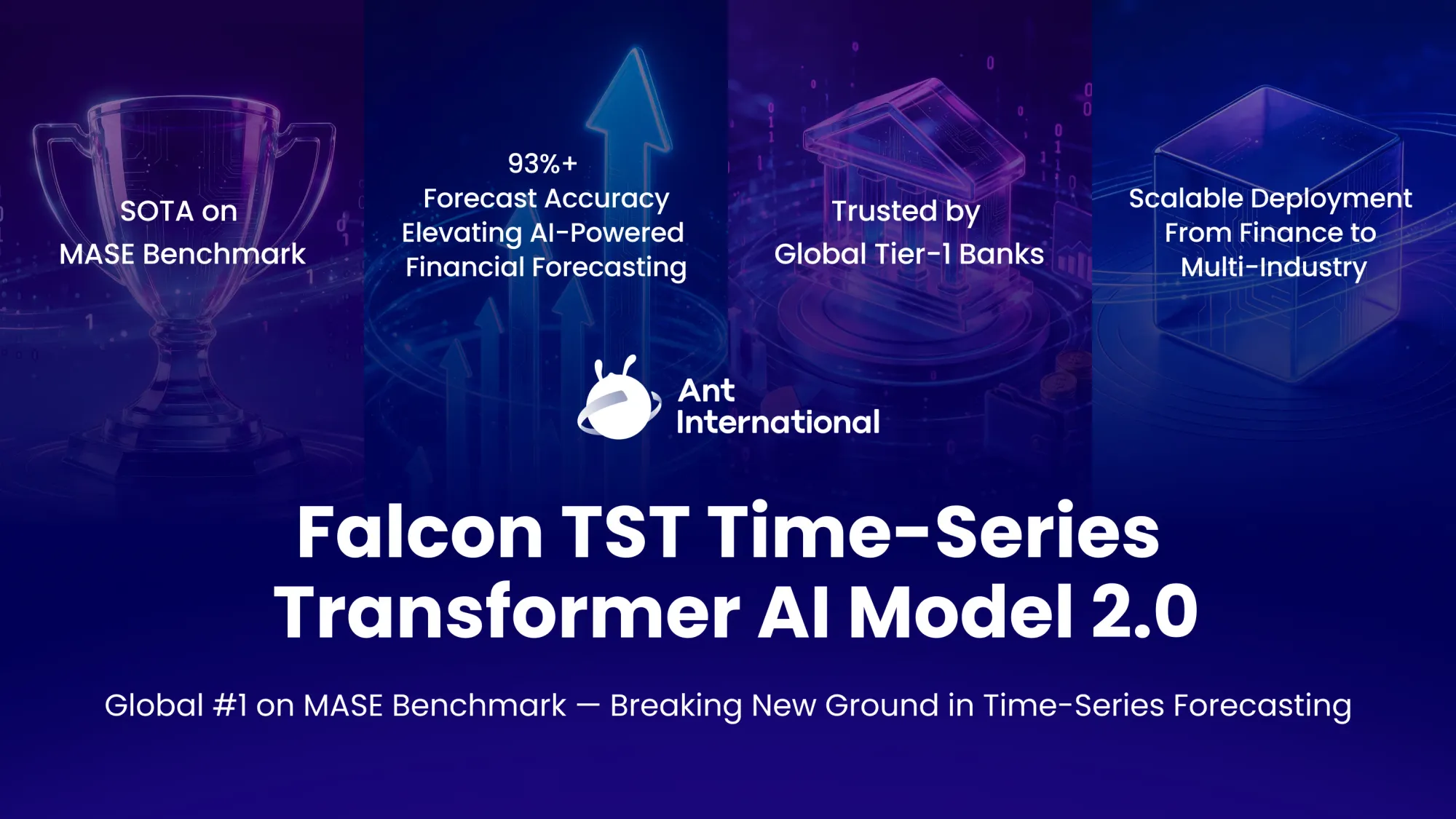
Ant International is positioning its latest time-series foundational model to move predictive AI from specialized financial tools to a reusable enterprise capability. The company has launched FalconTST 2.0, a Time-Series Transformer (TST) model designed to manage the rapid fluctuations in liquidity, foreign-exchange (FX) movements, and transaction flows inherent in global payments. By achieving state-of-the-art performance on the Mean Absolute Scaled Error (MASE) metric, the model aims to provide the precision required for high-stakes capital allocation. This deployment follows successful internal testing and integration by major global financial institutions, signaling a shift toward using foundational time-series models to manage complex, multi-currency operational risks across diverse industrial sectors.
FalconTST 2.0 Achieves SOTA on MASE Benchmarks
The release of FalconTST 2.0 marks a technical milestone in time-series forecasting, with the model securing a top position on global public evaluation leaderboards. Specifically, the model achieved a MASE score of 0.666, a critical metric for evaluating the accuracy of time-series foundational models. This performance reportedly surpasses other TST foundational models developed by leading global technology companies. Unlike large language models that prioritize textual relationships, FalconTST 2.0 is engineered to interpret continuously changing numerical data, such as account balances, settlement flows, and currency positions.
To address common data integrity issues in enterprise environments, the 2.0 version introduces advanced handling for missing data. The company notes that the model can distinguish between actual zero values and missing data points—such as a lack of bank transactions over a weekend—to prevent the generation of misleading patterns. Furthermore, the architecture supports multiple time frequencies, allowing it to process data ranging from second-level payment information to monthly economic indicators within a single framework. Through its ORBIT mechanism, the model attempts to learn common temporal patterns—including cycles, trends, and seasonality—across disparate domains like energy, retail, and tourism, which the company suggests enables direct forecasting in new business scenarios without requiring entirely separate models for every task.
Global Banking Integration and Sector Expansion
The deployment of FalconTST 2.0 has moved beyond internal use at Ant International into the core infrastructure of several major global banks. These institutions are integrating the model to enhance their FX hedging and liquidity management capabilities. Barclays has integrated the model into its BARX NetFX FX hedging platform, while Citi has combined it with its Fixed FX Rates solution. Additionally, Standard Chartered utilizes the model alongside its SCALE FX system as part of the PathFin.ai programme, a collaboration with the Monetary Authority of Singapore.
According to Ant International, these banking partners have adopted the 2.0 version, which has reportedly led to a consistent forecast accuracy rate of more than 93%. This level of precision is intended to mitigate the risks of over-hedging or under-hedging in foreign exchange markets. While the initial focus remains on the financial sector, Ant International is positioning the model as a reusable capability for other high-velocity industries. The company identifies aviation, e-commerce, and logistics as primary targets for expansion, noting that sectors like aviation require precise forecasting to manage revenues and costs that span multiple currencies and fluctuate rapidly.
Key Takeaways
- FalconTST 2.0 achieved a MASE score of 0.666, placing it at the top of global leaderboards for time-series foundational models.
- Major financial institutions, including Barclays, Citi, Deutsche Bank, and Standard Chartered, have integrated the model for FX and liquidity management.
- The model maintains a consistent forecast accuracy rate of over 93% across its current deployments.
TechInsyte's Take
In our view, Ant International is attempting to solve the "customization trap" that has long hindered enterprise AI. Traditionally, predictive modeling has been a fragmented endeavor, where an airline and a bank would each build bespoke, siloed systems for their specific temporal needs. By developing FalconTST 2.0 as a foundational model capable of learning cross-domain patterns through ORBIT, Ant is betting that temporal structures—cycles, seasonality, and shifts—are sufficiently universal to allow for a single, reusable architecture. If successful, this moves AI from a specialized cost center to a scalable, horizontal infrastructure component. The successful integration by tier-one banks like Citi and Barclays provides the necessary validation for this approach, suggesting that the market is ready for foundational time-series models that prioritize high-frequency, high-accuracy numerical forecasting over general-purpose generative capabilities.
Questions & Answers
How does FalconTST 2.0 differentiate between missing data and actual zero values?
The model utilizes advanced handling techniques to recognize that a lack of data—such as a gap in weekend bank transactions—does not equate to a zero-value demand. This distinction is designed to reduce the occurrence of misleading patterns in forecasting models.
Which specific banking platforms are currently utilizing this technology?
Barclays has integrated the model into its BARX NetFX platform, Citi uses it within its Fixed FX Rates solution, and Standard Chartered employs it alongside its SCALE FX system.
What is the strategic advantage of using a TST foundational model over traditional forecasting systems?
Traditional systems typically require separate, task-specific models for different industries or functions. FalconTST 2.0 uses a foundational approach to learn common temporal patterns across finance, retail, and energy, allowing for more efficient deployment across different business scenarios.
What technical metrics define the performance of FalconTST 2.0?
The model's performance is measured using the Mean Absolute Scaled Error (MASE) metric, where it achieved a score of 0.666, and it maintains a consistent forecast accuracy rate of more than 93%.
Source: Businesswire