The rapid deployment of autonomous AI agents across enterprise workflows is creating a critical governance gap that traditional application monitoring is unequipped to bridge. As organizations transition from static software to agents capable of reasoning and acting, the need for granular visibility into decision-making processes has become a primary operational requirement. Airrived is addressing this shift by introducing Agentic Observability, a new capability within its enterprise Agentic OS designed to provide end-to-end oversight of the entire agentic lifecycle. By tracing data from initial integration through reasoning and execution to the final business outcome, the company aims to transform the "black box" of AI into a transparent, accountable system for enterprise IT and security leaders.
Airrived Agentic Observability and the Context Lake
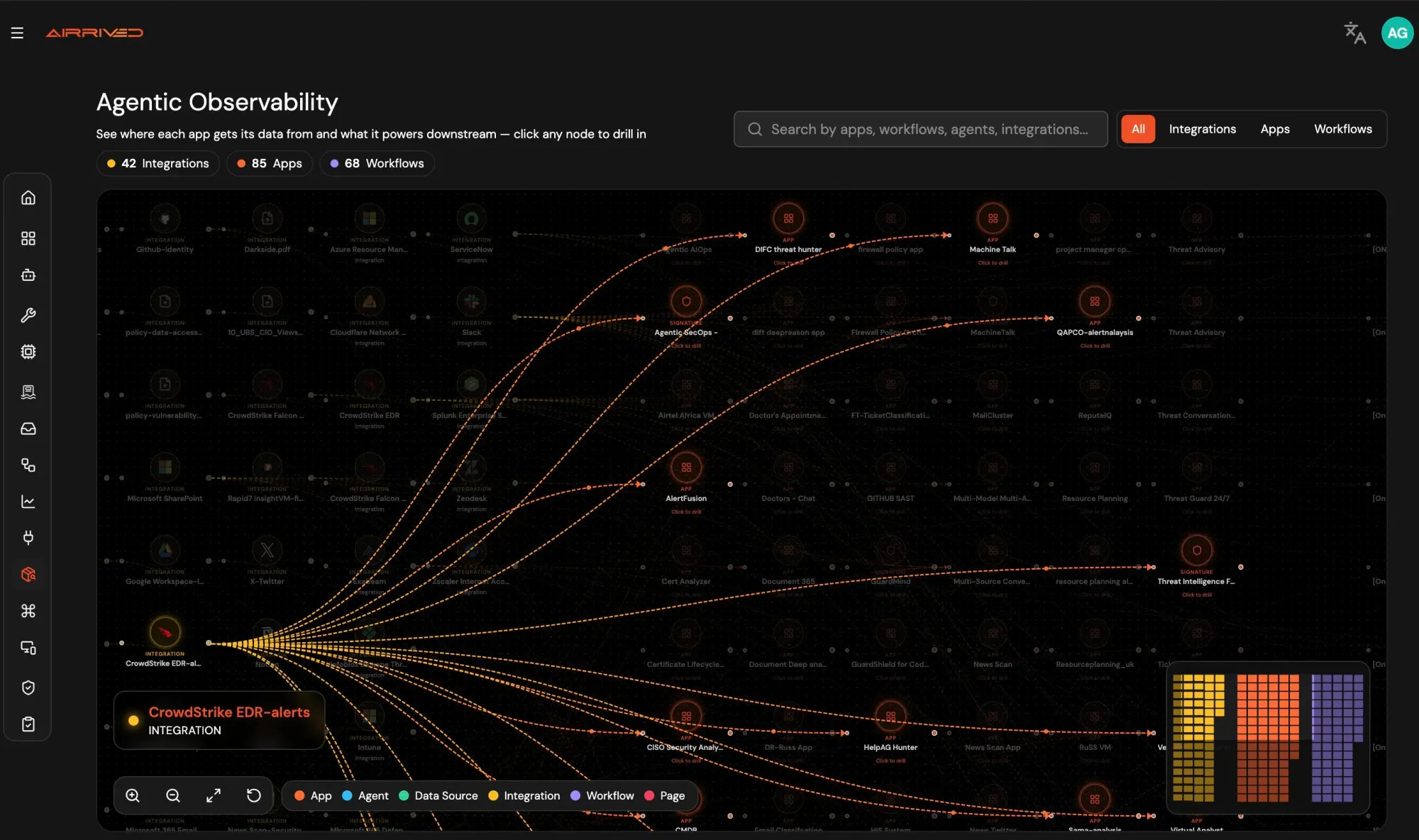
Airrived is positioning Agentic Observability as a centralized control plane that moves beyond simple uptime metrics to answer complex questions regarding agent identity, authorization, and data lineage. The capability is built upon the company's proprietary Context Lake, which aggregates data and operational context from across various enterprise systems. This architecture allows the platform to observe agents not as isolated processes, but as entities deeply connected to the enterprise information they consume. According to the company, the system traces the full journey of data: moving from enterprise integrations into the Context Lake, through agentic applications and individual agents, and finally to the resulting actions and outcomes.
For every agent and agentic application deployed, the platform surfaces specific metadata including the creator, owner, associated users, roles, and permissions. Crucially, it identifies which AI tools are being utilized—whether they are Airrived’s proprietary tools or third-party technologies used by customers—and tracks whether a "human-in-the-loop" approval is required before an agent executes a specific action. This level of detail is intended to provide a traceable path from the moment enterprise information enters the system to the ultimate decision or action produced by the AI.
Managing AI Risk and Tokenomics via Agentic OS
Beyond technical execution, Airrived is linking agentic behavior to two high-priority enterprise concerns: security risk and financial accountability. The company is targeting the opacity surrounding sensitive data exposure by allowing organizations to track the movement of PII, PCI, and PHI across agentic workflows. This capability is designed to ensure that as agents move through reasoning and execution phases, they do not inadvertently compromise protected information. By providing visibility into what data an agent can access and what it actually touches, Airrived is attempting to integrate AI governance into existing security frameworks.
The platform also introduces a layer of "AI FinOps" by providing visibility into the economics of agentic operations. Airrived is implementing token- and model-consumption tracking to give organizations a clear view of the costs associated with their AI deployments. This allows enterprises to move from estimated spending to measurable accountability for every dollar of AI consumption. By unifying orchestration, reasoning, models, and governance within the Agentic OS, Airrived is positioning observability as foundational infrastructure, suggesting that managing a network of autonomous agents will eventually require the same level of rigor as modern identity and access management (IAM) systems.
Key Takeaways
- Airrived's Agentic Observability traces the full lifecycle of an agent from enterprise integration and Context Lake ingestion to final business outcomes.
- The platform provides visibility into sensitive data movement, specifically tracking PII, PCI, and PHI across agentic workflows to mitigate exposure risks.
- Airrived is introducing AI FinOps capabilities through token- and model-consumption tracking to provide measurable accountability for AI operational costs.
TechInsyte's Take
In our view, Airrived is correctly identifying that the primary barrier to widespread autonomous agent adoption is not the technology's capability, but the enterprise's ability to govern it. As agents move from "copilots" that suggest actions to autonomous entities that execute them, the risk profile shifts from simple software errors to systemic operational and security failures. By linking technical execution directly to business outcomes and financial costs, Airrived is attempting to move AI from an experimental silo into a standard component of the enterprise IT stack. This signals a broader industry trend where the value of AI platforms will increasingly be measured by their "auditability" rather than just their reasoning power. For CIOs, the ability to treat AI consumption as a measurable FinOps exercise and agent permissions as a standard IAM function will be critical for scaling agentic workflows without losing control.
Questions & Answers
How does Agentic Observability differ from traditional application monitoring?
Traditional monitoring focuses on whether software is running; Airrived's Agentic Observability focuses on the "why" and "how" of autonomous decisions. It tracks agent reasoning, identifies the specific data (including PII, PCI, or PHI) touched during a process, and confirms whether the agent's actions were authorized or required human-in-the-loop approval.
What role does the Context Lake play in the observability process?
The Context Lake serves as the foundational data layer that provides agents with enterprise-specific context. For observability, it allows the platform to create an observable chain that connects the specific enterprise data available to an agent with the subsequent decisions and actions that the agent takes.
Can this platform help manage the rising costs of generative AI?
Yes. Airrived is incorporating "AI FinOps" capabilities by tracking token and model consumption. This provides organizations with a clear read on the specific costs of their AI operations, moving away from opaque spending toward measurable accountability for every dollar used in AI consumption.
What specific security data can be tracked within agentic workflows?
The platform allows organizations to track the presence and movement of sensitive information, specifically mentioning PII (Personally Identifiable Information), PCI (Payment Card Industry) data, and PHI (Protected Health Information) as it moves through the agentic lifecycle.
Source: Businesswire