ACCESS Co., Ltd. announced that it has been awarded a research contract by Japan’s Ministry of Internal Affairs and Communications (MIC) to develop and validate all‑photonics network (APN) technologies in overseas AI data centers. The project will be carried out jointly with ACCESS’s U.S. subsidiary, IP Infusion, and targets three core use cases that are critical for AI‑driven workloads. Successful validation could accelerate the adoption of open, optical‑based networking in a market currently dominated by proprietary GPU‑vendor solutions.
The award is part of a broader governmental push to position Japan as a leader in next‑generation optical infrastructure. In June 2025 the MIC released its “Comprehensive Strategy for Digital Overseas Expansion 2030,” which explicitly names APNs as a cornerstone for the AI era and sets a target for Japanese firms to rank among the top three globally in high‑end optical transmission equipment by around 2030. By securing this contract, ACCESS aligns its R&D roadmap with that national ambition, while also addressing a market reality: the AI data‑center communications sector has become effectively oligopolistic, with most high‑performance gear sourced from a handful of GPU‑focused vendors. ACCESS and IP Infusion intend to demonstrate that an open, disaggregated approach—built on end‑to‑end photonic links—can break that lock‑in and open a viable pathway for Japanese optical expertise to re‑enter the high‑value segment of the AI‑data‑center supply chain.
Announcement of Contract Award for Ministry of Internal Affairs and Communications ‘Research Project on Deployment of All‑Photonics Network Technologies in Overseas AI Data Centers’
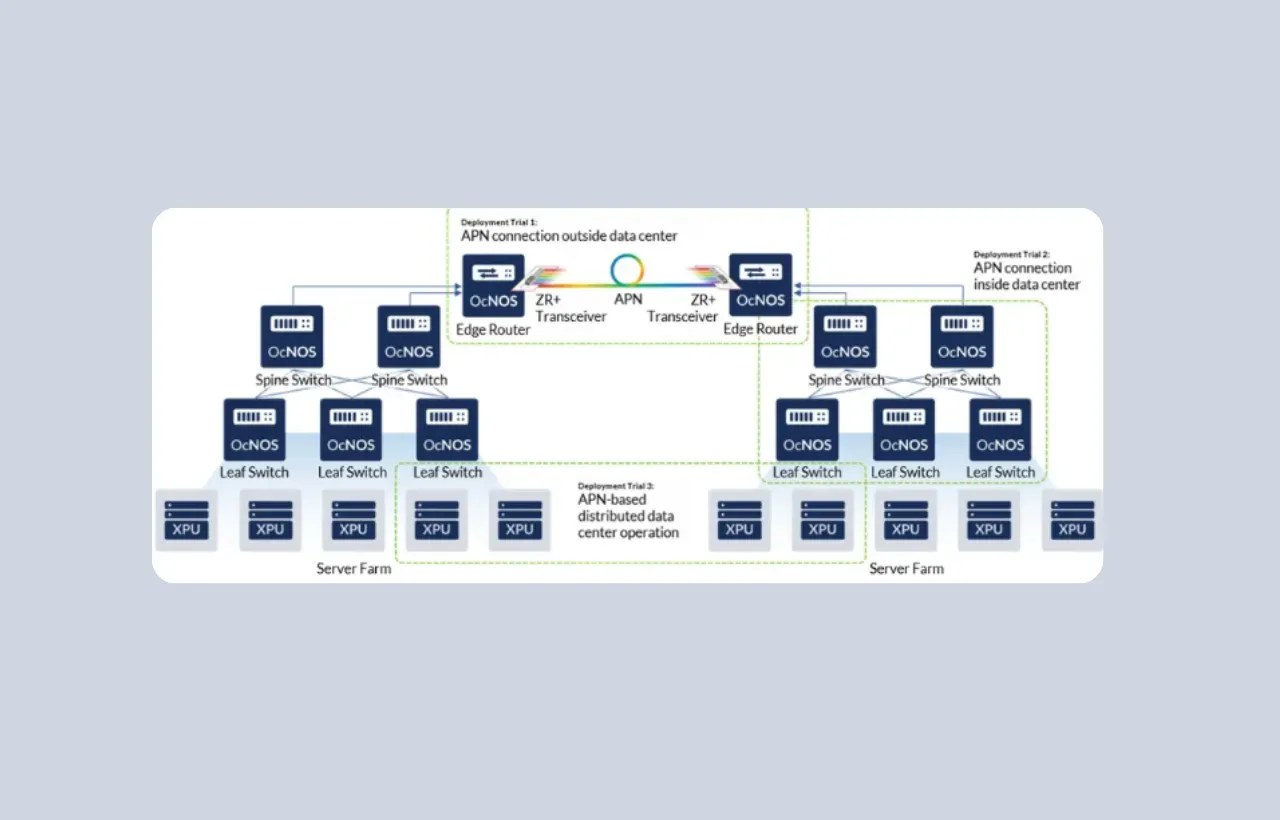
The MIC awarded ACCESS a “Research Project on Development of All‑Photonics Network Technologies in Overseas AI Data Centers.” ACCESS will lead the effort together with IP Infusion, a Santa Clara‑based provider of open networking software and optical communication expertise. The contract specifies verification of three use cases:
- External connections for AI data centers – establishing high‑capacity links between data‑center sites and external networks.
- Internal connections at AI data centers – replacing intra‑rack and inter‑rack Ethernet with end‑to‑end optical paths.
- Distributed AI data center solutions – linking geographically dispersed compute nodes with low‑latency photonic links.
These use cases were selected because they address the most pressing challenges faced by AI operators: the need for massive, low‑latency bandwidth on both the front‑end (inter‑site) and back‑end (intra‑rack) of the infrastructure, and the desire to spread compute across multiple locations to mitigate land‑scarcity, power‑grid constraints, and natural‑disaster risk—issues that are especially acute in Japan. By validating each scenario, ACCESS hopes to produce a reusable reference architecture that can be adapted by telecom operators and cloud providers worldwide.
The MIC’s “Comprehensive Strategy for Digital Overseas Expansion 2030,” released in June 2025, positions APNs as core infrastructure for the AI era and sets a goal for Japanese firms to rank among the top three globally in high‑end optical transmission equipment by around 2030. ACCESS’s contract aligns with that strategic target.
All‑Photonics Network Technology and Open Network OS
An APN is described as an optical architecture that routes data entirely in the light domain, eliminating high‑power electronic processing and delivering “massive bandwidth and near‑zero latency.” The project will leverage IP Infusion’s open network operating system (OcNOS®) and its optical communication capabilities to build disaggregated, vendor‑agnostic networking stacks. By using open specifications, the solution aims to avoid lock‑in to any single GPU or networking vendor, a concern highlighted by the MIC’s observation that the AI data‑center communications market has become “effectively oligopolistic,” with most equipment sourced from a few proprietary GPU manufacturers.
ACCESS and IP Infusion intend to demonstrate that APNs can meet the performance demands of generative‑AI workloads while reducing power consumption. The research will also explore how APNs can address Japan‑specific constraints—limited land availability, power grid capacity, natural‑disaster resilience, and the need for renewable‑energy integration—by enabling distributed AI data‑center architectures that are both high‑capacity and low‑energy. In practice, this means configuring OcNOS® to manage optical circuit‑switched paths, integrating wavelength‑division multiplexing (WDM) modules that can carry terabits per second, and employing software‑defined control planes that dynamically allocate light‑paths based on real‑time AI traffic patterns.
The open‑networking approach is central to the project’s ambition. “Open networking” in the MIC’s terminology refers to open specifications and functions of the disaggregated hardware and software that build a network, enabling the freedom of multi‑vendor equipment, choice of services, and interoperability. By pairing OcNOS® with APN hardware, ACCESS aims to create a stack where the data‑plane (the photonic fabric) and the control‑plane (the open OS) are decoupled from any single silicon vendor, thereby fostering a more competitive ecosystem.
Implications for AI Data Center Buyers
For enterprises evaluating AI‑focused infrastructure, the project’s outcomes could influence procurement decisions in several ways:
- Supply‑chain diversification – Validation of open network operating systems combined with APNs may give buyers alternatives to the dominant, proprietary GPU‑vendor stacks, potentially lowering total cost of ownership and reducing reliance on single‑source suppliers.
- Latency‑sensitive workloads – Near‑zero latency offered by end‑to‑end photonic paths could benefit real‑time inference and training scenarios that are bandwidth‑bound, though performance metrics have not yet been disclosed.
- Energy efficiency – By bypassing electronic switching, APNs promise lower power draw, which aligns with corporate sustainability goals and could mitigate the high electricity costs associated with large‑scale AI clusters.
The research does not yet provide quantitative results, and ACCESS has not disclosed a timeline for commercial rollout beyond the project’s completion. Buyers should monitor forthcoming test data to assess whether the claimed bandwidth and latency advantages translate into measurable operational benefits.
Key Takeaways
- ACCESS Co., Ltd. received a MIC contract to research all‑photonics networks in overseas AI data centers, collaborating with its subsidiary IP Infusion.
- The project will validate three use cases: external AI‑data‑center connections, internal AI‑data‑center connections, and distributed AI‑data‑center solutions.
- MIC’s 2030 digital expansion strategy aims for Japanese firms to be in the global top three for high‑end optical transmission equipment, and the ACCESS project is intended to help achieve that goal.
TechInsyte's Take
The contract signals a coordinated effort by Japanese industry and government to break the current vendor‑lock‑in dynamics in AI data‑center networking. While the technical promise of APNs is clear, concrete performance data and a clear path to commercial products remain pending. CIOs and network architects should watch for the project’s results, especially any benchmarks that compare APN‑based designs against existing proprietary solutions.
Source: Businesswire