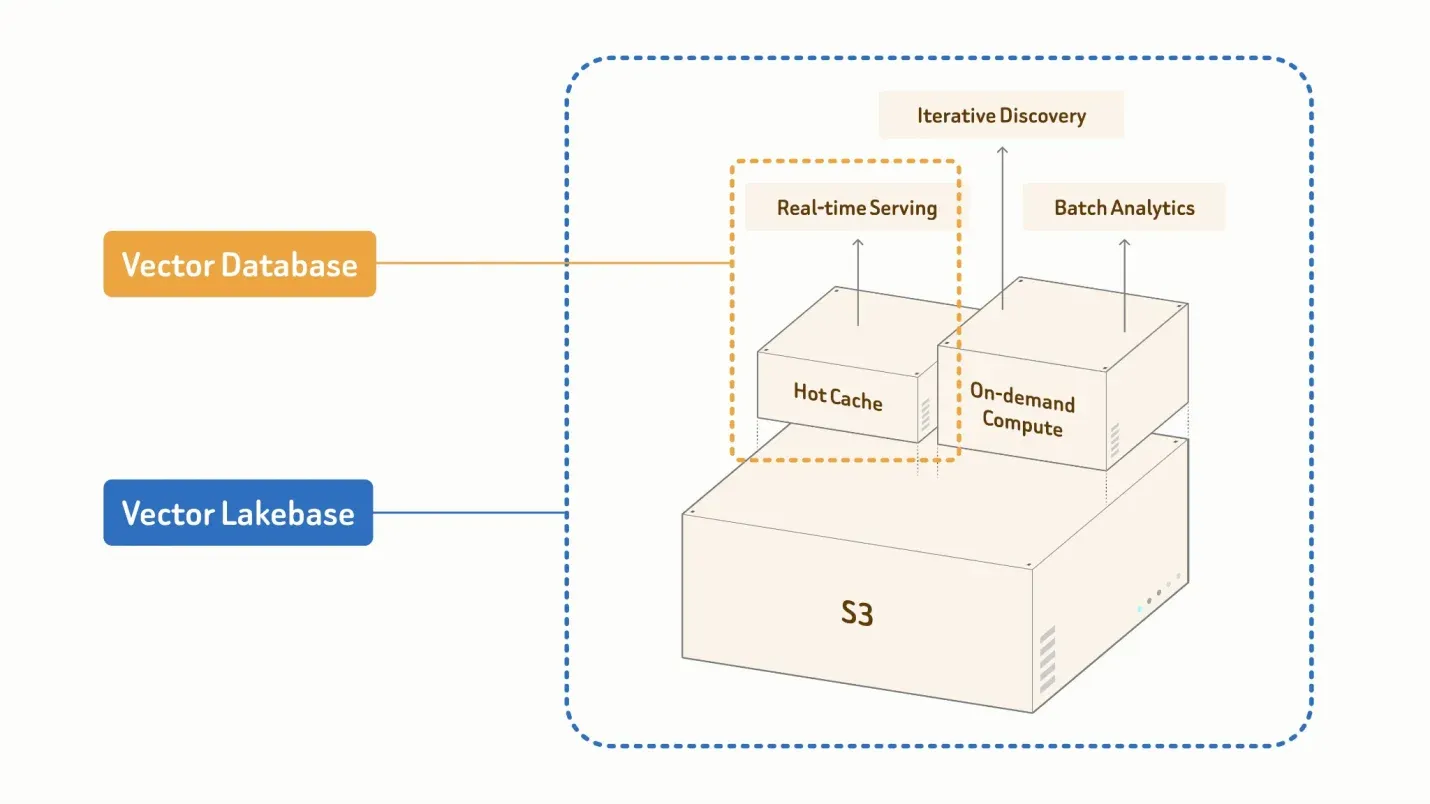
Zilliz, the company behind Milvus—the world’s most widely adopted open‑source vector database—has announced that Vector Lakebase is now available in public preview on Zilliz Cloud. The new platform extends the core, production‑grade Milvus engine with a shared, lake‑native storage layer and on‑demand compute, allowing enterprises to run real‑time serving, interactive discovery, and large‑scale batch analytics against a single logical copy of their data. By eliminating the need for separate data pipelines and costly data migrations, Vector Lakebase promises to tighten the feedback loop that powers modern AI systems, from instant query serving to overnight semantic deduplication and multi‑petabyte training pipelines.
Zilliz Launches Vector Lakebase Public Preview
The public preview represents a major Zilliz Cloud update that couples the proven Milvus‑based vector search engine—already trusted by more than 10,000 enterprises and AI teams such as Zillow, OpenEvidence, Exa, Filevine, and MiniMax—with a unified, lake‑native data foundation. The service is rolled out across more than 30 regions on AWS, Google Cloud, and Microsoft Azure, and can be deployed through Serverless, Dedicated, or BYOC (Bring‑Your‑Own‑Cloud) models. New work‑email sign‑ups receive $100 in free credits at zilliz.com, encouraging early experimentation.
According to Charles Xie, Founder and CEO of Zilliz, “Production vector search is and will remain at the heart of what Zilliz does… Vector Lakebase is what we believe comes next: one data foundation where the same vectors can serve a production query, anchor a discovery session, and power a multi‑petabyte training‑data pipeline—without copies, migration, or a parallel stack.” The preview therefore keeps “production vector search … at the core” while adding three new ways to operate on the same data: interactive discovery, large‑scale batch analytics, and direct search on external data lakes.
Architecture and Core Capabilities
Vector Lakebase builds on Zilliz Cloud’s existing engine and introduces a unified storage layer called Vortex. Vortex is an open columnar format that the company claims delivers faster, cheaper random reads than both Lance and Parquet, and it incorporates object‑storage‑aware indexes that reduce read amplification by over 90 %. This architecture enables a zero‑copy semantic data plane, meaning serving, discovery, and analytics all run against the same logical dataset, scaling seamlessly from gigabytes to petabytes.
The platform bundles five tightly integrated capabilities:
- Tiered Real‑Time Serving – Three production tiers (Performance‑Optimized, Capacity‑Optimized, Tiered‑Storage) deliver 1,000+ QPS with single‑digit‑millisecond latency, 100–500 QPS with sub‑100 ms latency, or 10–50 QPS with ~100 ms latency, respectively. All tiers default to 95–98 % recall (tunable to 99 %+), are covered by a 99.99 % uptime SLA, and benefit from global cross‑region high availability.
- On‑Demand Search – Pay‑as‑you‑go compute billed only for active usage. Zilliz’s internal benchmark on one billion 768‑dimensional vectors (10 hours of monthly active compute) showed a cost of $318 per month, compared with $4,937 for a comparable serverless path—roughly 1/15 the cost.
- External Data Lake Search – A zero‑copy “External Collection” mode adds state‑of‑the‑art indexing and full‑spectrum search to existing Lance, Iceberg, Parquet, and Vortex tables, with incremental synchronization on refresh. Source data remains in place, eliminating costly data movement.
- Full‑Spectrum AI Search – Hybrid retrieval across dense and sparse vectors, text, JSON, and geospatial data. The engine supports BM25, regex, multi‑vector, iterative search, and multi‑path retrieval, with optional reranking from models such as Cohere, Voyage AI, RRF, and custom weighted/boost/decay strategies.
- Unified Lake‑Native Storage – Shared storage for both serving and analytics built on Vortex. A typical 100‑million‑row schema backfill completes in single‑digit minutes without disrupting active queries, thanks to the columnar format and object‑storage‑aware indexes.
Together, these capabilities let AI teams replace parallel always‑on serving clusters and separate batch systems with a single platform that maintains consistent indexes, versioned data, and compute that scales to zero between jobs.
Enterprise Relevance
The announcement is aimed squarely at enterprises that currently juggle multiple stacks for real‑time vector serving, data exploration, and large‑scale training pipelines. By removing the need to copy billions of vectors between systems—a process that can take days—Vector Lakebase shortens the continuous AI loop of “serve, learn, mine, serve again.” Robert Guo, VP of Product at Zilliz and one of the architects behind Milvus, emphasized that teams “asked for a way to keep their data in one place and run very different workloads against it—from real‑time agent memory to overnight semantic deduplication.” The unified approach not only reduces operational complexity but, as Zilliz’s internal cost example demonstrates, can dramatically lower compute spend when workloads are idle for most of the month.
Key Takeaways
- Vector Lakebase entered public preview on Zilliz Cloud, supporting Serverless, Dedicated, and BYOC deployments in over 30 cloud regions.
- The platform combines real‑time vector search with lake‑native storage, offering tiered serving, on‑demand compute, external data lake search, and full‑spectrum AI search on a single logical data copy.
- Zilliz’s internal benchmark reported on‑demand search costing $318 per month for one billion vectors, roughly 1/15 of a comparable serverless solution.
TechInsyte's Take
Vector Lakebase consolidates multiple AI workloads onto a shared foundation, which could simplify architecture for enterprises managing large vector collections. However, performance and cost claims are based on Zilliz’s internal testing; independent benchmarks will be needed to validate the savings at scale. CIOs and data leaders should monitor the preview’s SLA adherence and the maturity of the external lake‑search integrations before committing production workloads.
Source: Businesswire