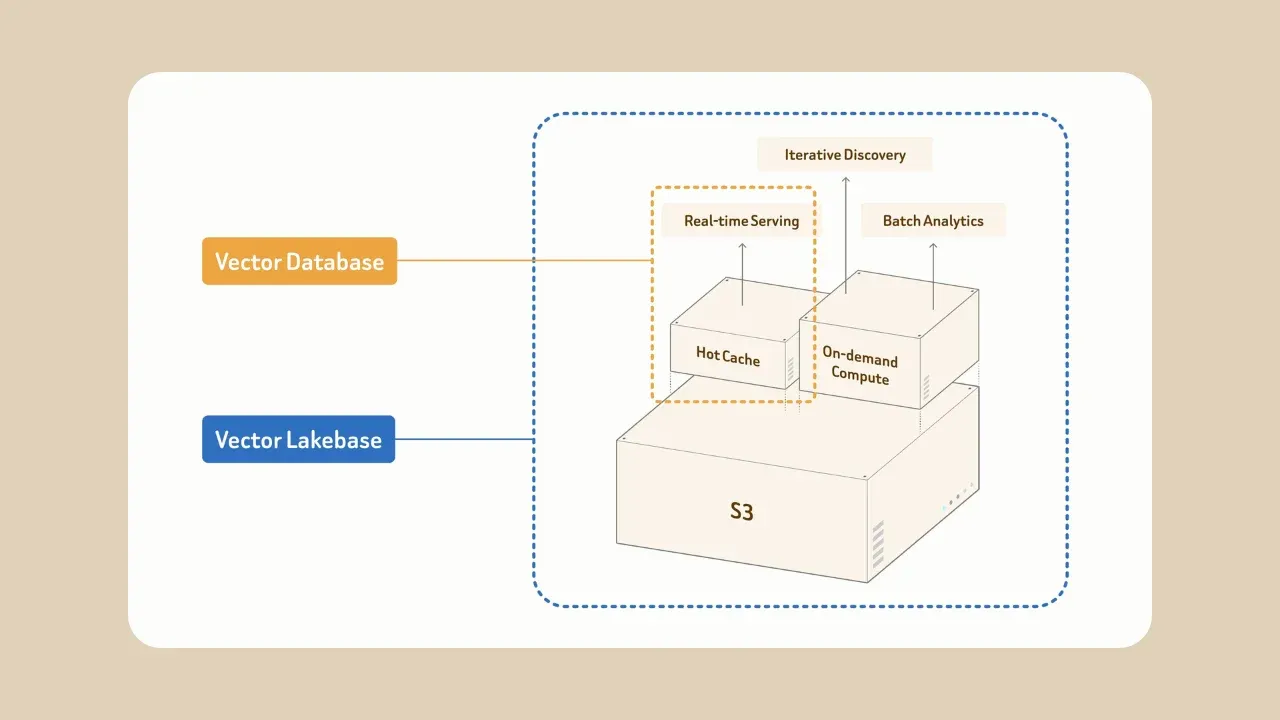
Zilliz has announced the release of Milvus 3.0, a major architectural update to its open-source vector database designed for production AI applications. The update introduces a lake-native architecture that allows organizations to build and serve production-grade indexes directly over vector data residing in object storage and open data formats. By expanding the retrieval engine to support richer ranking, aggregation, and multi-vector retrieval, Milvus 3.0 moves beyond traditional nearest-neighbor search. This release serves as the shared technical foundation for both the open-source Milvus project and Zilliz Cloud, providing a consistent path for developers to scale from independent deployments to a fully managed Vector Lakebase for AI data operations.
Lake-Native Architecture and Object Storage Integration
Milvus 3.0 addresses the operational complexity of maintaining separate data copies for real-time retrieval and offline processing. The new lake-native architecture enables production indexing and retrieval to operate directly on data stored in object storage, reducing the need for lengthy exports and synchronization pipelines. Through External Collections, Milvus can define collections over data in Parquet, Iceberg, Lance, or Vortex formats, building vector, JSON, scalar, and full-text indexes without copying the source data.
To optimize performance, Zilliz introduced Loon, a manifest-based storage engine designed to reduce read amplification during low-latency point access on object storage. Loon utilizes Vortex, an Arrow-compatible columnar format, as its default. Additionally, the update introduces Snapshots, which provide point-in-time, read-only views of live collections. This allows offline tasks, such as backfill validation, deduplication, and evaluation, to run against stable datasets without interrupting production writes.
Integration with broader data pipelines is expanded via a new Spark connector. By exposing Milvus as a Spark DataSource V2, the system allows Databricks, EMR, and Spark pipelines to read and write to Milvus within standard batch workflows. The release also adds vector-native batch operators specifically for clustering and deduplication tasks, further aligning online retrieval with offline data improvement on a shared foundation.
Expressive Retrieval Engine and Multi-Vector Support
The update expands the capabilities of the retrieval engine to support complex production requirements that exceed simple top-K vector searches. Milvus 3.0 now includes server-side aggregation, sorting, and faceted search. These features allow developers to combine semantic relevance with specific attributes—such as price, category, tenant, rating, freshness, and content source—directly within the engine, eliminating the need to over-fetch data for processing in application code.
For complex entities, the introduction of StructList enables native multi-vector retrieval. This allows a single entity or metadata record to retain multiple vectors, such as various chunks of a document, multiple visual patches of an image, or several multimodal representations of a product. This architecture specifically supports late-interaction retrieval models, including ColPali and ColBERT.
Zilliz has also optimized sparse and hybrid retrieval. Internal testing indicates that the new optimized sparse index is approximately three times smaller while maintaining comparable recall. Other technical enhancements include server-side MinHash generation, SINDI for learned-sparse vectors, nullable vector fields, and custom dictionaries for full-text search. The system maintains broad support for Faiss-compatible indexes. These tools are positioned to support a wide range of AI applications, including agent memory, multimodal discovery, recommendation systems, semantic search, and Retrieval-Augmented Generation (RAG).
Key Takeaways
- Milvus 3.0 introduces a lake-native architecture using the Loon storage engine and Vortex format to index data directly in object storage without copying source data.
- The new StructList feature enables multi-vector retrieval for single entities, supporting late-interaction models like ColBERT and ColPali.
- The release is available under the Apache 2.0 license for Kubernetes or Docker deployments and is integrated as the core engine for the managed Zilliz Cloud Vector Lakebase.
TechInsyte's Take
In our view, the shift toward a lake-native architecture in Milvus 3.0 signals a critical move to resolve the "data silos" problem inherent in AI infrastructure. By allowing indexing directly on object storage via formats like Parquet and Iceberg, Zilliz is positioning Milvus not just as a database, but as a retrieval layer for the modern data lake. This removes the operational tax of synchronization pipelines that often plague enterprise AI deployments. Furthermore, the addition of server-side aggregation and multi-vector support suggests that Zilliz recognizes that "semantic search" alone is insufficient for B2B applications; real-world utility requires the intersection of vector similarity with hard business logic and complex entity representations. For CIOs, this reduces the architectural overhead of RAG pipelines and suggests a more sustainable path for managing massive, dynamic AI datasets without exponential increases in storage costs.
Source: BUSINESSWIRE