
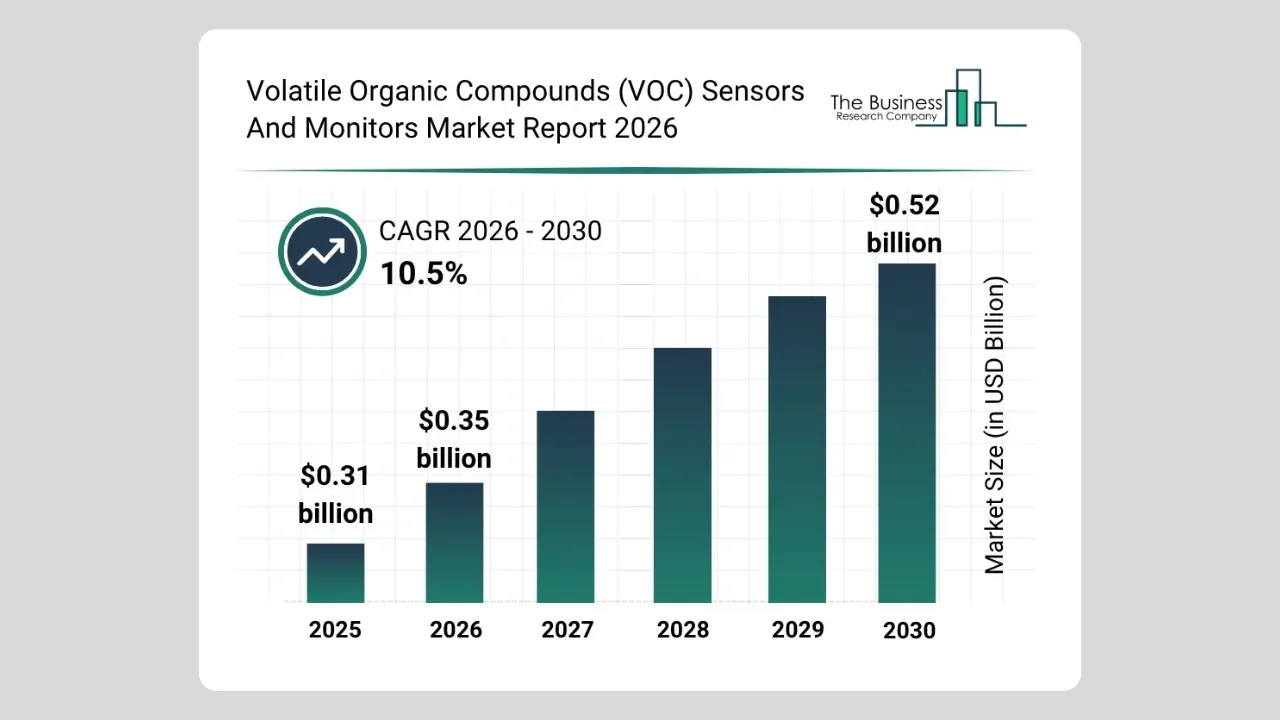
Stricter environmental regulations and the rapid expansion of smart building infrastructure are driving a significant capital shift toward air quality monitoring technologies. The volatile organic compounds (VOC) sensors and monitors market is projected to grow from $0.31 billion in 2025 to $0.52 billion by 2030, according to recent data from The Business Research Company. This trajectory reflects a growing enterprise focus on continuous environmental surveillance and industrial leak detection. As organizations prioritize workplace safety and regulatory compliance, the demand for high-sensitivity, real-time detection solutions is expected to accelerate across global industrial and commercial sectors.
VOC Sensor Market Expansion and Growth Drivers
The market for VOC detection devices is entering a period of sustained expansion, fueled by heightened concerns regarding indoor air quality and industrial emission monitoring. The sector is expected to rise from $0.31 billion in 2025 to $0.35 billion in 2026, representing a compound annual growth rate (CAGR) of 10.9%. This near-term momentum is largely attributed to tougher environmental regulations and enhanced workplace safety standards. Beyond simple compliance, the market is being pushed by a rising need for sophisticated air pollution detection systems that can provide continuous measurement. As industries face increasing pressure to manage chemical footprints, the transition from periodic testing to real-time, automated monitoring is becoming a strategic necessity for operational resilience and environmental safety management.
Smart Building Integration and Regional Dynamics
The rise of IoT-enabled smart buildings is positioning VOC sensors as a core component of modern digital infrastructure. These automated environments leverage digital connectivity to optimize energy efficiency and occupant comfort, often integrating VOC sensors to manage ventilation controls and detect harmful emissions in real time. This trend mirrors broader shifts in connected infrastructure; for example, data from the Central Statistics Office of Ireland indicated that internet-connected security devices in smart homes rose from 17% in 2022 to 30% in October 2024. Geographically, North America held the largest market share in 2025, but the Asia-Pacific region is projected to become the fastest-growing market. This shift suggests that industrialization and smart infrastructure deployment in Asia-Pacific will be primary drivers of global demand through 2030.
Key Takeaways
- The VOC sensors and monitors market is forecasted to reach $0.52 billion by 2030, growing at a CAGR of 10.5%.
- North America held the largest market share in 2025, while the Asia-Pacific region is expected to lead in growth rates.
- Market growth is being propelled by the integration of VOC monitoring into smart building technologies and IoT-enabled automation systems.
TechInsyte's Take
In our view, the projected 10.5% CAGR for the VOC sensor market signals a fundamental shift in how enterprises approach environmental risk management. We are seeing a transition where air quality monitoring is moving from a reactive compliance checkbox to a proactive component of digital building management systems. The integration of these sensors into smart infrastructure suggests that "environmental intelligence" will soon be as critical to facility operations as energy management or physical security. For CTOs and infrastructure leaders, this means VOC monitoring should be viewed not as a standalone hardware purchase, but as a data stream essential for the broader IoT and automated building orchestration strategy.
Questions & Answers
How much is the VOC sensor market expected to grow by 2030?
The market is projected to reach $0.52 billion by 2030, following a forecasted growth from $0.31 billion in 2025.
What specific technological trends are shaping the VOC monitoring sector?
Key trends include the widespread adoption of real-time monitoring, the rise of portable detection devices, and the integration of multi-gas detection features into continuous measurement systems.
Which regions are most critical for market growth and current dominance?
North America held the largest market share in 2025, but the Asia-Pacific region is projected to be the fastest-growing market in the coming years.
How does smart building technology influence VOC sensor demand?
Smart buildings use IoT and automation to optimize safety and efficiency; integrating VOC sensors allows these systems to manage ventilation and detect harmful emissions in real time to improve indoor air quality.
Source: The Business Research Company