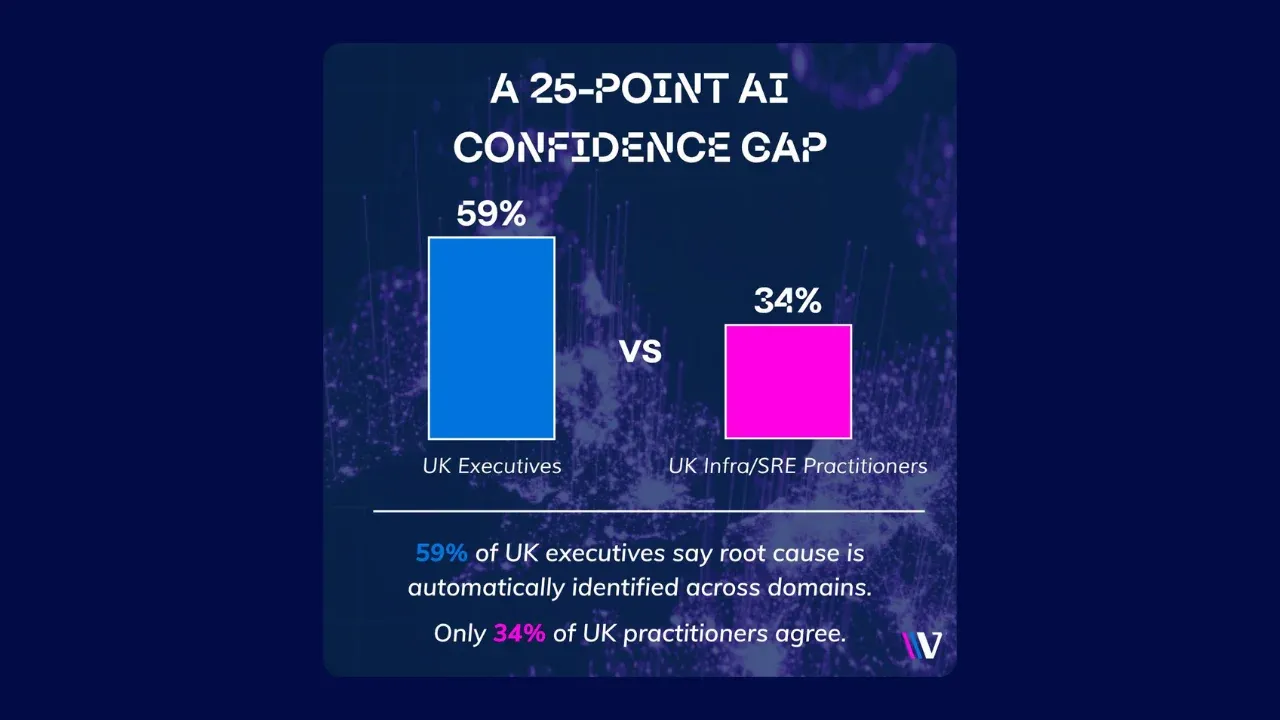
A significant visibility gap is emerging between UK enterprise executives and their engineering teams, potentially leaving leadership blind to the operational risks of scaling artificial intelligence. New research from Virtana reveals that while 59% of UK executives believe their organizations can automatically identify the root cause of AI failures, only 34% of the infrastructure engineers responsible for managing those systems agree. This 25-point divergence suggests that decision-makers are authorizing massive investments in AI "factories" based on a perceived level of diagnostic readiness that does not exist on the ground. As UK enterprises move AI from pilot programs into production, this lack of observability creates a compounding risk for organizations operating under increasingly stringent regulatory frameworks.
The Divergence Between Executive Confidence and Engineering Reality
The "AI Factory Reality Check" study, which surveyed 238 UK enterprise decision-makers, highlights a dangerous disconnect in how AI reliability is perceived. While UK enterprises are scaling AI faster than their US counterparts—with 59% of UK firms scaling across teams compared to 54% in the US—they are doing so with significantly less control. Only 26% of UK enterprises describe their AI workload performance as highly predictable, a figure notably lower than the 34% reported by US organizations. This suggests that the rapid deployment of AI in the UK is outstripping the development of the necessary governance and monitoring systems.
This gap is particularly acute because UK enterprises are deploying AI within a demanding regulatory landscape, including UK GDPR and emerging AI Act obligations. Virtana CEO Paul Appleby notes that in the UK, operational observability and regulatory accountability have become inseparable. For boards and regulators, the ability to prove an AI system is performing correctly is a requirement, yet 53% of UK enterprises are currently operating AI infrastructure that they cannot fully observe. This lack of end-to-end visibility across models, tokens, GPUs, and underlying infrastructure means that organizations may be absorbing hidden costs and performance variability without the ability to attribute or explain them.
Infrastructure Trade-offs and the Cost of Scaling AI
As the demand for AI capacity grows, many UK enterprises are making strategic trade-offs that could undermine long-term stability. The study finds that 66% of UK enterprises report that the high cost of premium AI hardware has fundamentally altered their investment approaches. To manage these costs, organizations are rebalancing workloads across existing hybrid environments and consolidating systems, often while the "AI factories" are already under heavy load. However, this pressure to scale is leading to the deferral of critical foundational investments. Specifically, 54% of UK enterprises are deprioritizing cost optimization, 48% are deferring legacy infrastructure modernization, 43% are deprioritizing team upskilling, and 39% are deprioritizing security and compliance reviews.
The technical challenges of maintaining these systems are mounting. While 75% of UK enterprises use automated alerting as a first response to failures, detecting a problem is not the same as explaining it. Only 47% of organizations can automatically identify a root cause across all infrastructure domains. The remaining majority struggle with fragmented visibility: 32% can only see a single domain, 12% require manual correlation across various tools, and 8% must rely on multi-team coordination that can take hours or even days. These visibility gaps manifest in several critical areas, with enterprises ranking cost and efficiency metrics, data pipeline visibility, storage and throughput, network bottleneck detection, and GPU utilization tracking as their most difficult monitoring challenges.
Key Takeaways
- A 25-point gap exists between UK executives (59%) and engineers (34%) regarding the ability to automatically identify AI failure root causes.
- UK enterprises are scaling AI faster than the US (59% vs 54%) but report lower workload predictability (26% vs 34%).
- Over half of UK enterprises (53%) are operating AI infrastructure that lacks full observability.
TechInsyte's Take
In our view, the Virtana data signals a looming "governance debt" crisis for UK enterprises. By scaling AI deployment faster than the underlying observability and security frameworks, leadership teams are effectively flying blind into a regulatory storm. The fact that 39% of firms are deprioritizing security and compliance reviews while simultaneously moving AI into production is a high-stakes gamble. This isn't just an operational risk; it is a fiduciary one. When executives authorize capital expenditure based on an inflated sense of diagnostic capability, they create a disconnect between reported readiness and actual resilience. For the C-suite, the priority must shift from mere deployment speed to building a unified platform that provides visibility across the entire stack—from GPUs to tokens—to ensure that "AI factories" are both performant and provably compliant.
Questions & Answers
How does the UK's regulatory environment change the stakes of AI observability compared to the US?
In the UK, observability is directly linked to regulatory accountability under frameworks like UK GDPR and emerging AI Act obligations. Unlike the US, where the focus may be more purely operational, UK enterprises must be able to see, attribute, and prove AI system behavior to satisfy sector-specific oversight in areas like healthcare and financial services.
What specific infrastructure investments are UK enterprises deferring to manage AI costs?
To cope with the high cost of premium AI hardware, 54% of UK enterprises are deprioritizing cost optimization, 48% are deferring legacy infrastructure modernization, 43% are deprioritizing team training, and 39% are deprioritizing security and compliance reviews.
What are the primary technical bottlenecks preventing effective AI workload management?
Enterprises are struggling with several key monitoring challenges, most notably cost and efficiency metrics, data pipeline visibility, storage and throughput, network bottleneck detection, and tracking GPU utilization.
Why is the gap between executive and engineer perception a strategic risk?
The gap creates a "false confidence" loop where executives authorize investments and report readiness to boards based on a 59% perceived diagnostic capability, while the engineers actually managing the systems report only 34% capability. This prevents accurate risk assessment and resource allocation.
Source: Businesswire