The escalating energy demands of artificial intelligence are shifting the industry's primary bottleneck from raw compute availability to electrical power capacity. Velaura AI is positioning itself to address this infrastructure crisis by developing ultra-low-power silicon and software designed to optimize energy efficiency across both hyperscale data centers and Physical AI applications. The company announced it has raised $110 million in Series A financing, a move that pushes its total valuation above $1 billion. This capital injection, led by Seligman Ventures, aims to accelerate the commercialization of the company's Titan Core™ silicon platform while expanding its engineering and customer-facing teams to support deepening engagements with hyperscalers and developers of autonomous systems.
Velaura AI Series A Funding and Valuation Milestone
The $110 million Series A round marks a significant financial milestone for Velaura AI, elevating the company to a unicorn valuation of more than $1 billion. The funding round was led by Seligman Ventures, with participation from new investors Capricorn Investment Group and Prosperity7 Ventures. Existing investors also contributed to the round, including Mayfield, Maverick Silicon, MARA, Premji Invest, Samsung Catalyst Fund, and StepStone Group. This capital is earmarked for the rapid development and commercialization of the company's AI compute portfolio, specifically targeting the Titan Core™ silicon platform.
Beyond hardware development, the company intends to use the funds to scale its workforce, specifically growing its engineering and customer-facing departments. Velaura is focusing on two primary market segments: hyperscale data centers, which face long lead times for power availability, and the emerging Physical AI sector, which includes intelligent robots, drones, and autonomous systems. These sectors are increasingly constrained by strict thermal and power limits, creating a demand for purpose-built, energy-efficient computing solutions. By targeting the silicon layer, Velaura aims to provide the foundational infrastructure necessary to scale AI from massive data centers to embodied intelligence operating in the physical world.
Titan Core™ Silicon and Proven Scalability
Velaura’s technical strategy centers on its proprietary Titan Core™ digital chip IP and design platform. According to the company, this platform delivers a 2-4x improvement in performance per watt for mathematical operations within AI accelerators, all while maintaining consistent performance levels. This efficiency gain is intended to address the "compute economics" of AI, where the cost and complexity of delivering more compute are increasingly tied to power consumption. The company is applying this ultra-low-power architecture to both large-scale AI accelerators and the specialized requirements of Physical AI, such as robotics and other embodied systems.
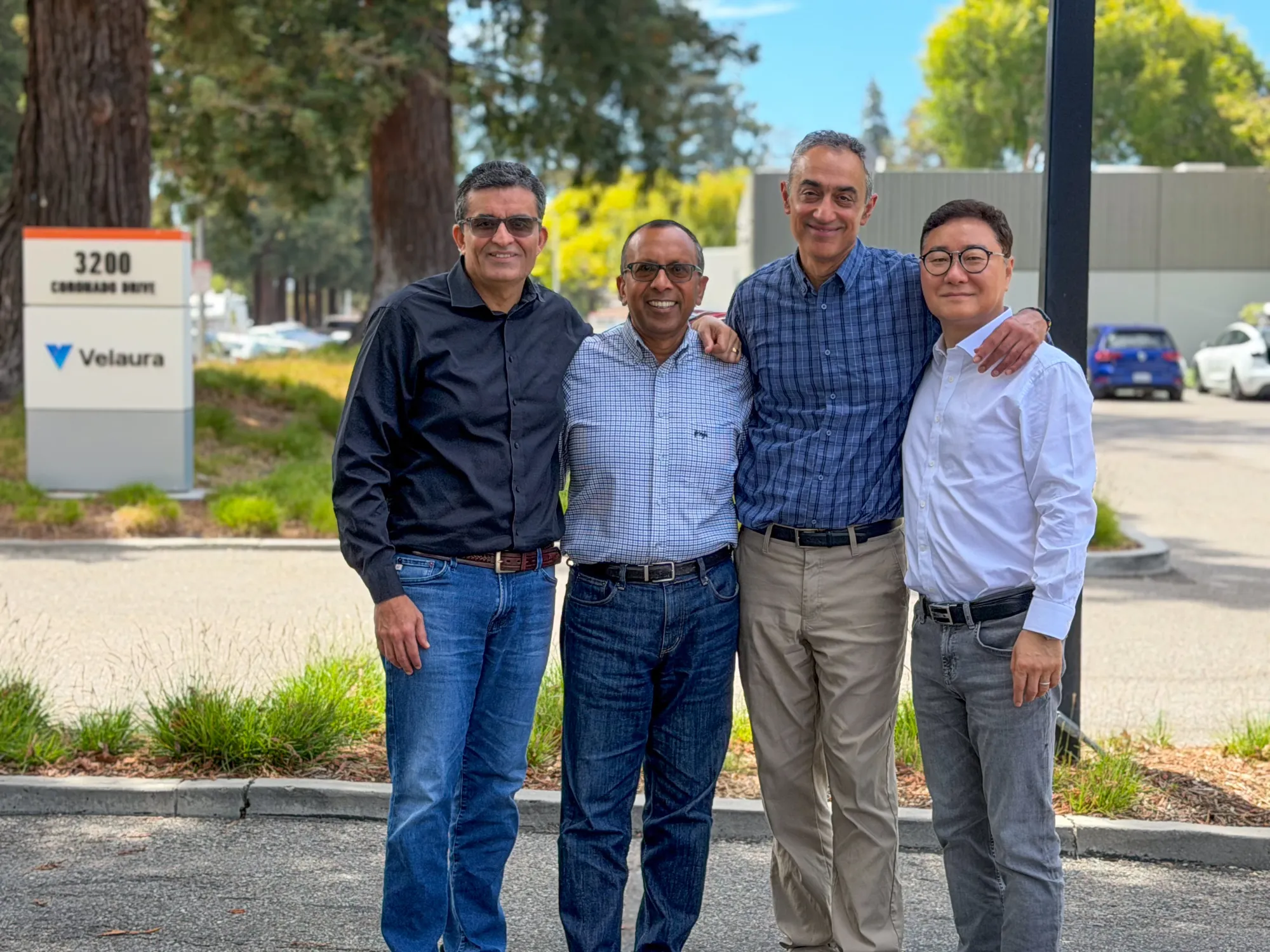
A critical differentiator for Velaura is the existing commercial validation of its underlying technology. The company states that its technology has already been deployed in more than 30 million ASICs across leading semiconductor process nodes. This track record is intended to demonstrate manufacturing yield and reliability at a commercial scale. The leadership team, which includes executives and engineers from Apple, NVIDIA, Google, Qualcomm, and Marvell, is leveraging this experience to build a silicon and software foundation that addresses the energy footprint of AI. This approach seeks to ease thermal limitations and enable higher AI capacity within existing infrastructure by attacking the problem at the silicon level.
Key Takeaways
- Velaura AI raised $110 million in Series A funding, bringing its total valuation to over $1 billion.
- The Titan Core™ silicon platform claims to deliver a 2-4x improvement in performance per watt for AI accelerator mathematical operations.
- The company's underlying technology has been deployed in more than 30 million ASICs in leading semiconductor process nodes.
TechInsyte's Take
In our view, Velaura AI’s massive valuation reflects a growing market consensus that the "AI gold rush" is hitting a hard physical limit: the power grid. While much of the industry has focused on model sophistication, Velaura is betting on the reality that the next phase of AI growth will be dictated by power density and thermal management. By targeting both the hyperscale data center and the "Physical AI" frontier—such as robotics and drones—the company is attempting to capture two distinct but equally power-starved markets. The fact that their technology has already shipped in 30 million ASICs provides a level of commercial de-risking that is rare for Series A semiconductor startups. If the Titan Core™ can indeed deliver the claimed 2-4x performance-per-watt improvement, Velaura could become a critical infrastructure provider for enterprises struggling to scale AI within existing power and thermal envelopes.
Questions & Answers
How does Velaura AI's technology impact total cost of ownership (TCO) for AI infrastructure?
By improving performance per watt by a claimed 2-4x, Velaura's technology could potentially reduce TCO by easing thermal limitations and allowing for increased AI capacity within existing power and infrastructure constraints.
What specific markets is Velaura AI targeting with its new capital?
The company is targeting two primary growth areas: hyperscale data centers, which face power availability challenges, and Physical AI, which includes intelligent robots, drones, and autonomous systems operating under strict power and thermal limits.
What is the significance of the Titan Core™ platform's deployment history?
The technology underlying the Titan Core™ platform has been validated at scale, having been deployed in more than 30 million ASICs in leading semiconductor process nodes, which serves as evidence of its manufacturing yield and reliability.
Who are the primary investors backing Velaura AI's Series A round?
The round was led by Seligman Ventures, with participation from Capricorn Investment Group, Prosperity7 Ventures, Mayfield, Maverick Silicon, MARA, Premji Invest, Samsung Catalyst Fund, and StepStone Group.
Source: Businesswire