


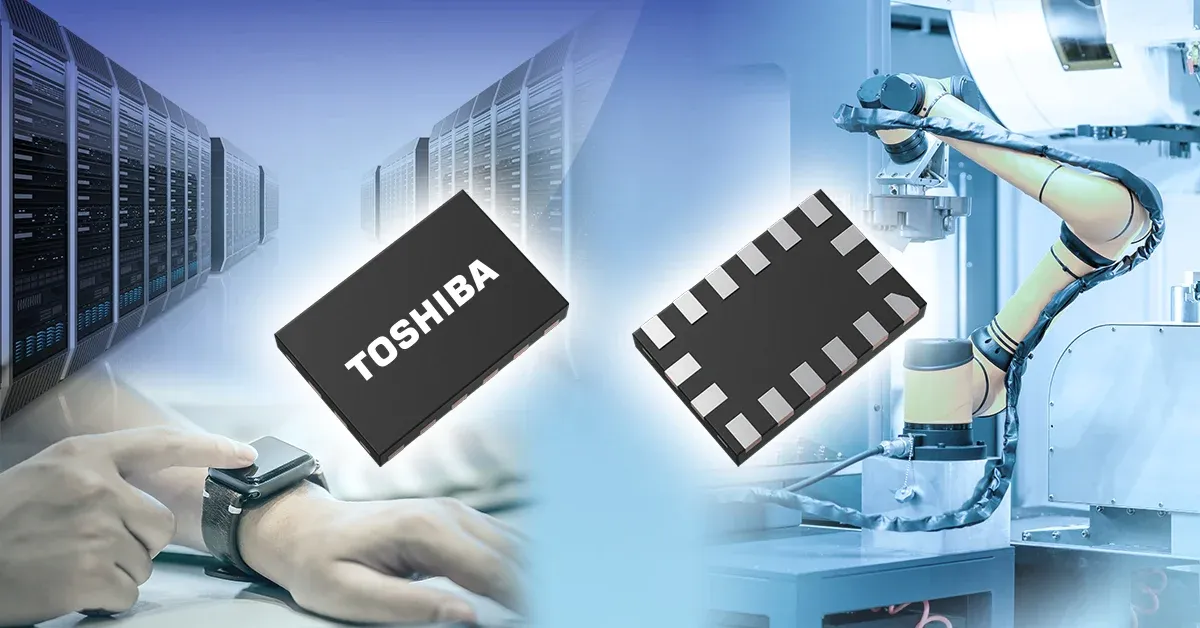
Toshiba Electronic Devices & Storage Corporation has introduced two new high-speed signal switches designed for next-generation interfaces used in servers, PCs, industrial equipment, robots, mobile devices and other connected systems.
The new products, TDS5C212MX and TDS5B212MX, are 2:1 multiplexer / 1:2 demultiplexer switches that support high-speed differential signals such as PCIe 6.0 and USB4 Version 2.0. Toshiba said volume shipments of both devices have started.
The launch addresses a practical hardware challenge: as data transfer speeds rise and system boards become more compact, device makers need reliable ways to switch wide-bandwidth differential signals without degrading signal quality.
Why These Switches Matter
Modern systems are moving more data at higher speeds across tighter board layouts. Servers, AI infrastructure, industrial testers, robots and high-performance PCs increasingly depend on interfaces such as PCIe, USB4, Thunderbolt, CXL and DisplayPort.
In these systems, signal switching is not just a routing function. Poor signal integrity can cause waveform distortion, reflection, insertion loss and reliability problems. That becomes more critical as interface speeds increase.
Toshiba’s new switches are designed to help system designers share a single high-speed interface across multiple devices or switch signal paths based on system requirements. The devices can operate as either a 2-input/1-output Mux switch or a 1-input/2-output De-Mux switch in high-speed differential signal applications.
Built for PCIe 6.0 and USB4 Version 2.0
The two switches support several high-speed interface families, including PCIe 6.0 / 5.0 / 4.0 / 3.0, CXL 3.0 / 2.0 / 1.0, USB4 Version 2.0, USB4, USB 3.2, Thunderbolt 5 / 4 / 3 / 2, and DisplayPort 2.0 / 1.4 / 1.3 / 1.2.
PCIe 6.0 doubles the data transfer rate to 64 GT/s compared with PCIe 5.0, while USB4 Version 2.0 supports high-speed data transfer of up to 80 Gbps.
That makes the components relevant for device makers building systems where high-speed interconnects are becoming central to performance, especially in compute-heavy and bandwidth-sensitive environments.
Toshiba’s TarfSOI Process
Toshiba said the switches use its proprietary TarfSOI process, short for Toshiba advanced RF SOI. It is an SOI-CMOS front-end process technology developed by Toshiba for high-frequency semiconductor applications.
Using this process, Toshiba says the devices achieve wide differential -3 dB bandwidth of 34GHz typical for TDS5C212MX and 29GHz typical for TDS5B212MX. The company describes this as industry-leading for a 2:1 Mux / 1:2 De-Mux switch, based on its own survey as of May 2026.
Higher bandwidth helps suppress signal waveform distortion, which can improve reliability in high-speed data transmission. For system designers, that can be important when routing signals across compact boards or supporting multiple interface paths.
Designed for Industrial and Compact Systems
Both products come in an XQFN16 package with a typical size of 2.4mm × 1.6mm and a maximum thickness of 0.4mm.
The devices also support a wide operating temperature range of -40°C to 125°C, making them suitable for industrial applications such as testers and robots, as well as commercial systems including PCs, servers, mobile devices and wearables.
Toshiba said both switches include pin layouts optimized for high-frequency characteristics. In particular, the TDS5C212MX is designed to minimize signal path length, helping reduce reflections and losses while improving high-speed signal integrity.
Main Specifications
| Specification | TDS5C212MX | TDS5B212MX |
|---|---|---|
| Package | XQFN16 | XQFN16 |
| Package size | 2.4mm × 1.6mm typ. | 2.4mm × 1.6mm typ. |
| Supply voltage | 1.6V to 3.6V | 1.6V to 3.6V |
| Operating temperature | -40°C to 125°C | -40°C to 125°C |
| Differential -3 dB bandwidth | 34GHz typ. | 29GHz typ. |
| Current consumption | 70μA typ. | 70μA typ. |
TechInsyte Take
Toshiba’s new Mux/De-Mux switches are not flashy components, but they sit in an increasingly important part of the hardware stack. As PCIe 6.0, USB4 Version 2.0, CXL, Thunderbolt and DisplayPort continue to evolve, system designers need signal-switching components that can keep up with higher bandwidth requirements and tighter board constraints.
The broader significance is clear: AI servers, industrial systems, robotics, PCs and edge devices are becoming more bandwidth-hungry. That puts more pressure on the small components that manage signal paths inside those systems.
By offering wide bandwidth, compact packaging, industrial temperature support and compatibility with multiple high-speed interface standards, Toshiba is positioning these switches for the next generation of data-intensive hardware designs.
Source link : Businesswire
