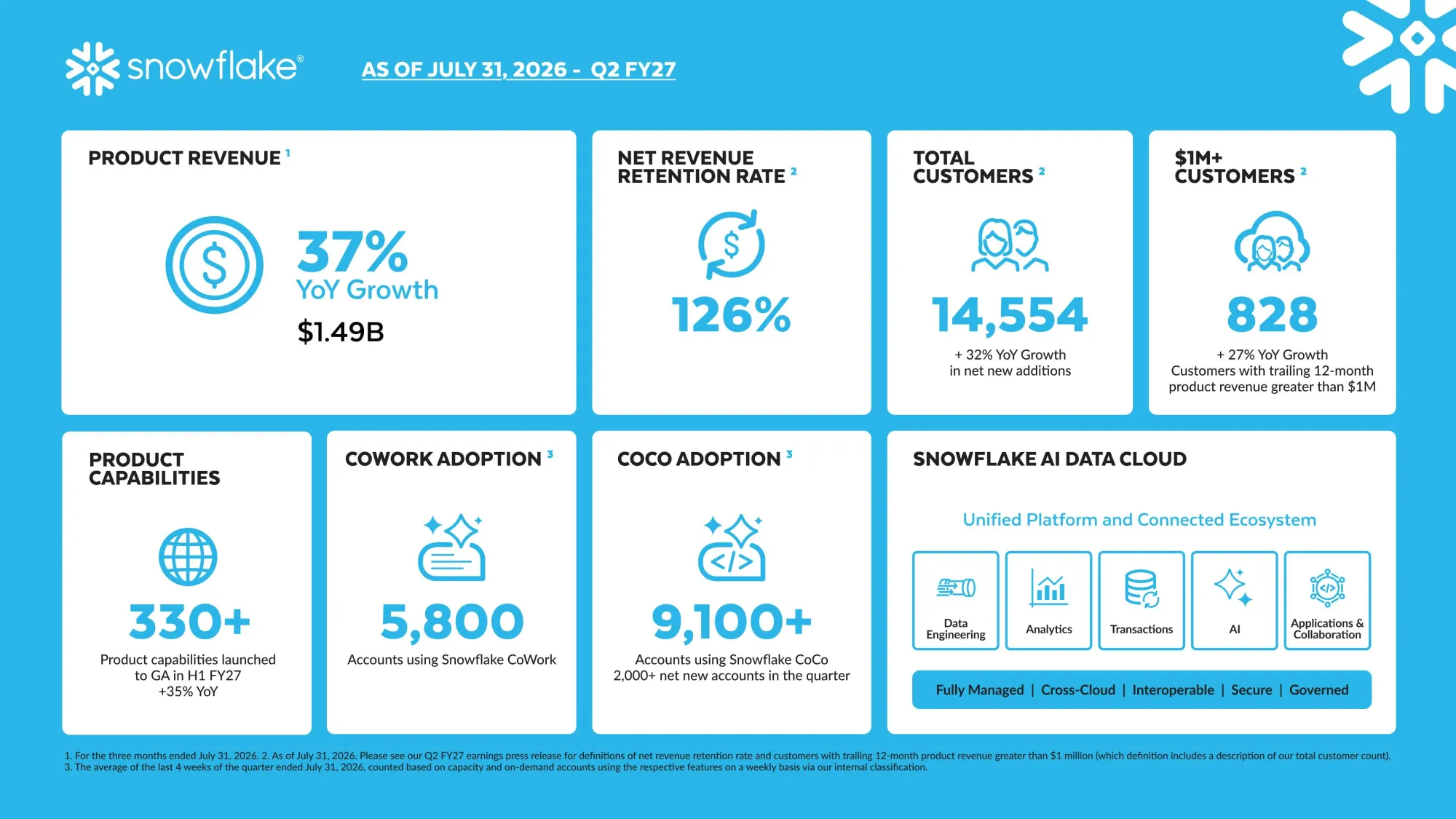
Snowflake is betting its future on the intersection of data infrastructure and generative AI, positioning its platform as the foundational layer for the "Agentic Enterprise." In its second quarter of fiscal 2027, the company reported product revenue of $1.49 billion, a 37% increase year-over-year. This performance marks the third consecutive quarter of accelerating product revenue growth, a trend the company attributes to a "flywheel effect" created by increasing AI workloads and platform consumption. As enterprises move from experimental AI to integrated agentic workflows, Snowflake is attempting to capture this shift by embedding AI capabilities directly into its core data cloud. The company's strategic pivot toward AI-driven revenue is reflected in its updated full-year guidance, which now expects product revenue growth of 36% year-over-year, up from a previous estimate of 31%.
Snowflake Q2 Fiscal 2027 Financial Performance
The company's financial results for the quarter ended July 31, 2026, highlight a strengthening balance between top-line expansion and operational discipline. Total revenue reached $1.55 billion, representing 35% year-over-year growth, while product revenue specifically climbed to $1.49 billion. A critical metric for the consumption-based model, net revenue retention rate, stood at 126%. Snowflake is also seeing increased penetration within the high-value enterprise segment; the company reported 828 customers with trailing 12-month product revenue exceeding $1 million, a 27% year-over-year increase. This segment includes 829 Forbes Global 2000 customers.
Looking ahead, Snowflake is raising its financial expectations for the remainder of fiscal 2027. For the full year, the company expects product revenue to reach $6,070 million, a 36% year-over-year increase, significantly higher than the previously guided $5,840 million (31% growth). Management is also projecting an improved non-GAAP operating margin of 14.5%, up from the previous guidance of 13.5%. For the third quarter of fiscal 2027, the company anticipates product revenue between $1,588 million and $1,593 million, representing 37% to 38% year-over-year growth. Remaining performance obligations (RPO), a key indicator of contracted future revenue, reached $9.00 billion, up 30% year-over-year. This growth in RPO suggests a deepening of long-term commitments from the enterprise customer base, even as the company navigates the variable nature of consumption-based billing.
AI Product Velocity and Customer Adoption
Snowflake is aggressively expanding its technical capabilities to support AI-driven workloads, launching over 330 product capabilities to general availability in the first half of fiscal 2027—a 35% increase year-over-year. Key recent introductions include Cortex Sense for business context and the Cortex AI Gateway, which the company claims extends AI from insight to action through its integration of Natoma. These tools are designed to facilitate the transition toward "Agentic" workflows, where AI agents can perform complex tasks within the data environment.
The adoption of these AI-centric features is showing measurable momentum in user metrics. The CoCo feature surpassed 9,100 accounts, adding more than 2,000 accounts in the second quarter alone. Similarly, CoWork expanded to 5,800 accounts. The company is leveraging these tools to secure major enterprise wins; for instance, Sayari reportedly used CoCo to accelerate the migration of 12 billion records while cutting costs by more than half. Other notable customers, including 1Password and Indeed, have selected Snowflake as the foundation for their data and AI transformation efforts. This rapid deployment of AI-specific features appears to be a primary driver for the company's ability to add 692 net new customers during the quarter, a 32% year-over-year increase.
Key Takeaways
- Snowflake reported $1.49 billion in product revenue for Q2 fiscal 2027, representing 37% year-over-year growth.
- The company raised its full-year product revenue growth guidance to 36% year-over-year, up from 31%.
- AI-related adoption is accelerating, with CoCo surpassing 9,100 accounts, including 2,000 new accounts added this quarter.
TechInsyte's Take
In our view, Snowflake's latest results signal a successful, albeit high-stakes, transition from a pure data warehousing play to an AI-integrated data cloud. The acceleration in product revenue—marking three consecutive quarters of increasing growth rates—suggests that the company's "flywheel" theory is gaining empirical support. By embedding AI tools like Cortex Sense and the Cortex AI Gateway directly into the data layer, Snowflake is attempting to prevent the fragmentation of the AI stack, where data and intelligence reside in separate silos.
This strategy is clearly working to capture the enterprise "Agentic" trend, as evidenced by the rapid expansion of CoCo and CoWork account numbers. However, the reliance on a consumption-based model remains a double-edged sword; while it allows for rapid scaling during AI workloads, it requires constant innovation to ensure customers do not revert to more predictable subscription models elsewhere. The decision to raise both revenue and operating margin guidance simultaneously indicates that Snowflake is successfully managing the high costs of AI innovation while maintaining the operational discipline required by the market.
Questions & Answers
How is Snowflake's AI strategy impacting its top-line revenue growth?
Snowflake is seeing a "step-up" in AI revenue that is contributing to an acceleration in product revenue growth. The company reported that AI continues to create a flywheel effect, driving rapid adoption, new workloads, and increased platform consumption, contributing to a 37% year-over-year increase in product revenue.
What does the increase in Remaining Performance Obligations (RPO) indicate for Snowflake's future?
The $9.00 billion in RPO, representing 30% year-over-year growth, indicates a significant volume of contracted future revenue that has not yet been recognized. While RPO is subject to the timing of customer consumption, the growth suggests strengthening long-term enterprise commitments to the Snowflake platform.
How is Snowflake scaling its product development to meet AI demands?
The company is significantly increasing its product velocity, having launched over 330 product capabilities to general availability in the first half of fiscal 2027. This represents a 35% year-over-year increase in the pace of innovation, specifically targeting AI integration through tools like Cortex AI Gateway and Cortex Sense.
Which customer segments are driving the most value for Snowflake?
Snowflake is seeing significant traction in the large enterprise market, with 829 Forbes Global 2000 customers and 828 customers contributing more than $1 million in trailing 12-month product revenue, a 27% year-over-year increase.
Source: Businesswire