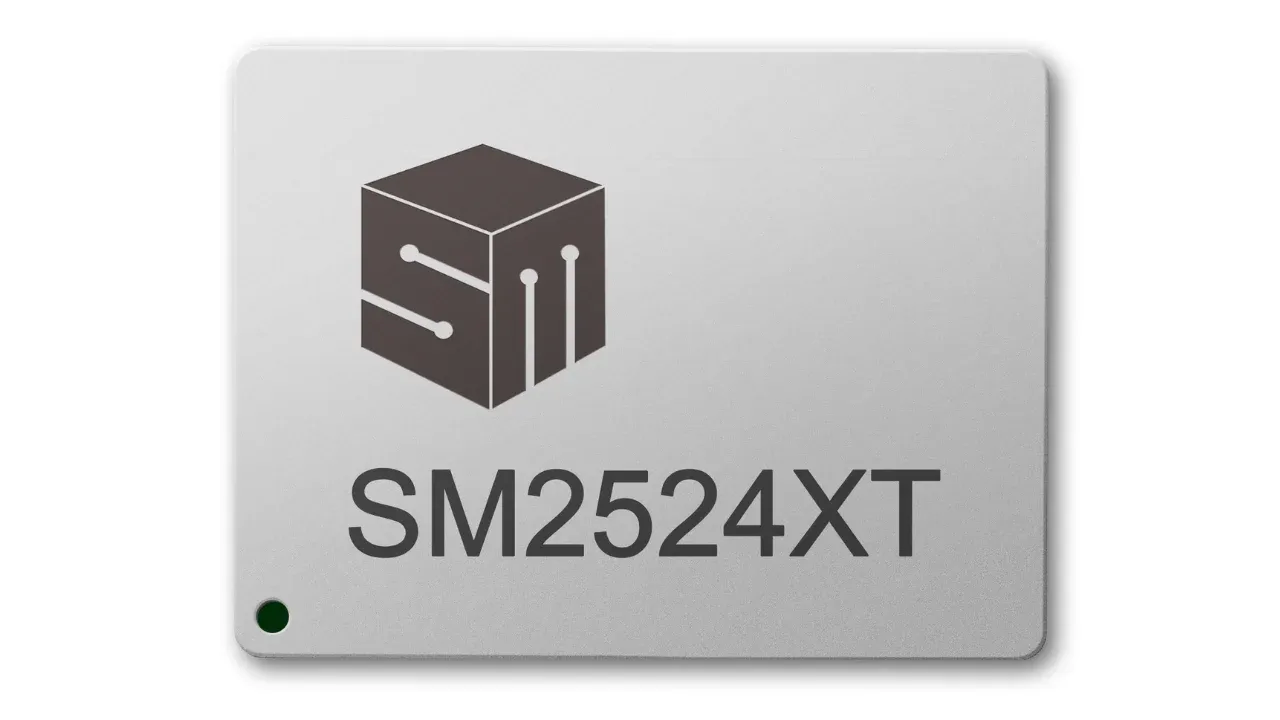
Silicon Motion Technology Corporation (NasdaqGS: SIMO) announced the SM2524XT, a PCIe Gen5 x4 DRAM‑less SSD controller built for AI inference and KV‑Cache workloads. The controller promises up to 2.5 million IOPS random performance and sequential reads of 14 GB/s, targeting AI‑focused PCs and edge devices.
SM2524XT Announcement Details
The SM2524XT uses a four‑processor‑core architecture and supports NAND interface speeds up to 4,800 MT/s. Silicon Motion says the controller delivers “industry‑leading random performance of up to 2.5 million IOPS” and sequential read speeds of up to 14 GB/s. Built on TSMC’s 6 nm process, it offers up to 25 percent higher performance per watt than the prior generation and improves random performance by up to 25 percent. The product is positioned for “AI PCs” that run local agents and on‑device LLM workloads, according to senior VP Nelson Duann.
Technical Architecture and Features
The SM2524XT integrates Silicon Motion’s Separated Command Address (SCA) technology, advanced FTL scheduling, and NANDXtend® LDPC ECC. These elements aim to improve parallel data processing efficiency, reduce latency interruptions, and keep performance stable under sustained AI inference loads. The controller’s DRAM‑less design relies on the four‑core architecture to handle the “highly fragmented, latency‑sensitive random read/write operations” typical of KV‑Cache workloads.
Implications for Enterprise AI Storage
Silicon Motion frames KV‑Cache as a “critical factor in AI inference performance,” suggesting that the SM2524XT could alleviate storage bottlenecks in AI‑enabled PCs and edge devices. By maintaining stable random I/O throughput under continuous load, the controller may enable more responsive on‑device AI services without adding significant power or thermal headroom, according to the company’s statements.
Key Takeaways
- The SM2524XT offers up to 2.5 million IOPS random performance and 14 GB/s sequential reads on a PCIe Gen5 x4 interface.
- Built on a 6 nm process, it delivers up to 25 percent higher performance per watt and up to 25 percent better random performance versus the previous generation.
- The controller incorporates SCA, advanced FTL scheduling, and NANDXtend® LDPC ECC to sustain low‑latency, high‑IOPS workloads typical of KV‑Cache and AI inference.
TechInsyte's Take
Silicon Motion’s SM2524XT targets a niche where AI inference and KV‑Cache demand sustained random throughput on power‑constrained platforms. While the specs suggest a clear technical advantage, real‑world adoption will depend on ecosystem support and the ability of OEMs to integrate a DRAM‑less design without compromising reliability. Buyers should monitor reference designs and performance validation from early adopters.
Source: Businesswire