The escalating cost of serving AI workloads is forcing a fundamental reassessment of data center networking architectures. As energy consumption and latency become primary barriers to scaling AI, Resolight is positioning its nanosecond optical circuit switching (OCS) as a solution to the economic challenges of massive data movement. By leveraging new Co-Packaged Optics (CPO) specifications from the Advanced Photonics Coalition (APC), the company aims to enable native photon routing. This approach seeks to move data through the network while keeping payloads in the light domain, potentially addressing the critical need for more efficient, scalable AI infrastructure as back-end switch spending is forecasted to reach nearly $1 trillion between 2026 and 2030.
APC Specifications Enable Native Photon Routing
The Advanced Photonics Coalition (APC) has introduced new CPO specifications designed to address the protocol integration necessary for nanosecond optical circuit switching. These specifications, announced at the Optica + APC PECC Summit, establish a foundation for integrating photonic engines with the coordination required for data-plane operations. For Resolight, this development is a critical milestone, as it moves the industry conversation from the mechanics of switching light to the practicalities of how endpoints and network elements work together to deliver data at nanosecond speeds.
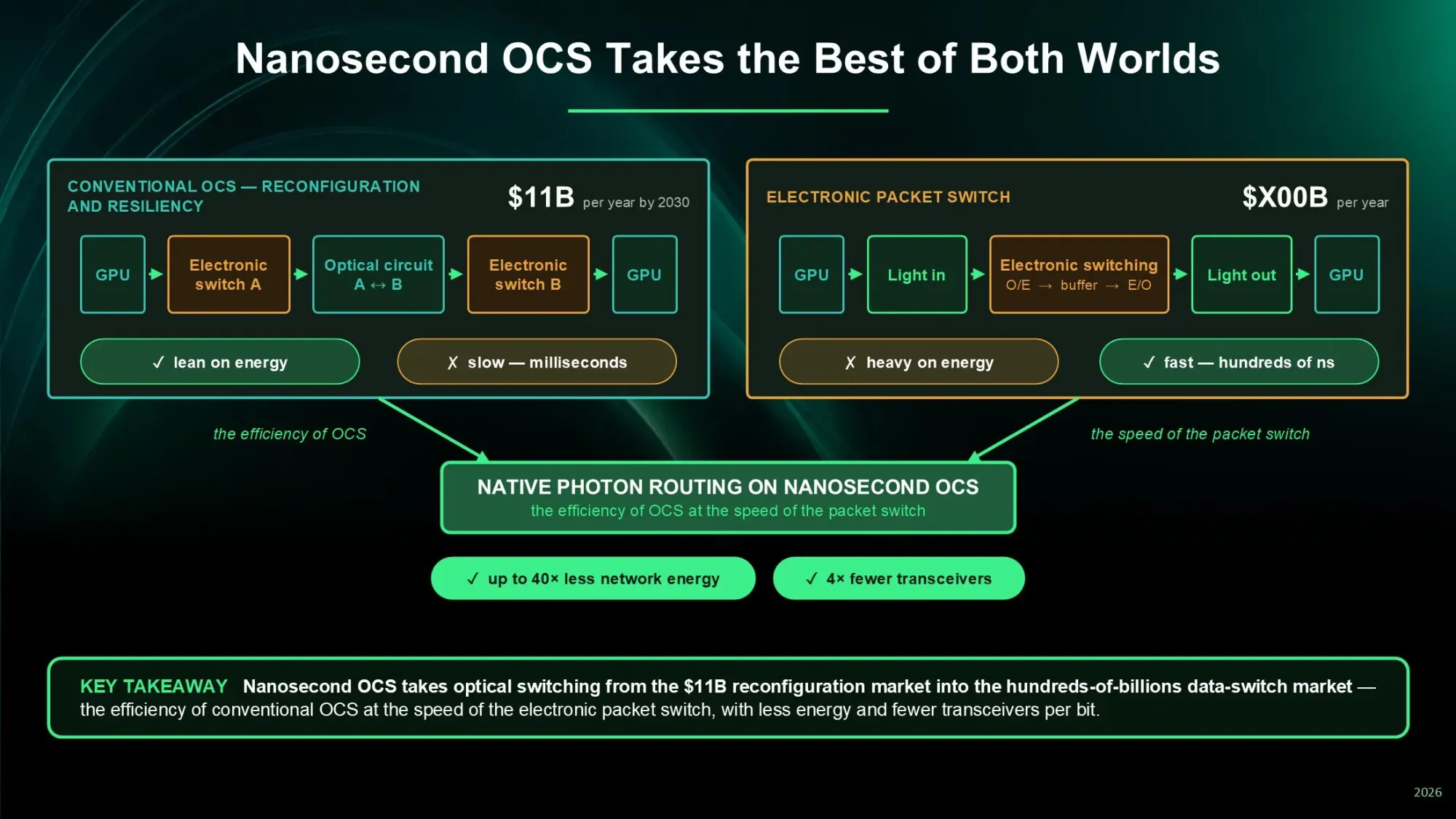
Resolight’s architecture targets the inefficiencies inherent in conventional switching methods. While traditional OCS reconfigures optical connections, electronic switches typically handle the actual data switching, necessitating repeated optical-to-electrical-to-optical (OEO) conversions. Resolight is positioning its nanosecond OCS to bypass these conversions by extending optical switching directly into the data plane. This native photon routing is designed to coordinate data transfers through the network, keeping information in the light domain. According to the company, this method could provide up to 40× better network energy efficiency and reduce the requirement for optical transceivers by up to 75% in multi-rack AI scale-up networks. By reducing the hardware footprint and power consumption, the technology aims to ease the pressure of optical supply constraints while improving the overall economics of AI workload delivery.
Addressing AI Scale-Up Infrastructure Bottlenecks
The shift toward AI-centric networking is already visible in market data. Dell’Oro Group reports that AI back-end switch sales overtook front-end network sales in the second quarter of this year, marking a significant inflection point for data center design. As operators face the dual pressures of increasing power demands and hardware shortages, the ability to scale AI networks with fewer components becomes a strategic necessity. Resolight’s approach attempts to solve the system-level challenge of nanosecond switching by combining high-speed optical mechanisms with endpoint and protocol coordination.
Without this coordination, an optical fabric cannot achieve the burst-by-burst data-switching functionality required to replace traditional packet switches. Current OCS technologies often lack the switching speeds necessary to compete with packet switches, while packet switches themselves consume more power than an OCS. Resolight is attempting to bridge this gap by targeting both data-switching latency and energy consumption simultaneously. If successful, this architecture could expand the addressable market for optical switching by orders of magnitude, making it a viable contender for functions currently dominated by electronic switching fabrics. While the technology faces standardization and manufacturing hurdles, its successful implementation could disrupt or necessitate partnerships with major industry players, including NVIDIA, Broadcom, AMD, Marvell, Arista, Cisco, HPE, Lumentum, and Coherent.
Key Takeaways
- Resolight's nanosecond OCS architecture targets up to 40× better network energy efficiency and a 75% reduction in optical transceiver requirements.
- The Advanced Photonics Coalition (APC) has released CPO specifications that address the data-plane integration needed for native photon routing.
- Dell’Oro Group forecasts that cumulative AI back-end switch spending will reach nearly $1 trillion during the 2026–2030 period.
TechInsyte's Take
In our view, Resolight is betting on a high-stakes architectural pivot: moving the intelligence of the network from the electronic domain into the photonic domain. The industry is currently hitting a wall where the energy cost of moving data between accelerators is beginning to rival the cost of the computation itself. By aligning with the APC’s new CPO specifications, Resolight is attempting to transform nanosecond OCS from a niche component into a standardized, scalable alternative to traditional electronic packet switching. This is not merely a speed upgrade; it is a fundamental attempt to solve the "AI economics" problem by slashing the transceiver count and power overhead. However, the path to adoption is steep. Success depends entirely on whether the broader ecosystem—from chipmakers to software protocols—can adopt these new standards to enable the coordinated, burst-level switching that native photon routing requires.
Questions & Answers
How does native photon routing impact the total cost of ownership (TCO) for AI data centers?
Native photon routing aims to reduce TCO by significantly lowering hardware and power requirements. Specifically, Resolight claims the technology can provide up to 40× better network energy efficiency and reduce the number of required optical transceivers by up to 75%, which helps mitigate both power costs and optical supply chain constraints.
Why is the timing of the APC CPO specifications significant for companies like Resolight?
The APC specifications provide the necessary protocol coordination and data-plane integration that previously prevented nanosecond OCS from being a practical alternative to electronic switching. This standardization allows endpoints and network elements to work together, making it possible to manage transmission windows and contention at nanosecond speeds.
What market shift is driving the demand for more efficient AI networking architectures?
The demand is driven by the fact that AI back-end switch sales have overtaken front-end network sales as of Q2, according to Dell’Oro Group. As AI workloads scale, the energy and latency costs of moving data become major economic barriers, creating a massive $1 trillion market opportunity for back-end switching through 2030.
What are the primary technical challenges Resolight must overcome to replace traditional packet switches?
To replace packet switches, Resolight must successfully integrate nanosecond switching speeds with robust networking-protocol coordination. This ensures that endpoints can manage data bursts and contention reliably, moving beyond simple light switching to a coordinated system-level architecture that maintains data in the optical domain.
Source: Resolight