Rambus Inc. announced a complete DDR5 9600 client memory module chipset designed for high‑performance CUDIMM, CQDIMM and CSODIMM modules in upcoming AI‑focused desktop, notebook and workstation platforms. The offering includes a Gen2 Client Clock Driver (CKD02), PMIC5120 power‑management IC and an SPD Hub, delivering up to 9 600 MT/s data rates. The announcement is relevant to CIOs and CTOs evaluating memory bandwidth and capacity for agentic AI, gaming and professional content‑creation workloads.
Rambus Introduces DDR5 9600 Client Chipset
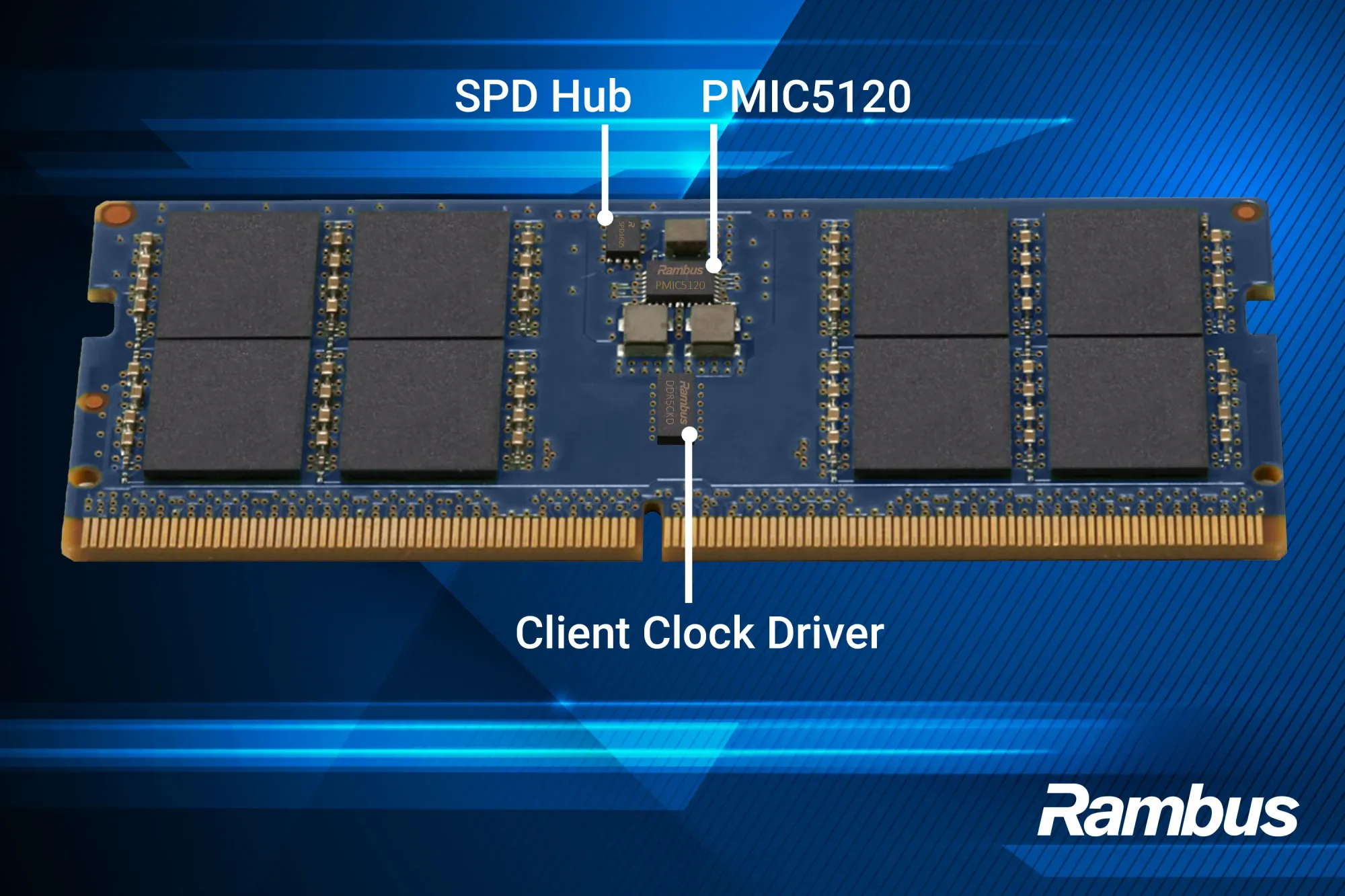
The new DDR5 9600 Client Chipset provides a full solution for clocked DDR5 modules operating between 8 000 and 9 600 MT/s. It integrates three key components:
- Gen2 Client Clock Driver (CKD02) – retimes, conditions and distributes the processor‑originated clock to DRAM devices on the DIMM.
- PMIC5120 – steps down the system voltage to the levels required by DRAM and other active chips on the module.
- SPD Hub – handles module identification, configuration and telemetry communication.
Rambus positions the chipset as the industry’s fastest DDR5 client chipset, extending its memory‑module portfolio from server‑to‑client platforms. The company did not disclose pricing or availability timelines in the announcement.
Technical Challenges Behind Clocked DDR5 Modules
Agentic AI workloads increase demand for persistent context, concurrent processing and continuous data movement, which in turn raise memory‑bandwidth and capacity requirements. Scaling DDR5 beyond 6 400 MT/s introduces signal‑degradation, clock‑jitter and timing‑instability issues. To mitigate these problems, the industry is moving toward clocked memory modules—CUDIMM and CQDIMM for desktops, CSODIMM for laptops—that embed an on‑module client clock driver (CKD). The Gen2 CKD02 in Rambus’s chipset conditions the clock signal to preserve integrity at higher data rates.
Rami Sethi, SVP and General Manager of Memory Interface Chips at Rambus, said the chipset “delivers the performance foundation needed to enable this new era of intelligent, high‑performance client systems for AI‑driven productivity, next‑generation gaming and professional content creation.” IDC research vice president Jeff Janukowicz added that “complete chipset solutions that deliver stable, high‑speed operation will play a critical role in accelerating the adoption of next‑generation AI PCs.”
Implications for Enterprise and OEM Design Teams
The chipset’s ability to support up to 9 600 MT/s simplifies the design of AI‑ready client platforms by handling signal‑integrity, power delivery and system coordination at the module level. OEMs and system integrators can leverage the integrated PMIC5120 and SPD Hub to reduce board‑level component count and streamline validation cycles. For enterprises planning to deploy AI‑enhanced desktops or workstations, the higher bandwidth may accommodate workloads that require rapid context switching and large model footprints without resorting to multiple memory channels.
Rambus did not provide details on roadmap extensions, backward compatibility with existing DDR5 modules, or certification status with major CPU vendors. Prospective buyers will need to confirm support within their target platform ecosystems before committing to design changes.
Key Takeaways
- Rambus’s DDR5 9600 Client Chipset supports clocked CUDIMM, CQDIMM and CSODIMM modules at data rates up to 9 600 MT/s.
- The chipset integrates a Gen2 Client Clock Driver (CKD02), PMIC5120 power‑management IC, and an SPD Hub to address signal‑integrity and power‑delivery challenges at high speeds.
- Rambus positions the solution as a foundation for AI‑driven desktops, notebooks and workstations, aiming to meet the bandwidth needs of agentic AI, gaming and professional content‑creation workloads.
TechInsyte's Take
Rambus’s end‑to‑end DDR5 9600 chipset could reduce the engineering effort required to bring AI‑ready client systems to market, but its real impact will depend on OEM adoption and validation with leading CPU platforms. Decision‑makers should monitor product qualification timelines and assess whether the higher data rates align with their specific AI workload profiles.
Source: Businesswire